Racah parameter
The Racah parameters are a set of parameters used in atomic and molecular spectroscopy to describe the amount of total electrostatic repulsion in an atom that has multiple electrons.
When an atom has more than one electron, there will be some electrostatic repulsion between the electrons. The amount of repulsion varies from atom to atom, depending upon the number of electrons, their spin, and the orbitals that they occupy. The total repulsion can be expressed in terms of three parameters A, B and C which are known as the Racah parameters after Giulio Racah, who first described them. They are generally obtained empirically from gas-phase spectroscopic studies of atoms.[1]
They are often used in transition-metal chemistry to describe the repulsion energy associated with an electronic term. For example, the interelectronic repulsion of a 3P term is A + 7B, and of a 3F term is A - 8B, and the difference between them is therefore 15B.
Definition
The Racah parameters are defined as
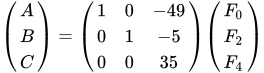
where are Slater integrals

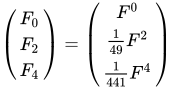
and are the Slater-Condon parameters


where is the normalized radial part of an electron orbital, and .[2]



See also
References
- ^ Ballhausen, C.J. (1980). Molecular Electronic Structure of Transition Metal Complexes. McGraw-Hill. ISBN 0070034958.
- ^ Sugano, Satoru; Tanabe, Yukito; Kamimura, Hiroshi (1970). Multiplets of Transition Metal Ions in Crystals. Academic Press.
External links
- Multiplets in Transition Metal Ions in E. Pavarini, E. Koch, F. Anders, and M. Jarrell (eds.): Correlated Electrons: From Models to Materials, Jülich 2012, ISBN 978-3-89336-796-2
 | This spectroscopy-related article is a stub. You can help Wikipedia by adding missing information. |
Content Disclaimer
Informasi ini disarikan dari Wikipedia dan disajikan kembali untuk tujuan edukasi. Konten tersedia di bawah lisensi CC BY-SA 3.0. Kami tidak bertanggung jawab atas ketidakakuratan data yang bersumber dari kontribusi publik tersebut.
- The information displayed on this website is sourced in part or in whole from Wikipedia and has been adapted for the purpose of restating it. We strive to provide accurate and relevant information, however:
- There is no guarantee of absolute accuracy. Wikipedia is an open, collaborative project that can be edited by anyone, so information is subject to change.
- It is not intended to constitute professional advice. The content displayed is for informational and educational purposes only. For important decisions (e.g., medical, legal, or financial), please consult a professional.
- Content copyright. Wikipedia is licensed under the Creative Commons Attribution-ShareAlike License (CC BY-SA). This means that content may be reused with appropriate attribution and shared under a similar license.
- Responsible use. Any risk arising from the use of information from this website is entirely the responsibility of the user.