Quarter period
In mathematics, the quarter periods K(m) and iK ′(m) are special functions that appear in the theory of elliptic functions.
The quarter periods K and iK ′ are given by
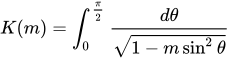
and

When m is a real number, 0 < m < 1, then both K and K ′ are real numbers. By convention, K is called the real quarter period and iK ′ is called the imaginary quarter period. Any one of the numbers m, K, K ′, or K ′/K uniquely determines the others.
These functions appear in the theory of Jacobian elliptic functions; they are called quarter periods because the elliptic functions and are periodic functions with periods and However, the function is also periodic with a smaller period (in terms of the absolute value) than , namely .


Notation
The quarter periods are essentially the elliptic integral of the first kind, by making the substitution . In this case, one writes instead of , understanding the difference between the two depends notationally on whether or is used. This notational difference has spawned a terminology to go with it:


- is called the parameter
- is called the complementary parameter
- is called the elliptic modulus
- is called the complementary elliptic modulus, where
- the modular angle, where
- the complementary modular angle. Note that



The elliptic modulus can be expressed in terms of the quarter periods as

and

where and are Jacobian elliptic functions.


The nome is given by


The complementary nome is given by

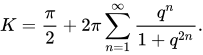
The real quarter period can be expressed as a Lambert series involving the nome:
Additional expansions and relations can be found on the page for elliptic integrals.
References
- Milton Abramowitz and Irene A. Stegun (1964), Handbook of Mathematical Functions, Dover Publications, New York. ISBN 0-486-61272-4. See chapters 16 and 17.
Content Disclaimer
Informasi ini disarikan dari Wikipedia dan disajikan kembali untuk tujuan edukasi. Konten tersedia di bawah lisensi CC BY-SA 3.0. Kami tidak bertanggung jawab atas ketidakakuratan data yang bersumber dari kontribusi publik tersebut.
- The information displayed on this website is sourced in part or in whole from Wikipedia and has been adapted for the purpose of restating it. We strive to provide accurate and relevant information, however:
- There is no guarantee of absolute accuracy. Wikipedia is an open, collaborative project that can be edited by anyone, so information is subject to change.
- It is not intended to constitute professional advice. The content displayed is for informational and educational purposes only. For important decisions (e.g., medical, legal, or financial), please consult a professional.
- Content copyright. Wikipedia is licensed under the Creative Commons Attribution-ShareAlike License (CC BY-SA). This means that content may be reused with appropriate attribution and shared under a similar license.
- Responsible use. Any risk arising from the use of information from this website is entirely the responsibility of the user.