Quantum gyroscope
 | This article includes a list of references, related reading, or external links, but its sources remain unclear because it lacks inline citations. (June 2016) |
A quantum gyroscope is a very sensitive device to measure angular rotation based on quantum mechanical principles. The first of these was built by Richard Packard and his colleagues at the University of California, Berkeley. The extreme sensitivity means that theoretically, a larger version could detect effects like minute changes in the rotational rate of the Earth.
Principle
In 1962, Cambridge University PhD student Brian Josephson hypothesized that an electric current could travel between two superconducting materials even when they were separated by a thin insulating layer. The term Josephson effect has come to refer generically to the different behaviors that occur in any two weakly connected macroscopic quantum systems—systems composed of molecules that all possess identical wavelike properties. Among other things, the Josephson effect means that when two superfluids (zero friction fluids) are connected using a weak link and pressure is applied to the superfluid on one side of a weak link, the fluid will oscillate from one side of the weak link to the other.[citation needed]
This phenomenon, known as quantum whistling, occurs when pressure is applied to push a superfluid through a very small hole, somewhat as sound is produced by blowing air through an ordinary whistle. A ring-shaped tube full of superfluid, blocked by a barrier containing a tiny hole, could in principle be used to detect pressure differences caused by changes in rotational motion of the ring, in effect functioning as a sensitive gyroscope. Superfluid whistling was first demonstrated using helium-3, which has the disadvantage of being scarce and expensive, and requiring extremely low temperature (a few thousandths of a Kelvin). Common helium-4, which remains superfluid at 2 Kelvin, is much more practical, but its quantum whistling is too weak to be heard with a single practical-sized hole. This problem was overcome by using barriers with thousands of holes, in effect a chorus of quantum whistles producing sound waves that reinforced one another by constructive interference.[citation needed]
Equation
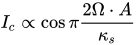
Where is the rotation vector, A is the area vector, and is the quantum of circulation of helium-3.


References
- Simmonds, R. W.; Marchenkov, A.; Hoskinson, E.; Davis, J. C.; Packard, R. E. (2001). "Quantum interference of superfluid 3He". Nature. 412 (6842): 55–58. Bibcode:2001Natur.412...55S. doi:10.1038/35083518. ISSN 0028-0836. PMID 11452302. S2CID 4413976.
- Barker, B. M.; O'Connell, R. F. (1970). "Derivation of the Equations of Motion of a Gyroscope from the Quantum Theory of Gravitation". Physical Review D. 2 (8): 1428–1435. Bibcode:1970PhRvD...2.1428B. doi:10.1103/PhysRevD.2.1428. ISSN 0556-2821.
- Robert Sanders (31 Jan 2005). "Superfluid helium-4 whistles just the right tune". Innovations Report. Retrieved 30 Mar 2019.
See also
- Polariton interferometer
- Ring laser gyroscope
- Gyroscope
- Vibrating structure gyroscope
- Inertial measurement unit
- Hemispherical resonator gyroscope
 | This standards- or measurement-related article is a stub. You can help Wikipedia by adding missing information. |
Content Disclaimer
Informasi ini disarikan dari Wikipedia dan disajikan kembali untuk tujuan edukasi. Konten tersedia di bawah lisensi CC BY-SA 3.0. Kami tidak bertanggung jawab atas ketidakakuratan data yang bersumber dari kontribusi publik tersebut.
- The information displayed on this website is sourced in part or in whole from Wikipedia and has been adapted for the purpose of restating it. We strive to provide accurate and relevant information, however:
- There is no guarantee of absolute accuracy. Wikipedia is an open, collaborative project that can be edited by anyone, so information is subject to change.
- It is not intended to constitute professional advice. The content displayed is for informational and educational purposes only. For important decisions (e.g., medical, legal, or financial), please consult a professional.
- Content copyright. Wikipedia is licensed under the Creative Commons Attribution-ShareAlike License (CC BY-SA). This means that content may be reused with appropriate attribution and shared under a similar license.
- Responsible use. Any risk arising from the use of information from this website is entirely the responsibility of the user.