Probalign
Probalign is a sequence alignment tool that calculates a maximum expected accuracy alignment using partition function posterior probabilities.[1] Base pair probabilities are estimated using an estimate similar to the Boltzmann distribution. The partition function is calculated using a dynamic programming approach.
Algorithm
The following describes the algorithm used by probalign to determine the base pair probabilities.[2]
Alignment score
To score an alignment of two sequences two things are needed:
- a similarity function (e.g. PAM, BLOSUM,...)
- affine gap penalty:

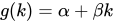
The score of an alignment a is defined as:


Now the boltzmann weighted score of an alignment a is:

Where is a scaling factor.

The probability of an alignment assuming boltzmann distribution is given by
![{\displaystyle Pr[a|x,y]={\frac {e^{\frac {S(a)}{T}}}{Z}}}](https://wikimedia.org/api/rest_v1/media/math/render/svg/bc95755b68056106788d9ba71ad9e9bc5be6fafb)
Where is the partition function, i.e. the sum of the boltzmann weights of all alignments.

Dynamic programming
Let denote the partition function of the prefixes and . Three different cases are considered:



- the partition function of all alignments of the two prefixes that end in a match.
- the partition function of all alignments of the two prefixes that end in an insertion .
- the partition function of all alignments of the two prefixes that end in a deletion .


Then we have:

Initialization
The matrixes are initialized as follows:
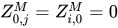


Recursion
The partition function for the alignments of two sequences and is given by , which can be recursively computed:


- analogously
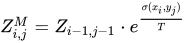


Base pair probability
Finally the probability that positions and form a base pair is given by:


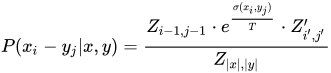
are the respective values for the recalculated with inversed base pair strings.

See also
References
- ^ U. Roshan and D. R. Livesay, Probalign: multiple sequence alignment using partition function posterior probabilities, Bioinformatics, 22(22):2715-21, 2006 (PDF)
- ^ Lecture "Bioinformatics II" at University of Freiburg
External links
Content Disclaimer
Informasi ini disarikan dari Wikipedia dan disajikan kembali untuk tujuan edukasi. Konten tersedia di bawah lisensi CC BY-SA 3.0. Kami tidak bertanggung jawab atas ketidakakuratan data yang bersumber dari kontribusi publik tersebut.
- The information displayed on this website is sourced in part or in whole from Wikipedia and has been adapted for the purpose of restating it. We strive to provide accurate and relevant information, however:
- There is no guarantee of absolute accuracy. Wikipedia is an open, collaborative project that can be edited by anyone, so information is subject to change.
- It is not intended to constitute professional advice. The content displayed is for informational and educational purposes only. For important decisions (e.g., medical, legal, or financial), please consult a professional.
- Content copyright. Wikipedia is licensed under the Creative Commons Attribution-ShareAlike License (CC BY-SA). This means that content may be reused with appropriate attribution and shared under a similar license.
- Responsible use. Any risk arising from the use of information from this website is entirely the responsibility of the user.