Powder tower
 | The examples and perspective in this article may not represent a full view of the subject. (July 2023) |
 | This article includes a list of references, related reading, or external links, but its sources remain unclear because it lacks inline citations. (February 2024) |


A powder tower (German: Pulverturm), occasionally also powder house (Pulverhaus), was a building used by the military or by mining companies, frequently a tower, to store gunpowder or, later, explosives. They were common until the 20th century, but were increasingly succeeded by gunpowder magazines and ammunition depots. The explosion of a powder tower could be catastrophic as, for example, in the Delft Explosion of 1654.
List of powder towers
Buildings formerly used as powder towers include the following:
Germany
These are sorted by states of Germany, since there are so many.
Baden-Württemberg
Bavaria
- Pulverturm, Bad Reichenhall
- Pulverturm, Burghausen
- Färberturm, Gunzenhausen
- Pulverturm, Lindau
- Pulverturm, Memmingen
- Pulverturm, Munich
- Pulverturm, Ochsenfurt
- Pulverturm, Straubing
Brandenburg
Bremen
Lower Saxony
- Pulverturm, Bad Bentheim
- Knochenturm in Einbeck
- Pulverturm, Hameln
- Pulverturm Lingen, Ems
- Pulverturm, Oldenburg
Mecklenburg-Vorpommern
The Pulverturm, Demmin, bears the name, but was probably not used for this purpose.
North Rhine-Westphalia
- Langer Turm, Aachen
- Pulvertürmchen in Aachen
- Pulverturm, Meschede
- Buddenturm in Münster
- Pulverturm, Rheinberg
- Pulverturm, Wiedenbrück
Rhineland-Palatinate
Saxony
- Pulverturm, Johanngeorgenstadt
- Pulverturm in Zwickau
Saxony-Anhalt
Thuringia
Austria
Czechia
- Despite its name the Powder Tower in Prague was never actually used to store gunpowder
Italy
Latvia
- Powder Tower, Riga (Pulvertornis)
Namibia
Switzerland
- Malteserturm in Chur
- Pulverturm, Merano
- Pulverturm, Zofingen
USA
Gallery
-
 The Powder Tower in Prague
 -
 Pulverturm in Oldenburg with remains of the old town wall
 -
 Pulverturm Wiedenbrück, exterior view
 -
 Pulverturm in Landsberg am Lech
 -
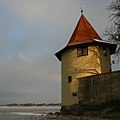 Pulverturm in Lindau
 -
 Pulverturm in Neumarkt in the Upper Palatinate
 -
 Pulverturm in Riga
 -
 Pulverturm in Memmingen
 -
 Langer Turm in Aachen
 -
 Pulverturm in Linz am Rhein
 -
 Pulverturm in Rottenburg/Neckar
 -
 Pulverturm in Johanngeorgenstadt
 -
 Pulverturm in Otjimbingwe, Namibia
 -
 Pulverturm in Zofingen
 -
 Pulverturm in Zwickau


.JPG)


.jpg)
Literature
- Adolf Weinbrenner: Pulvermagazin, in Otto Lueger (ed.): Lexikon der gesamten Technik und ihrer Hilfswissenschaften, Vol. 7 Stuttgart, Leipzig 1909, pp. 274–275; digitalised at zeno.org
- Brewer, Ted (1999). Czech and Slovak Republics Guide. Londres: Open Road Publishing.
- Legal, Claus; Legal, Gert (2020). Friedrich II. von Preußen und Quintus Icilius: Der König und der Obrist. Munique: utzverlag GmbH.
- Prokopovych, Markian (2009). Habsburg Lemberg: Architecture, Public Space, and Politics in the Galician Capital, 1772-1914. Lafaiete Oeste, Indiana: Imprensa da Universidade de Purdue.
External links


Content Disclaimer
Informasi ini disarikan dari Wikipedia dan disajikan kembali untuk tujuan edukasi. Konten tersedia di bawah lisensi CC BY-SA 3.0. Kami tidak bertanggung jawab atas ketidakakuratan data yang bersumber dari kontribusi publik tersebut.
- The information displayed on this website is sourced in part or in whole from Wikipedia and has been adapted for the purpose of restating it. We strive to provide accurate and relevant information, however:
- There is no guarantee of absolute accuracy. Wikipedia is an open, collaborative project that can be edited by anyone, so information is subject to change.
- It is not intended to constitute professional advice. The content displayed is for informational and educational purposes only. For important decisions (e.g., medical, legal, or financial), please consult a professional.
- Content copyright. Wikipedia is licensed under the Creative Commons Attribution-ShareAlike License (CC BY-SA). This means that content may be reused with appropriate attribution and shared under a similar license.
- Responsible use. Any risk arising from the use of information from this website is entirely the responsibility of the user.