Portal:Numismatics

The Numismatics Portal

Numismatics is the study or collection of currency, including coins, tokens, paper money, medals, and related objects. Experts of this study, known as numismatists, are often characterized as students or collectors of coins, but the discipline also includes the broader study of money and other means of payment used to resolve debts and exchange goods.
The earliest forms of money used by people are categorised by collectors as "odd and curious", but the use of other goods in barter exchange is excluded, even where used as a circulating currency (e.g., cigarettes or instant noodles in prison). As an example, the Kyrgyz people used horses as the principal currency unit, and gave small change in lambskins; the lambskins may be suitable for numismatic study, but the horses are not.[dubious – discuss] Many objects have been used for centuries, such as cowry shells, precious metals, cocoa beans, large stones, and gems. (Full article...)
 Featured article -

-


A 1980 Grant Wood one ounce gold medallion
American Arts Commemorative Series Medallions are a series of ten gold bullion medallions that were produced by the United States Mint from 1980 to 1984. They were sold to compete with the South African Krugerrand and other bullion coins.
The series was proposed by North Carolina Senator Jesse Helms after the United States Department of the Treasury began selling portions of the national stockpile of gold. Iowa Representative Jim Leach suggested that the medallions depict notable American artists. President Jimmy Carter signed the bill containing the authorizing legislation into law on November 10, 1978, despite objections from Treasury officials. (Full article...) -

The Flying Eagle cent is a one-cent piece struck by the Mint of the United States as a pattern coin in 1856 and for circulation in 1857 and 1858. The coin was designed by Mint Chief Engraver James B. Longacre, with the eagle in flight based on the work of Longacre's predecessor, Christian Gobrecht.
By the early 1850s, the large cent (about the size of a half dollar) being issued by the Mint was becoming both unpopular in commerce and expensive to mint. After experimenting with various sizes and compositions, the Mint decided on an alloy of 88% copper and 12% nickel for a new, smaller cent. After the Mint produced patterns with an 1856 date and gave them to legislators and officials, Congress formally authorized the new piece in February 1857. (Full article...) -

The Illinois Centennial half dollar is a commemorative 50-cent piece struck by the United States Bureau of the Mint in 1918. The obverse, depicting Abraham Lincoln, was designed by Chief Engraver George T. Morgan; the reverse, based on the Seal of Illinois, was by his assistant and successor, John R. Sinnock. Morgan's obverse is based on the statue by Andrew O'Connor.
A commemorative was wanted by the State of Illinois to mark the centennial of its 1818 admission to the Union, and in 1918, legislation was introduced into Congress to accomplish this. It met no opposition, though several amendments were made during the legislative process. After it passed, the two engravers produced designs, but Treasury Secretary William G. McAdoo required changes, not all of which were made. (Full article...) -
The United States Assay Commission was an agency of the U.S. federal government from 1792 to 1980. Its function was to supervise the annual testing of the gold, silver, and (in its final years) base metal coins produced by the United States Mint to ensure that they met specifications. Although some members were designated by statute, for the most part the commission, which was freshly appointed each year, consisted of prominent Americans, including numismatists. Appointment to the Assay Commission was eagerly sought after, in part because commissioners received a commemorative medal. These medals, different each year, are extremely rare, with the exception of the 1977 issue, which was sold to the general public.
The Mint Act of 1792 authorized the Assay Commission. Beginning in 1797, it met in most years at the Philadelphia Mint. Each year, the president appointed unpaid members, who would gather in Philadelphia to ensure the weight and fineness of silver and gold coins issued the previous year were to specifications. In 1971, the commission met, but for the first time had no gold or silver to test, with the end of silver coinage. Beginning in 1977, President Jimmy Carter appointed no members of the public to the commission, and in 1980, he signed legislation abolishing it. (Full article...) -

The Barber coinage consists of a dime, quarter, and half dollar designed by United States Bureau of the Mint Chief Engraver Charles E. Barber. They were minted between 1892 and 1916, though no half dollars were struck in the final year of the series.
By the late 1880s, there were increasing calls for the replacement of the Seated Liberty design, used since the 1830s on most denominations of silver coins. In 1891, Mint Director Edward O. Leech, having been authorized by Congress to approve coin redesigns, ordered a competition, seeking a new look for the silver coins. As only the winner would receive a cash prize, invited artists refused to participate and no entry from the public proved suitable. Leech instructed Barber to prepare new designs for the dime, quarter, and half dollar, and after the chief engraver made changes to secure Leech's endorsement, they were approved by President Benjamin Harrison in November 1891. Striking of the new coins began the following January. (Full article...) -
The penny of Great Britain and the United Kingdom from 1714 to 1901, the period in which the House of Hanover reigned, saw the transformation of the penny from a little-used small silver coin to the bronze piece recognisable to modern-day Britons. All bear the portrait of the monarch on the obverse; copper and bronze pennies have a depiction of Britannia, the female personification of Britain, on the reverse.
During most of the 18th century, the penny was a small silver coin rarely seen in circulation, and that was principally struck to be used for Maundy money or other royal charity. Beginning in 1787, the chronic shortage of good money resulted in the wide circulation of private tokens, including large coppers valued at one penny. In 1797 industrialist Matthew Boulton gained a contract to produce official pennies at his Soho Mint in Birmingham; he struck millions of pennies over the next decade. After that, it was not until 1825 that pennies were struck again for circulation, and the copper penny continued to be issued until 1860. (Full article...) -

The Louisiana Purchase Exposition gold dollar is a commemorative coin issue dated 1903. Struck in two varieties, the coins were designed by United States Bureau of the Mint Chief Engraver Charles E. Barber. The pieces were issued to commemorate the Louisiana Purchase Exposition held in 1904 in St. Louis; one variety depicted former president Thomas Jefferson, and the other, the recently assassinated president William McKinley. Although not the first American commemorative coins, they were the first in gold.
Promoters of the Louisiana Purchase Exposition, originally scheduled to open in 1903, sought a commemorative coin for fundraising purposes. Congress authorized an issue in 1902, and exposition authorities, including numismatic promoter Farran Zerbe, sought to have the coin issued with two designs, to aid sales. The price for each variety was $3, the same cost whether sold as a coin, or mounted in jewelry or on a spoon. (Full article...) -

The Gobrecht dollar, minted from 1836 to 1839, was the first silver dollar struck for circulation by the United States Mint after production of that denomination had been halted in 1806 (the last previous silver dollars were struck in 1804 but dated 1803). The coin was struck in small numbers to determine whether the reintroduced silver dollar would be well received by the public.
In 1835, Director of the United States Mint Samuel Moore resigned his post, and Robert M. Patterson assumed the position. Shortly after, Patterson began an attempt to redesign the nation's coinage. After Mint Chief Engraver William Kneass suffered a stroke later that year, Christian Gobrecht was hired as an engraver. On August 1, Patterson wrote a letter to Philadelphia artist Thomas Sully laying out his plans for the dollar coin. He also asked Titian Peale to create a design for the coin. Sully created an obverse design depicting a seated representation of Liberty and Peale a reverse depicting a soaring bald eagle, which were adapted into coin designs by Gobrecht. After the designs were created and trials struck, production of the working dies began in September 1836. (Full article...) -

The Roosevelt dime is the current dime, or ten-cent piece, of the United States. Struck by the United States Mint continuously since 1946, it displays President Franklin D. Roosevelt on the obverse and was authorized soon after his death in 1945.
Roosevelt had been stricken with polio, and was one of the moving forces of the March of Dimes. The ten-cent coin could be changed by the Mint without the need for congressional action, and officials moved quickly to replace the Mercury dime. Chief Engraver John R. Sinnock prepared models, but faced repeated criticism from the Commission of Fine Arts. He modified his design in response, and the coin went into circulation in January 1946. (Full article...) -
The Louisiana Purchase Sesquicentennial half dollar was a proposed United States commemorative coin, legislation for which passed both houses of Congress, but was vetoed in 1954 by President Dwight Eisenhower. Intended to celebrate the 150th anniversary of the Louisiana Purchase (1803), the coin was lobbied for by both the Missouri Historical Society (MHS) and the Louisiana Purchase 150th Anniversary Association of New Orleans, who hoped to be able to buy the entire coin issue from the government and sell it at a profit.
Numismatist Eric P. Newman led the MHS's efforts, and corresponded with Congressman Thomas B. Curtis of Missouri, who helped push the bill forward with officials of the Louisiana group, such as Clay Shaw. Although many commemorative coins had been authorized by Congress in the 1930s, legislators passed few after that; the Treasury Department was strongly against their issue. When the House of Representatives held a hearing on the Louisiana Purchase Sesquicentennial half dollar, the bill was opposed by assistant director of the Mint F. Leland Howard. The House passed the bill in April 1953, but the Senate was slow to act, passing it in January 1954, and after the House concurred with the Senate amendments, the bill was sent to Eisenhower later that month. (Full article...) -

The Hawaii Sesquicentennial half dollar was struck in 1928 by the United States Bureau of the Mint in honor of the 150th anniversary of Captain James Cook's landing in Hawaii, the first European to reach there. The coin depicts Captain Cook on the obverse and a Hawaiian chieftain on the reverse. Only 10,000 were struck for the public, making the coin rare and valuable.
In 1927, the legislature of the Territory of Hawaii passed a resolution calling on the U.S. government to produce a commemorative coin for the 150th anniversary of Cook's arrival in Hawaii. Treasury Secretary Andrew Mellon thought the occasion important enough that, unusually for him, he did not oppose such an issue. The bill for the Hawaii half dollar passed through Congress without opposition or amendment, and became the Act of March 7, 1928 with the signature of President Calvin Coolidge. (Full article...) -

The Norse-American medal was struck at the Philadelphia Mint in 1925, pursuant to an act of the United States Congress. It was issued for the 100th anniversary of the voyage of the ship Restauration, bringing early Norwegian immigrants to the United States.
U.S. Representative from Minnesota Ole Juulson Kvale, a Norwegian American, wanted a commemorative for the centennial celebrations of the Restauration journey. Rebuffed by the Treasury Department when he sought the issuance of a special coin, he instead settled for a medal. Sculpted by Buffalo nickel designer James Earle Fraser, the medals recognize those immigrants' Viking heritage, depicting a warrior of that culture on the obverse and his vessel on the reverse. The medals also recall the early Viking explorations of North America. (Full article...) -
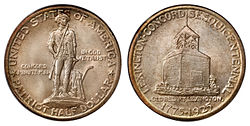
The Lexington–Concord Sesquicentennial half dollar, sometimes the Lexington–Concord half dollar or Patriot half dollar, is a commemorative fifty-cent piece struck by the United States Bureau of the Mint in 1925 in honor of the 150th anniversary of the Battles of Lexington and Concord, which began the American Revolutionary War. It was designed by Chester Beach and features Daniel Chester French's 1874 The Minute Man statue on the obverse.
Members of the Massachusetts congressional delegation introduced legislation in 1924 which would provide for a commemorative half dollar for the anniversary. The bill passed both houses of Congress and was signed by President Calvin Coolidge. Beach had to satisfy committees from both Lexington and Concord, and the Commission of Fine Arts passed the design only reluctantly, feeling Beach had been given poor materials to work with. (Full article...) -

The Waterloo Medal was designed by Italian-born sculptor Benedetto Pistrucci. He worked on it from 1819 to 1849, when the completed matrices were presented to Britain's Royal Mint. The medal was commissioned by the British Government in 1819 on the instructions of the Prince Regent (later George IV); copies were to be presented to the generals who had been victorious in the 1815 Battle of Waterloo, and to the leaders of Britain's allies. As most of the intended recipients had died by 1849, and relations with France had improved, the medals were never struck, though modern-day editions have been made for sale to collectors.
In 1816, the Prince Regent had first suggested a medal to be presented to allies and commanders from Waterloo. The Royal Academy proposed work by John Flaxman, one of its members, but Pistrucci, whose responsibility it was to engrave the dies, refused to copy another's work, and brought forth designs of his own. The Prince Regent and William Wellesley-Pole, Master of the Mint were impressed by Pistrucci's models, and he gained the commission. (Full article...) -

Kalākaua 1883 dime
The Kalākaua coinage is a set of silver coins of the Kingdom of Hawaii dated 1883, authorized to boost Hawaiian pride by giving the kingdom its own money. They were designed by Charles E. Barber, Chief Engraver of the United States Bureau of the Mint, and were struck at the San Francisco Mint. The issued coins are a dime (ten-cent piece), quarter dollar, half dollar, and dollar.
No immediate action had been taken after the 1880 act authorizing coins, but King Kalākaua was interested and government officials saw a way to get out of a financial bind by getting coins issued in exchange for government bonds. Businessman Claus Spreckels was willing to make the arrangements with the United States in exchange for profits from the coin production, and contracted with the US Mint to have $1,000,000 worth of coins struck. Originally, a 121⁄2 cent piece was planned and a few specimens were struck, but it was scrapped in an effort to have uniformity between US and Hawaiian coins, and a dime was substituted. The coins were struck at San Francisco in 1883 and 1884, though all bear the earlier date. (Full article...)


.jpg)


Selected article -

The Achaemenid Empire issued coins from 520 BCE–450 BCE to 330 BCE. The Persian daric was the first gold coin which, along with a similar silver coin, the siglos (from Ancient Greek: σίγλος, Hebrew: שֶׁקֶל, shékel) represented the first bimetallic monetary standard. It seems that before the Persians issued their own coinage, a continuation of Lydian coinage under Persian rule is likely. Achaemenid coinage includes the official imperial issues (Darics and Sigloi), as well as coins issued by the Achaemenid provincial governors (satraps), such as those stationed in Asia Minor. (Full article...)
Selected image

Credit: Poznaniak
The Lituanian 1 litas commemorative coin was released into circulation in 2005 to promote reconstruction of the royal palace.
Did you know...

- ...that with its two-dollar coin (reverse pictured), Newfoundland was the only British colony to issue circulating gold coinage?
- ...that Mount Burgess is nicknamed the Ten Dollar Mountain because it was featured on Canadian currency?
- ...that the American Buffalo gold bullion coin was the first .9999 fine 24-carat gold coin released by the United States Mint?
- ...that the Alabama centennial half dollar was the first commemorative coin minted with the image of a living individual?
- ...that Aksumite currency was the only native coinage to be issued in Africa without direct influence by an outside culture like Roman, Greek, etc...?
Related portals


Selected coin -

The penny, officially the cent, is a coin in the United States representing one-hundredth of a dollar. It has been the lowest face-value physical unit of U.S. currency since the abolition of the half-cent in 1857. Introduced in 1793, it was produced for circulation until 2025 and continues to circulate.
The United States Mint's official name for the coin is "cent" and the U.S. Treasury's official name is "one cent piece". The colloquial term penny derives from the British coin of the same name, which occupies a similar place in the British system. Pennies is the plural form, not to be confused with pence, which refers to the unit of currency. (Full article...)
Selected banknote image -
_back.jpg)
General images -
-
-
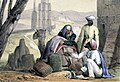
 Song dynasty Jiaozi, the world's earliest paper money (from Currency)
 -
 Obverse and reverse of an old American $100 note (1928) (from Banknote)
 -
 Hoard of mostly Mauryan Empire coins, 3rd century BC (from Coin)
 -
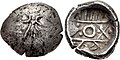 Punch-marked coin minted in the Kabul Valley under Achaemenid administration, c. 500–380 BC, or c. 350 BC. (from Coin)
 -
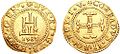 Genoese doppia, 1589 (from History of money)
 -
![Image 7Chinese round coins, Eastern Zhou dynasty – Warring States Period, c. 300–220 BC. Four Hua (四化, 30mm, 6.94 g). Legend Yi Si Hua ([City of] Yi Four Hua). (from Coin)](//upload.wikimedia.org/wikipedia/commons/thumb/f/f9/CHINA%2C_Eastern_Zhou_dynasty_-_Warring_States_Period._State_of_Q%C3%AD._City_of_Yi._Circa_300-220_BC.jpg/120px-CHINA%2C_Eastern_Zhou_dynasty_-_Warring_States_Period._State_of_Q%C3%AD._City_of_Yi._Circa_300-220_BC.jpg) Chinese round coins, Eastern Zhou dynasty – Warring States Period, c. 300–220 BC. Four Hua (四化, 30mm, 6.94 g). Legend Yi Si Hua ([City of] Yi Four Hua). (from Coin)
Chinese round coins, Eastern Zhou dynasty – Warring States Period, c. 300–220 BC. Four Hua (四化, 30mm, 6.94 g). Legend Yi Si Hua ([City of] Yi Four Hua). (from Coin) -
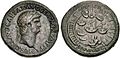
-
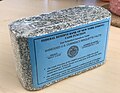 Shredded and briquetted US dollar notes from the Federal Reserve Bank of New York (approx. 1000 pieces, 1 kg) (from Banknote)
 -
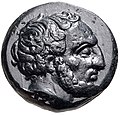 The Achaemenid Empire satraps and dynasts in Asia Minor developed the usage of portraiture from c. 420 BC. Portrait of the satrap of Lydia, Tissaphernes (c. 445–395 BC). (from Coin)
 -
 Spade money from the Zhou dynasty, c. 650–400 BC (from History of money)
 -

-
 Silver stater of Aegina, 550–530 BC. Obverse: sea turtle with large pellets down centre. Reverse: incuse square punch with eight sections. (from Coin)
 -
-
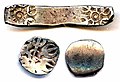
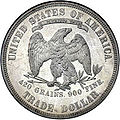 1884 United States trade dollar (from Coin)
 -

-
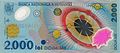 A 2000 Romanian lei polymer banknote (from Banknote)
 -
-
 Genoese scudo, 1541 (from History of money)
 -
 Earliest banknote from China during the Song Dynasty which is known as "Jiaozi" (from History of money)
 -
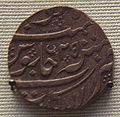 The French Indies Company issued rupees in the name of Muhammad Shah (1719–1748) for Northern India trade. This was cast in Pondicherry. (from History of money)
 -
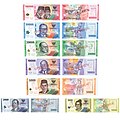 Many currencies, such as the Indonesian rupiah, vary the sizes of their banknotes by denomination. This is done so that they may be told apart through touch alone. (from Banknote)
 -
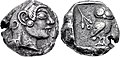 Athenian coin (c. 500/490–485 BC) discovered in the Shaikhan Dehri hoard in Pushkalavati, Pakistan. This coin is the earliest known example of its type to be found so far east. (from Coin)
 -
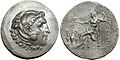 Posthumous Alexander the Great tetradrachm from Temnos, Aeolis. Dated 188–170 BC. Obverse: Alexander the Great as Herakles facing right wearing the nemean lionskin. Reverse: Zeus seated on throne to the left holding eagle in right hand and scepter in left; in left field PA monogram and angular sigma above grape vine arching over oinochoe; ALEXANDROU vertical in right field. Reference: Price 1678. (from Coin)
 -
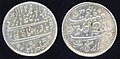
-
 Name of currency units by country, in Portuguese (from Currency)
 -
 Five million mark coin (Weimar Republic, 1923). Despite its high denomination, this coin's monetary value dropped to a tiny fraction of a US cent by the end of 1923, substantially less than the value of its metallic content. (from Coin)
 -
 Fed Shreds as souvenir from the Federal Reserve Bank of San Francisco (from Banknote)
 -
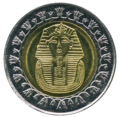 Bimetallic Egyptian one pound coin featuring King Tutankhamen (from Coin)
 -
 Florentine florin, 1347 (from Coin)
 -
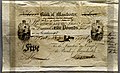 Collage for banknote design with annotations and additions to show proposed changes (figure rather higher so as to allow room for the No.), Bank of Manchester, UK, 1833. On display at the British Museum in London (from Banknote)
 -
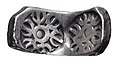 Gandharan "bent-bar" punch-marked coin minted under Achaemenid administration, of the type found in large quantities in the Chaman Hazouri and the Bhir Mound hoards. (from Coin)
 -
Alexander the Great Tetradrachm from the Temnos Mint, c. 188–170 BC (from Coin)
-
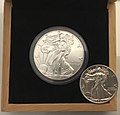 An American Silver Eagle minted in 2019 (left), an example of a Bullion coin. Its obverse design is based on the older, formerly circulating silver Walking Liberty half dollar (right). (from Coin)
 -
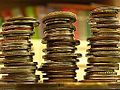 Coins can be stacked. (from Coin)
 -
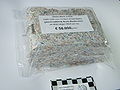 Shredded and briquetted euro banknotes from the Deutsche Bundesbank, Germany (approx. 1 kg) (from Banknote)
 -
 The Piloncitos are tiny engraved gold coins found in the Philippines, along with barter rings, which are gold ring-like ingots. These barter rings are bigger than softballs in size and are made of pure gold from the Archaic period (c. 10th to 16th century). (from Coin)
 -
 Egyptian gold stater of Nectanebo II: reverse with hieroglyphs nfr-nb (around 360 BC). (from Currency)
 -
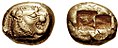 A 7th century one-third stater coin from Lydia, shown larger (from History of money)
 -
 A Swiss ten-cent coin from 1879, similar to the oldest coins still in official use today (from Coin)
 -
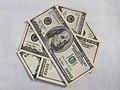 100 USD banknote (from History of money)
 -
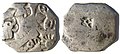 Silver coin of the Maurya Empire, known as rūpyarūpa, with symbols of wheel and elephant. 3rd century BC (from History of money)
 -

-
 Timeline of monetary history (from History of money)
 -
-
-
 Genoese 10 doppie, 1641 (from History of money)
 -
 A siglos found in the Kabul valley, 5th century BC. Coins of this type were also found in the Bhir Mound hoard. (from Coin)
 -
 French 1992 twenty Franc Tri-Metallic coin (from Coin)
 -

-
 Holographic coin from Liberia features the Statue of Liberty (Liberty Enlightening the World) (from Coin)
 -
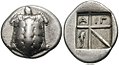 Greek drachm of Aegina. Obverse: Land turtle. Reverse: ΑΙΓ(INA) and dolphin (from History of money)
 -
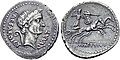
-
 Shredded and briquetted US dollar notes from the Federal Reserve Bank of New York (approx. 1000 pieces, 1 kg) (from Banknote)
 -
 A $5 note issued by Citizens Bank of Louisiana in the 1850s. (from Banknote)
 -
 An oxhide ingot from Crete. Late Bronze Age metal ingots were given standard shapes, such as the shape of an "ox-hide", suggesting that they represented standardized values. (from Coin)


![Image 7Chinese round coins, Eastern Zhou dynasty – Warring States Period, c. 300–220 BC. Four Hua (四化, 30mm, 6.94 g). Legend Yi Si Hua ([City of] Yi Four Hua). (from Coin)](https://dokumen123.com/en/File:CHINA,_Eastern_Zhou_dynasty_-_Warring_States_Period._State_of_Q%C3%AD._City_of_Yi._Circa_300-220_BC.jpg)


.jpg)


.jpg)


.jpg)


Numismatic terminology
- Bullion – Precious metals (platinum, gold and silver) in the form of bars, ingots or plate.
- Error – Usually a mis-made coin not intended for circulation, but can also refer to an engraving or die-cutting error not discovered until the coins are released to circulation. This may result is two or more varieties of the coin in the same year.
- Exonumia – The study of coin-like objects such as token coins and medals, and other items used in place of legal currency or for commemoration.
- Fineness – Purity of precious metal content expressed in terms of one thousand parts. 90% is expressed as .900 fine.
- Notaphily – The study of paper money or banknotes.
- Scripophily – The study and collection of stocks and Bonds.
WikiProjects

Numismatic topics
Money - Coins - Banknotes - Electronic money - Exchange rate - Legal tender - Clubs - Terminology
Ancient currency: Asia - Byzantium - Greece - Primitive Money - Roman - Indian coinage
Modern currency: Africa - The Americas - Asia and the Pacific - Europe - Bullion coins - Challenge coin - Commemorative coins - Token coins
Economics: Banking - Bonds - Cheques - Credit Cards - Fiat currency - Gold standard - Mints - Monetary union - Reserve currency - Stocks
Production: Coining (machining) - Designers - Die making - Mint (coin) • Coinage Metals: Aluminum - Bronze - Copper - Gold - Platinum - Silver - Tin
Subcategories

Most traded currencies
| Currency | ISO 4217 code |
Proportion of daily volume | Change (2022–2025) | |
|---|---|---|---|---|
| April 2022 | April 2025 | |||
| U.S. dollar | USD | 88.4% | 89.2% |  0.8pp 0.8pp
|
| Euro | EUR | 30.6% | 28.9% |  1.7pp 1.7pp
|
| Japanese yen | JPY | 16.7% | 16.8% | 0.1pp
|
| Pound sterling | GBP | 12.9% | 10.2% | 2.7pp
|
| Renminbi | CNY | 7.0% | 8.5% | 1.5pp
|
| Swiss franc | CHF | 5.2% | 6.4% | 1.2pp
|
| Australian dollar | AUD | 6.4% | 6.1% | 0.3pp
|
| Canadian dollar | CAD | 6.2% | 5.8% | 0.4pp
|
| Hong Kong dollar | HKD | 2.6% | 3.8% | 1.2pp
|
| Singapore dollar | SGD | 2.4% | 2.4% | 
|
| Indian rupee | INR | 1.6% | 1.9% | 0.3pp
|
| South Korean won | KRW | 1.8% | 1.8% |
|
| Swedish krona | SEK | 2.2% | 1.6% | 0.6pp
|
| Mexican peso | MXN | 1.5% | 1.6% | 0.1pp
|
| New Zealand dollar | NZD | 1.7% | 1.5% | 0.2pp
|
| Norwegian krone | NOK | 1.7% | 1.3% | 0.4pp
|
| New Taiwan dollar | TWD | 1.1% | 1.2% | 0.1pp
|
| Brazilian real | BRL | 0.9% | 0.9% |
|
| South African rand | ZAR | 1.0% | 0.8% | 0.2pp
|
| Polish złoty | PLN | 0.7% | 0.8% | 0.1pp
|
| Danish krone | DKK | 0.7% | 0.7% |
|
| Indonesian rupiah | IDR | 0.4% | 0.7% | 0.3pp
|
| Turkish lira | TRY | 0.4% | 0.5% | 0.1pp
|
| Thai baht | THB | 0.4% | 0.5% | 0.1pp
|
| Israeli new shekel | ILS | 0.4% | 0.4% |
|
| Hungarian forint | HUF | 0.3% | 0.4% | 0.1pp
|
| Czech koruna | CZK | 0.4% | 0.4% |
|
| Chilean peso | CLP | 0.3% | 0.3% |
|
| Philippine peso | PHP | 0.2% | 0.2% |
|
| Colombian peso | COP | 0.2% | 0.2% |
|
| Malaysian ringgit | MYR | 0.2% | 0.2% |
|
| UAE dirham | AED | 0.4% | 0.1% | 0.3pp
|
| Saudi riyal | SAR | 0.2% | 0.1% | 0.1pp
|
| Romanian leu | RON | 0.1% | 0.1% |
|
| Peruvian sol | PEN | 0.1% | 0.1% |
|
| Other currencies | 2.6% | 3.4% | 0.8pp
| |
| Total[a] | 200.0% | 200.0% | ||
References
- ^ Triennial Central Bank Survey Foreign exchange turnover in April 2025 (PDF) (Report). Bank for International Settlements. 30 September 2025. p. 14. Archived (PDF) from the original on 2025-10-12.
Web resources
- NumisWiki
- International Association of Professional Numismatists
- American Numismatic Association
- American Numismatic Society
- British Numismatic Association
- American Vecturist Association
- Challenge Coin Association
- Numismatic Museum of Athens, Greece
- The Perth Mint Australia
- Central Mint of China
- Royal Mint
- The French Mint
- United States Mint
- Bank of Russia
- Royal Canadian Mint
- Exact Change numismatic software
Things you can do
|
|
 |
Here are some tasks awaiting attention:
|
Associated Wikimedia
The following Wikimedia Foundation sister projects provide more on this subject:
-
 Commons
Free media repository -
 Wikidata
Free knowledge base -
 Wikiquote
Collection of quotations -
 Wikisource
Free-content library -
 Wikiversity
Free learning tools -
 Wiktionary
Dictionary and thesaurus


Sources
- ^ The total sum is 200% because each currency trade is counted twice: once for the currency being bought and once for the currency being sold. The percentages above represent the proportion of all trades involving a given currency, regardless of which side of the transaction it is on.


Content Disclaimer
Informasi ini disarikan dari Wikipedia dan disajikan kembali untuk tujuan edukasi. Konten tersedia di bawah lisensi CC BY-SA 3.0. Kami tidak bertanggung jawab atas ketidakakuratan data yang bersumber dari kontribusi publik tersebut.
- The information displayed on this website is sourced in part or in whole from Wikipedia and has been adapted for the purpose of restating it. We strive to provide accurate and relevant information, however:
- There is no guarantee of absolute accuracy. Wikipedia is an open, collaborative project that can be edited by anyone, so information is subject to change.
- It is not intended to constitute professional advice. The content displayed is for informational and educational purposes only. For important decisions (e.g., medical, legal, or financial), please consult a professional.
- Content copyright. Wikipedia is licensed under the Creative Commons Attribution-ShareAlike License (CC BY-SA). This means that content may be reused with appropriate attribution and shared under a similar license.
- Responsible use. Any risk arising from the use of information from this website is entirely the responsibility of the user.