Portal:Nudity

Introduction

Nudity is the state of being in which a human is without clothing. While estimates vary, for the first 90,000 years of pre-history, anatomically modern humans were naked, having lost their body hair, living in hospitable climates, and not having developed the crafts needed to make clothing.
As humans became behaviorally modern, body adornments such as jewelry, tattoos, body paint and scarification became part of non-verbal communications, indicating a person's social and individual characteristics. Indigenous peoples in warm climates used clothing for decorative, symbolic or ceremonial purposes but were often nude, having neither the need to protect the body from the elements nor any conception of nakedness being shameful. In many societies, both ancient and contemporary, children might be naked until the beginning of puberty and women often do not cover their breasts due to the association with nursing babies more than with sexuality.
In the ancient civilizations of the Mediterranean, from Mesopotamia to the Roman Empire, proper attire was required to maintain social standing. The majority might possess a single piece of cloth that was wrapped or tied to cover the lower body; slaves might be naked. However, through much of Western history until the modern era, people of any status were also unclothed by necessity or convenience when engaged in labor and athletics; or when bathing or swimming. Such functional nudity occurred in groups that were usually, but not always, segregated by sex. Although improper dress might be socially embarrassing, the association of nudity with sin regarding sexuality began with Abrahamic beliefs, spreading through Europe in the post-classical period. Traditional clothing in temperate regions worldwide also reflect concerns for maintaining social status and order, as well as by necessity due to the colder climate. However, societies such as Japan and Finland maintain traditions of communal nudity based upon the use of baths and saunas that provided alternatives to sexualization. (Full article...)
Selected general article

Body painting is a form of body art where artwork is painted directly onto the human skin. Unlike tattoos and other forms of body art, body painting is temporary, lasting several hours or sometimes up to a few weeks (in the case of mehndi or "henna tattoos" about two weeks). Body painting that is limited to the face is known as face painting. Body painting is also referred to as (a form of) "temporary tattoo". Large scale or full-body painting is more commonly referred to as body painting, while smaller or more detailed work can sometimes be referred to as temporary tattoos. (Full article...)
Did you know...
- ... that sales from Dieux du Stade, a nude calendar produced by the French professional rugby union club Stade Français featuring photos of its players, helped to finance the club for many years?
- ... that The Battle of Calverhine, Henry Darger's largest collage, is ten feet (3 m) wide and almost impossible to make out with the naked eye?
- ... that a Golkar official claimed that he "would run around town naked" if Laurentius Say survived two terms as regent of Sikka?
- ... that the runway show for Scanners by Alexander McQueen concluded with a mostly nude model struggling through an artificial snowstorm in a wind tunnel?
- ... that Ettore Sottsass's design of the Olivetti Valentine typewriter was inspired by the pop-art nudes of Tom Wesselmann?
- ... that former Scottish Conservative leader Ruth Davidson said that she would swim in Loch Ness naked if the SNP won more than 50 seats at the 2019 United Kingdom general election?
- ... that Tobias Rahim sold a nude photo of himself to challenge his fears?
- ... that Will Wood performed nude for the music video of a song on SELF-iSH?
Need help?
Do you have a question about Nudity that you can't find the answer to?
Consider asking it at the Wikipedia reference desk.
Get involved
For editor resources and to collaborate with other editors on improving Wikipedia's Nudity-related articles, see WikiProject Nudity.
General images
-
 A publicity photo showing a North American naturist couple making tea (from Naturism)
 -
-
 This year Venuses again... always Venuses!... (1864) by Daumier (from Nude (art))
 -
 David (1504)
"And what barbarous judge is there that cannot understand that the foot of a man is more noble than his shoe? His skin than that of the sheep from which his clothes are made?"
— Michelangelo (from Nude (art)) -
 Public naturist recreation area at Lake Unterbach; Strandbad Süd, Düsseldorf-Unterbach, Germany (from Naturism)
 -
 World Naked Bike Ride in London, 2016 (from Naturism)
 -

-
 Sunrise on the beach, Taitung County, Taiwan (from Naturism)
 -
-
 Ariadne Asleep on the Island of Naxos (1808–1812) by John Vanderlyn. The painting was initially considered too sexual for display in the Pennsylvania Academy of the Fine Arts. "Although nudity in art was publicly protested by Americans, Vanderlyn observed that they would pay to see pictures of which they disapproved." (from Nude (art))
 -
 Crayon-style print by Gilles Demarteau with a nude man after original drawing by Edmé Bouchardon was acquired by Academy of Fine Arts in Warsaw as a teaching material (from Nude (art))
 -

-

-
-
 A necklace reconstructed from perforated sea snail shells from Upper Palaeolithic Europe, dated between 39,000 and 25,000 BCE. The practice of body adornment is associated with the emergence of behavioral modernity. (from Nudity)
 -
 Naked person looking over the stern rail on the QNA nude boat cruise on the Gold Coast Broadwater, Queensland, in December 2025 (from Naturism)
 -
 Odalisque (1857) by Eugène Delacroix, a painting with similar pose (from Nude photography)
 -
 Signpost at Mpenjati Naturist Beach (from Naturism)
 -
 Five nude people on the rocks around Black Pond, McLean, Virginia in July 1980 (from Nudity)
 -
 Photograph by Jean Louis Marie Eugène Durieu, c. 1855 (from Nude photography)
 -
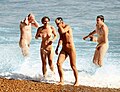
 Naturist swimmers in Australia (from Naturism)
 -

-
 In many European countries, women may sunbathe without covering their breasts. (from Nudity)
 -
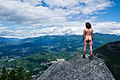 Nudist hiker in British Columbia (from Naturism)
 -

-
 Kayapo women, Pará State, Brazil
 -

-
![Image 28Banya [ru] (1913) by Zinaida Serebriakova (from Nudity)](//upload.wikimedia.org/wikipedia/commons/thumb/7/7e/Serebryakova_Bath_house_1913.jpg/120px-Serebryakova_Bath_house_1913.jpg)
-
 Nude men at the Przystanek Woodstock festival, 2014 (from Naturism)
 -

-
 Bathing in the center of East Berlin, East Germany (1958) (from Nudity)
 -
 A woman breastfeeding in Rio de Janeiro, Brazil, 2017 (from Nudity)
 -
 One of the photographs of the Abu Ghraib prison torture scandal: a naked prisoner being forced to crawl and bark like a dog on a leash. (from Nudity)
 -

-

-

-
 Using birch branches in a Finnish sauna, 1967 (from Nudity)
 -
 A woman naked on the beach at Valalta, Croatia (from Naturism)
 -

-
 Photograph by Jean Louis Marie Eugène Durieu, part of a series made with Eugène Delacroix (from Nude photography)
 -
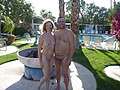 Nudist couple at Terra Cotta Inn, Palm Springs, California, US (from Naturism)
 -
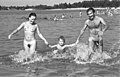 Naturist family on Lake Senftenberg in 1983 (from Naturism)
 -

-
 The Venus of Willendorf (made between 24,000 and 22,000 BCE) (from Nude (art))
 -
 Couple walking naked in the streets of Barcelona, Spain (from Naturism)
 -
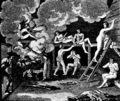 Finnish Sauna (1802) (from Naturism)
 -
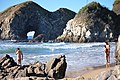 The far west end of Zipolite Beach, Oaxaca, Mexico (from Naturism)
 -

-
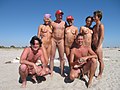
-
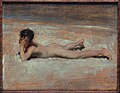 A Nude Boy on a Beach (1878) by John Singer Sargent (from Nude (art))
 -
 The Barricade (1918), oil on canvas, by George Bellows. A painting inspired by an incident in August 1914 in which German soldiers used Belgian townspeople as human shields. (from Nude (art))
 -
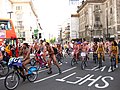 People taking part in the World Naked Bike Ride in London, 2012 (from Nudity)
 -
Families bathing nude at a hot spring in Taiwan (from Naturism)
-
 Susanna and the Elders, 1610, Artemisia Gentileschi. This work may be compared with male depictions of the same tale. (from Nude (art))
 -
 Florida naturists (from Naturism)
 -
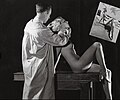 Zoë Mozert was one of Earl Moran's first nude models in the 1930s. (from Nude photography)


_(125970187).jpg)

.jpg)
.jpg)


_-_Nu_masculin_debout_-_ca._1855_-_02.jpg)


.jpg)


![Image 28Banya [ru] (1913) by Zinaida Serebriakova (from Nudity)](https://dokumen123.com/en/File:Serebryakova_Bath_house_1913.jpg)


.jpg)


_-_1897_-_Freilicht_-_vmp_01_(cropped).jpg)


,_Artemisia_Gentileschi.jpg)


In the news
- 3 June 2026 –
- German filmmaker Wim Wenders withdraws his 1975 film The Wrong Move from distribution after actress Nastassja Kinski objected to a nude scene filmed when she was 13 years old, calling for the film to be re-edited. (AP)
Subcategories

- Select [►] to view subcategories
Related portals


.svg)

Subtopics
| Nakedness and clothing | |
|---|---|
| Nudity and sexuality | |
| Issues in social nudity | |
| Naturism | |
| Nude recreation | |
| By location | |
| Social nudity advocates | |
| Depictions of nudity | |
| Related | |


Associated Wikimedia
The following Wikimedia Foundation sister projects provide more on this subject:
-
 Commons
Free media repository -
 Wikidata
Free knowledge base -
 Wikiquote
Collection of quotations -
 Wikisource
Free-content library -
 Wikiversity
Free learning tools -
 Wiktionary
Dictionary and thesaurus


Content Disclaimer
Informasi ini disarikan dari Wikipedia dan disajikan kembali untuk tujuan edukasi. Konten tersedia di bawah lisensi CC BY-SA 3.0. Kami tidak bertanggung jawab atas ketidakakuratan data yang bersumber dari kontribusi publik tersebut.
- The information displayed on this website is sourced in part or in whole from Wikipedia and has been adapted for the purpose of restating it. We strive to provide accurate and relevant information, however:
- There is no guarantee of absolute accuracy. Wikipedia is an open, collaborative project that can be edited by anyone, so information is subject to change.
- It is not intended to constitute professional advice. The content displayed is for informational and educational purposes only. For important decisions (e.g., medical, legal, or financial), please consult a professional.
- Content copyright. Wikipedia is licensed under the Creative Commons Attribution-ShareAlike License (CC BY-SA). This means that content may be reused with appropriate attribution and shared under a similar license.
- Responsible use. Any risk arising from the use of information from this website is entirely the responsibility of the user.