Portal:Monaco

The Monaco Portal
Welcome! — Bienvenue! — Benvegnüu!


Monaco, officially the Principality of Monaco, is a sovereign city-state and microstate in Western Europe. Situated on the French Riviera, it is a semi-enclave bordered by France to the north, east, and west, with the Mediterranean Sea to the south; the Italian region of Liguria is about 15 km (9.3 mi) east. With a population of 38,423 living in an area of 2.08 km2 (0.80 sq mi), Monaco is the second smallest sovereign state in the world, after Vatican City, as well as the most densely populated. It also has the world's shortest national coastline of any non-landlocked nation, at 3.83 km (2.38 mi). Fewer than 10,000 of its residents are Monégasque nationals. Although French is the official language of Monaco, Italian and Monégasque are also widely spoken and understood.
Monaco is governed under a form of semi-constitutional monarchy, with Prince Albert II as head of state, who holds substantial political powers. The prime minister, who is the head of government, can be either a Monégasque or French citizen; the monarch consults with the Government of France before an appointment. Key members of the judiciary are detached French magistrates. The House of Grimaldi has ruled Monaco, with brief interruptions, since 1297. The state's sovereignty was officially recognised by the Franco-Monégasque Treaty of 1861, with Monaco becoming a full United Nations voting member in 1993. Despite Monaco's independence and separate foreign policy, its defence is the responsibility of France, notwithstanding two small military units.
Monaco is recognised as one of the wealthiest and most expensive places in the world. Its economic development was spurred in the late 19th century with the opening of the state's first casino, the Monte Carlo Casino, and a rail connection to Paris. The country's mild climate, scenery, and gambling facilities contributed to its status as a tourist destination and recreation centre for the wealthy. Monaco has become a major banking centre and sought to diversify into the services sector and small, high-value-added, non-polluting industries. Monaco is a tax haven; it has no personal income tax (except for French citizens) and low business taxes. Over 30% of residents are millionaires, with real estate prices reaching €100,000 ($116,374) per square metre in 2018. Monaco is a global hub of money laundering, and in June 2024 the Financial Action Task Force placed Monaco under increased monitoring to combat money laundering and terrorist financing. (Full article...)
Selected location article

The Casino Gardens and Terraces are public gardens that surround the Monte Carlo Casino in the Monte Carlo district of Monaco. The gardens contain lawns and fountains and a "Little Africa" garden. At the bottom of the terraces is Victor Vasarely's artwork Hexa Grace, made of multi coloured tiles. The gardens were founded in the late 19th century and formed the largest public space in Monaco in the 1950s. The gardens are frequently used to display large public artworks. The gardens were designed by the architect Edouard André. The original designs for the garden incorporated waterfalls stretching down a slope to terminate in a pond amidst sunken gardens. The trees washingtonia robusta and brachychiton populneus are prominent in the gardens.
A 1959 report on the gardens noted a long avenue of palm trees, in addition to flower beds, bottle trees, and cacti thriving in the frost free subtropic environment. (Full article...)
Selected pictures
-
 Lycée Albert Premier of Monaco (from Outline of Monaco)
 -
 Genovese coin from 1655 (from Monaco)
 -
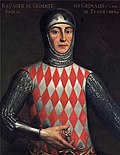
 The marriage of Hollywood actress Grace Kelly to Prince Rainier III brought media attention to the principality. (from Monaco)
 -
 The Monaco harbour during the days of the 2016 Monaco Grand Prix (from Outline of Monaco)
 -

-
 Hotel de Paris lobby ceiling: Monaco draws tourists with its late 19th- and early-20th-century buildings and glamor. (from Monaco)
 -
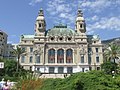 Seaside façade of the Salle Garnier, home of the Opéra de Monte-Carlo (from Outline of Monaco)
 -
 Saint Martin Gardens (from Outline of Monaco)
 -
 Monte-Carlo Bay Hotel & Resort overlooks the Mediterranean Sea (from Monaco)
 -
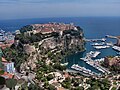 View of the Rock of Monaco (from Outline of Monaco)
 -
 Ville ruelle in Monaco (from Monaco)
 -

-
 Public art in Monaco (from Outline of Monaco)
 -
 Monaco-Ville (from Outline of Monaco)
 -
 Logo of the princely government of Monaco (from Monaco)
 -
 Monaco's flag and its coat of arms (from Monaco)
 -
 Espresso at Café de Paris, Monte Carlo (from Monaco)
 -
 A map of the County of Nice showing the area of the Italian kingdom of Sardinia annexed in 1860 to France (light brown). The area in red had already become part of France before 1860. (from Monaco)
 -

-
 Monaco (as part of the Republic of Genoa) in 1494 (from Monaco)
 -
Lycée Albert Premier of Monaco (from Monaco)
-
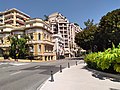 Boulevard des Moulins meets Avenue Saint-Michel (from Monaco)
 -
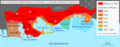 Land reclamation in Monaco since 1861(from Monaco)
 -
 Formation lap of the 1996 Monaco Grand Prix (from Monaco)
 -
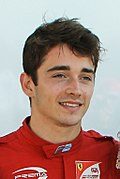 Charles Leclerc (from Outline of Monaco)
 -
 Fontvieille and its harbour (from Monaco)
 -
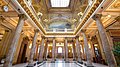 Atrium in Monte Carlo Casino (from Monaco)
 -
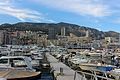 La Condamine (from Outline of Monaco)
 -
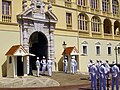 Palace guards in Monaco (from Monaco)
 -
-

-
 Lamarck intersection, Les Moneghetti (from Monaco)
 -
 Prince's Palace of Monaco (from Monaco)
 -
 Embassy of Monaco, Paris, France (from Monaco)
 -
 Photochrom of Monaco circa 1900 (from Monaco)
 -
 Oceanographic Museum (from Monaco)
 -
 Monte Carlo (from Outline of Monaco)
 -
 Tall buildings in Monaco (from Monaco)
 -
 The location of Monaco (from Outline of Monaco)
 -
 Satellite view of Monaco, with the France–Monaco border shown in yellow (from Monaco)
 -

-
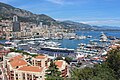 Port Hercules (from Outline of Monaco)
 -
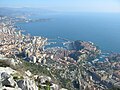 In the centre is La Condamine. At the right with the smaller harbour is Fontvieille, with The Rock (the old town, fortress, and Palace) jutting out between the two harbours. At the left are the high-rise buildings of La Rousse/Saint Roman. (from Monaco)
 -
 The Rock of Monaco in 1890 (from Monaco)
 -

-
 Enlargeable, detailed map of Monaco (from Monaco)
 -
 Japanese Gardens (from Outline of Monaco)
 -
-
Satellite view with border (from Outline of Monaco)
-
Monte Carlo Casino (from Monaco)
-
-
 Monaco's Japanese Gardens (from Monaco)
 -
 Walkway in the jardin exotique de Monaco (Exotic Gardens) (from Monaco)
 -
 Seaside façade of the Salle Garnier, home of the Opéra de Monte-Carlo (from Monaco)
 -
Fontvieille (from Outline of Monaco)
-
 Pedestrian crossing on Avenue de la Costa (from Monaco)
 -

-
 Hôtel de Paris (from Outline of Monaco)


.jpg)


.jpg)
.jpg)


_2009-05-09.jpg)
_(32774947955).jpg)


.jpg)


.jpg)
.jpg)


Selected ward

La Condamine (French pronunciation: [la kɔ̃damin]; Monégasque: A Cundàmina [a kuŋˈdamina]) is the central ward and a quartier in the Principality of Monaco. The quartier's landmarks include Port Hercules, the Rainier III Nautical Stadium, and the Princess Antoinette Park. Its farmers' market, at Place d'Armes, has been held since 1880. (Full article...)
Selected environment article
.jpg)
Land reclamation is done in Monaco through a policy of building land in the sea with concrete blocks because land is very scarce, as the country is comparatively tiny, at 2.08 km2 (0.80 sq mi). To solve this problem and to continue economic development, for years the country has added to its total land area by reclaiming land from the sea. (Full article...)
List of articles
|
|---|
Selected arts article

Monaco is a sovereign city-state, country, and microstate on the French Riviera, along the Mediterranean coast. The country has long been under the control of the Grimaldi family, who have encouraged musical development. Prince Rainier III introduced the Prince Rainier III Prize for Musical Composition to reward Monegasque musicians. (Full article...)
Selected religion article

The Roman Catholic Church in Monaco is part of the worldwide Roman Catholic Church, under the spiritual leadership of the Pope in Rome.
The country forms a single archdiocese: the Roman Catholic Archdiocese of Monaco, which is part of the Roman Catholic Church in France since the beginning of its history. Per the Constitution of Monaco (Art. 9) Roman Catholicism is the official church of Monaco, and is the majority religion; religious freedom is also guaranteed by the constitution. In 2023, the country was scored 4 out of 4 for religious freedom. (Full article...)
Selected sports article
.jpg)
Bernard Francis Genghini (born 18 January 1958) is a French former professional footballer who played as a midfielder. (Full article...)
Selected education article
The International School of Monaco (ISM) is a co-educational day school located in the Larvotto District of Monaco. The school was founded in 1994 by Neil Phillips, Vincent Hillsdon, Sina Rosberg, Countess Augusta, and Gerard Cohen. As of January 2026, ISM had over 850 students aged 3 to 18 years old, drawn from over 60 nationalities. It is one of seventeen educational establishments located in the country. The school is independent from the Monaco government, unlike other private institutions located in the principality ISM has no contract with them. (Full article...)
Selected transportation article
The Chemin des Révoires (Monégasque: Cami̍n d’ë Revëre) is a pathway within Les Révoires district of the Principality of Monaco. It is the highest point in Monaco. (Full article...)
Selected biography

Louis Alexandre Chiron (French pronunciation: [lwi ʃi.ʁɔ̃]; 3 August 1899 – 22 June 1979) was a Monégasque racing driver who competed in rallies, sports car races, and Grands Prix.
Among the greatest drivers between the two World Wars, his career embraced over thirty years, starting in 1923, and ending at the end of the 1950s. He is still the oldest driver ever to have started a race in the Formula One World Championship, having taken 6th place in the 1955 Monaco Grand Prix when he was 55. Three years later he became the oldest driver to enter a Formula One race, at 58. The Bugatti Chiron takes its name from him. Until 2024, when Charles Leclerc matched his achievement, he was the only Monegasque driver to have won the Monaco Grand Prix. (Full article...)
Related portals


Need help?
Do you have a question about Monaco that you can't find the answer to?
Consider asking it at the Wikipedia reference desk.
Get involved
For editor resources and to collaborate with other editors on improving Wikipedia's Monaco-related articles, see WikiProject Monaco.
Topics
Sources
- Notes
- References
Associated Wikimedia
The following Wikimedia Foundation sister projects provide more on this subject:
-
 Commons
Free media repository -
 Wikidata
Free knowledge base -
 Wikiquote
Collection of quotations -
 Wikisource
Free-content library -
 Wikiversity
Free learning tools -
 Wikivoyage
Free travel guide -
 Wiktionary
Dictionary and thesaurus


Content Disclaimer
Informasi ini disarikan dari Wikipedia dan disajikan kembali untuk tujuan edukasi. Konten tersedia di bawah lisensi CC BY-SA 3.0. Kami tidak bertanggung jawab atas ketidakakuratan data yang bersumber dari kontribusi publik tersebut.
- The information displayed on this website is sourced in part or in whole from Wikipedia and has been adapted for the purpose of restating it. We strive to provide accurate and relevant information, however:
- There is no guarantee of absolute accuracy. Wikipedia is an open, collaborative project that can be edited by anyone, so information is subject to change.
- It is not intended to constitute professional advice. The content displayed is for informational and educational purposes only. For important decisions (e.g., medical, legal, or financial), please consult a professional.
- Content copyright. Wikipedia is licensed under the Creative Commons Attribution-ShareAlike License (CC BY-SA). This means that content may be reused with appropriate attribution and shared under a similar license.
- Responsible use. Any risk arising from the use of information from this website is entirely the responsibility of the user.