Portal:Germany

Welcome to the Germany Portal!
Willkommen im Deutschland-Portal!
.svg)
|

|

| |
Germany (German: Deutschland), officially the Federal Republic of Germany (German: Bundesrepublik Deutschland), is a country in Central and Western Europe, lying between the Baltic Sea and the North Sea to the north with the Alps to the south. It borders Denmark to the north, Poland and the Czech Republic to the east, Austria and Switzerland to the south, France to the southwest, and Luxembourg, Belgium and the Netherlands to the west.
Germany includes 16 constituent states, covers an area of 357,596 square kilometres (138,069 sq mi) and has a largely temperate seasonal climate. With over 83 million inhabitants, it is the second most populous state of Europe after Russia, the most populous state lying entirely in Europe, as well as the most populous member state of the European Union. Germany is a very decentralized country. Its capital and most populous city is Berlin, while Frankfurt serves as its financial capital and has the country's busiest airport.
In 1871, Germany became a nation-state when most of the German states unified into the Prussian-dominated German Empire. After World War I and the Revolution of 1918–19, the Empire was replaced by the parliamentary Weimar Republic. The Nazi seizure of power in 1933 led to World War II and the Holocaust. After the end of World War II in Europe and a period of Allied occupation, two new German states were founded: West Germany, formed from the American, British, and French occupation zones, and East Germany, formed from the western part of the Soviet occupation zone, reduced by the newly established Oder-Neisse line. Following the Revolutions of 1989 that ended communist rule in Central and Eastern Europe, the country was reunified on 3 October 1990.
Germany is a federal parliamentary republic led by a chancellor. It is a great power with the largest economy in Europe. As a global leader in several industrial, scientific and technological sectors, it is a major trading nation. The Federal Republic of Germany was a founding member of the European Economic Community in 1957 and the European Union in 1993. Read more...
Selected article
.jpg)
Der 100. Psalm (The 100th Psalm), Op. 106, is a composition in four movements by Max Reger in D major for mixed choir and orchestra, a late Romantic setting of Psalm 100. Reger began composing the work in 1908 for the 350th anniversary of Jena University. The occasion was celebrated that year with the premiere of Part I, conducted by Fritz Stein on 31 July. Reger completed the composition in 1909. It was published that year and premiered simultaneously on 23 February 1910 in Chemnitz, conducted by the composer, and in Breslau, conducted by Georg Dohrn.
Reger structured the text in four movements, as a choral symphony. He scored it for a four-part choir with often divided voices, a large symphony orchestra, and organ. He requested additional brass players for the climax in the last movement when four trumpets and four trombones play the melody of Luther's chorale "Ein feste Burg ist unser Gott". Reger used both late-Romantic features of harmony and dynamics, and polyphony in the Baroque tradition, culminating in the final movement, a double fugue with the added instrumental cantus firmus.
In 1922, the biographer Eugen Segnitz noted that this work, of intense expression, was unique in the sacred music of its period, with its convincing musical interpretation of the biblical text and manifold shades of emotion. Paul Hindemith wrote a trimmed adaption which probably helped to keep the work in the repertory, and François Callebout wrote an organ version, making the work accessible for smaller choirs. The organ version was first performed in 2003, in Wiesbaden where the composer studied. The celebration of the Reger Year 2016, reflecting the centenary of the composer's death, led to several performances of Der 100. Psalm. (Full article...)
Selected picture
-
 Photograph credit: Jörg BraukmammThe Hoher Göll is a mountain in the Berchtesgaden Alps. At 2,522 metres (8,274 feet), it is the highest peak of the Göll massif, which straddles the border between the German state of Bavaria and the Austrian state of Salzburg. This photograph shows the Hoher Göll (left) and the Hohes Brett (right) from the west.
 -
 Photo credit: Daniel SchwenSparrenburg Castle, located in Bielefeld, Germany, as seen from the western lawn. The castle was constructed between 1240 and 1250 by the Counts of Ravensberg. The castle has been rebuilt many times. Although often under siege, it was never stormed. After extensive restoration work, the castle now presents itself as an imposing historic site.
 -
 Painting credit: Karl Friedrich SchinkelKarl Friedrich Schinkel (1781–1841) was a Prussian architect and city planner. He was one of the most prominent architects in Germany and designed both Neoclassical and Neo-Gothic buildings, the most famous of which are found in and around Berlin. He was also a painter and a designer of furniture and stage sets.
This oil-on-canvas painting, entitled Castle by the River, was created by Schinkel in 1820. As an artist, his architectural talent shone through, and his buildings and landscapes are carefully drafted and meticulously executed. The painting is in the collection of the Alte Nationalgalerie in Berlin. -
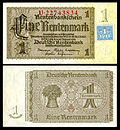 The Rentenmark was a currency introduced on 15 November 1923 in Weimar Germany after the value of the previous currency had been destroyed by hyperinflation.
The banknote shown at left was printed in 1937 or later. It bears an adhesive coupon attached by the East German government in 1948, extending its validity while new East German mark banknotes were being printed. -
 Banknote design credit: Deutsch-Ostafrikanische Bank; photographed by Andrew ShivaThe rupie was the unit of currency of German East Africa between 1890 and 1916. During World War I, the colony was cut off from Germany as a result of a wartime blockade and the colonial government needed to create an emergency issue of banknotes. Paper made from linen or jute was initially used, but because of wartime shortages, the notes were later printed on commercial paper in a variety of colours, wrapping paper, and in one instance, wallpaper. This twenty-rupie banknote was issued in 1915, and is now part of the National Numismatic Collection at the Smithsonian Institution.
Other denominations:
'"`UNIQ--templatestyles-00000019-QINU`"' -


Chinese House in Potsdam Credit: Andreas Tille -
 Painting: Hans BaluschekCity of Workers is an oil painting on canvas completed by the Berlin Secessionist painter Hans Baluschek in 1920. It depicts a dark and dirty working class sector of the German capital, Berlin, in which industrial smoke dominates the skyline and the few lights of windows are drowned in the gloom. The 48.44 × 36.25 in (123 × 92.1 cm) work is held at the Milwaukee Art Museum.
 -

Saar river at Mettlach Credit: Wolfgang Staudt] -
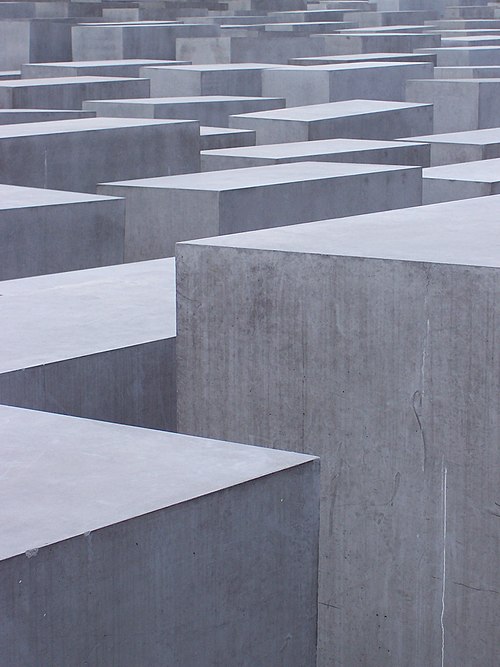
The Memorial to the Murdered Jews of Europe in Berlin -
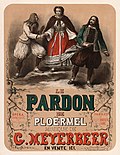 Poster credit: Henri Télory; restored by Adam CuerdenGiacomo Meyerbeer (1791–1864) was a German opera composer. Born to a wealthy Berlin family, he began his musical career as a pianist but soon decided to devote himself to opera. Meyerbeer spent several years in Italy studying and composing, before moving to Paris, where he became a dominant figure in the world of opera. This poster advertised the premiere of Meyerbeer's opera Le pardon de Ploërmel, which opened at the Opéra-Comique in Paris on 4 April 1859.
 -

Church of Peace in Sanssouci Park Credit: Wolfgang StaudtThe Church of Peace in the Marly Gardens, Sanssouci Park -
 Photo credit: Daniel SchwenA portrait of a senior police officer in Hamburg, wearing the new blue uniform in accordance with the policy of using the same colour for police uniforms and vehicles throughout the European Union. Law enforcement in Germany is divided into two groups: the federal police and the state police.
 -
 Photograph: Michael KranewitterThomas Müller (b. 1989) is a German professional footballer who has played for Bayern Munich since 2009; he is also the team's vice-captain. A versatile player, Müller plays as a midfielder or forward but has also been deployed in attacking roles such as attacking midfielder, second striker, centre forward and on either wing. He has represented Germany on its national team since 2010.
 -

Königsallee in Düsseldorf Credit: Mikhail ShcherbakovThe Königsallee (literally "King's Avenue") is an urban boulevard in Düsseldorf, state capital of North Rhine-Westphalia, Germany. The Königsallee is noted for both the landscaped canal that runs along its center, as well as for the fashion showrooms and luxury retail stores located along its sides. -
 Banknote: Allied-occupied Germany (image courtesy of the National Numismatic Collection, National Museum of American History)A one Deutsche Mark banknote issued by Allied-occupied Germany and circulated by the United States Army Command in 1948. This was the first of three issues of West German currency introduced that year. The Mark remained the official currency of West Germany until German reunification in 1990, then the official currency of Germany until the adoption of the euro in 2002.
 -

Interior of the Ulm Minster Credit: Uwe AranasInterior of the Ulm Minster, Ulm -
 Photograph: Taxiarchos228Bellevue Palace is a palace (schloss) in Berlin's Tiergarten district, along the northern edge of the Großer Tiergarten park. Designed by architect Michael Philipp Boumann, Schloss Bellevue was erected in 1786 as a summer residence for Prince Augustus Ferdinand of Prussia. Variously used as a residence, museum, and guest house in subsequent decades, Bellevue was damaged heavily in World War II. Following substantial refurbishments, it has served as the secondary residence of the President of West Germany and official residence of the President of Germany.
 -
-
 Banknote design credit: Danzig Central Finance Department; photographed by Andrew ShivaThe Papiermark is the name given to the German currency from 4 August 1914, when the link between the Goldmark and gold was abandoned. In particular, the name is used for the banknotes issued during the period of hyperinflation in Germany in 1922 and especially 1923. During this period, the Papiermark was also issued by the Free City of Danzig. The last of five series of the Danzig mark was the 1923 inflation issue, which consisted of denominations of 1 million to 10 billion issued from August to October 1923. The Danzig mark was replaced on 22 October 1923 by the Danzig gulden.
This one-million-mark banknote, issued on 8 August 1923, features a portrait of Danzig-born painter and printmaker Daniel Chodowiecki on the obverse and is in the National Numismatic Collection of the Smithsonian Institution's National Museum of American History.
Other denominations:
'"`UNIQ--templatestyles-00000017-QINU`"' -
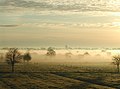 Photo credit: Matthias SüßenMorning fog on the plains of East Frisia, a coastal region in the northwest of the German federal state of Lower Saxony. It connects Western Frisia (in the Netherlands) with the district of Nordfriesland ("Northern Frisia") in Schleswig-Holstein, all of which belong to the historic and geographic Frisia.
 -
 Photo credit: Daniel SchwenThe interior of the Neue Wache, the central memorial of Germany for victims of war and tyranny. Located in Berlin, the building was originally built as a guardhouse, and has been used as a war memorial since 1931. The statue, Mother with her Dead Son is directly under the oculus, and so is exposed to the rain, snow and cold, symbolising the suffering of civilians during World War II.
 -
 Photograph credit: Lt. Moore; restored by Adam CuerdenThe German Instrument of Surrender was the legal document that effected the termination of the Nazi regime and ended World War II in Europe. A July 1944 draft version had also included the surrender of the German government, but this was changed due to concern that there might be no functional German government that could surrender; instead, the document stated that it could be "superseded by any general instrument of surrender imposed by, or on behalf of the United Nations", which was done the next month.
This photograph shows Field Marshal Wilhelm Keitel signing the German Instrument of Surrender in Berlin. The first surrender document was signed on 7 May 1945 in Reims by General Alfred Jodl, but this version was not recognized by the Soviet High Command and a revised version was required. Prepared in three languages on 8 May, it was not ready for signing in Berlin until after midnight; consequently, the physical signing was delayed until nearly 1:00 a.m. on 9 May, and backdated to 8 May to be consistent with the Reims agreement and public announcements of the surrender already made by Western leaders.
.jpg)


.jpg)
.jpg)


.jpg)


.jpg)


.jpg)


Related portals
- Parent portals
.svg)

- Regional


- History
 Holy Roman Empire (900–1806)
 East Germany (1949–1990)


- Neighbouring countries


Anniversaries for June 6

- 1436 – Birth of mathematician Regiomontanus
- 1843 – Death of poet Friedrich Hölderlin
- 1850 – Birth of physicist Karl Ferdinand Braun, winner of the 1909 Nobel Prize in Physics
- 1944 – D-Day: The Battle of Normandy begins
- 1946 – Death of dramatist Gerhart Hauptmann, winner of the 1912 Nobel Prize in Literature
Did you know...

- ... that Beethoven's "Tremate, empi, tremate" was not performed for ten years after it was written?
- ... that the 1935 Free City of Danzig parliamentary election was seen as a setback for the Nazi Party, even though it won an absolute majority of seats?
- ... that every year in July, a whole German town is taken over by the Rudolstadt Festival and swept up in "folk fever"?
- ... that the pianist Alide Topp (pictured) once responded to claims that women lacked the "biceps of a man" for great music by stating she broke her pianos as well as any man?
- ... that Bernhard Waldenfels discussed "black holes of everyday life" in a book subtitled Challenges of Phenomenology?
- ... that Agostino Steffani missed the 1709 premiere of his opera Amor vien dal destino because he was in Rome mediating between the pope and the emperor?
- ... that Ruth Wagner, the minister of culture in Hesse from 1999 to 2003, was nicknamed Mother Courage of Hesse?
- ... that mathematician Grete Hermann wrote political philosophy articles for Der Funke and Sozialistische Warte under various pseudonyms during the German resistance to Nazism?
Selected cuisines, dishes and foods

Topics
Categories

Things you can do

A list of articles needing cleanup associated with this project is available. See also the tool's wiki page and the index of WikiProjects.
Here are some tasks you can do. Please remove completed tasks from the list.
- Requests: German Archaeological Institute at Rome, Deutsche Familienversicherung, Hermann Bachmann (Journalist), Dietlof von Arnim-Boitzenburg, Rolf von Bargen, Hennes Bender, Eduard Georg von Bethusy-Huc, Rolf Brandt (1886–1953), Jan Philipp Burgard, Rudolf Epp, Lisa Feller, Georg Gafron, Ferdinand Heribert von Galen, Gundula Gause, Wolfgang von Geldern, Karl-Heinz Hagen, Herbert Helmrich, Nils von der Heyde, Monty Jacobs (1875–1945), Siegfried Kauder, Klimbim Matze Knop, Wolfgang Kryszohn, Claus Larass, Isidor Levy (1852–1929), Richard Lewinsohn (1894-1968), Markus Löning, Tobias Mann, Julius Meyer (Kunsthistoriker), Mathias Müller von Blumencron ,Günther Nonnenmacher, Nord bei Nordwest, Günter von Nordenskjöld, Anke Plättner, Hans Heinrich X. Fürst von Pless, Günter Prinz, Ulrich Reitz, Hans Sauer (inventor), Franz August Schenk von Stauffenberg, Paul Schlesinger (1878-1928), Hajo Schumacher, Der Seewolf (1971), Otto Theodor von Seydewitz, Christoph Sieber (comedian), Dorothea Siems, Werner Sonne, Udo zu Stolberg-Wernigerode, Christoph Strässer, Karl Trimborn, Joseph von Utzschneider, Hedda von Wedel, Jürgen Wieshoff, Hans Wilhelmi, Dietmar Wischmeyer, Doris Wittner (1880-1937), Alexandra Würzbach
- Unreferenced: especially Unreferenced BLPs
- Cleanup: 53541 issues in total as of 2024-03-03
- Translate: Articles needing translation from German Wikipedia
- Stubs: the largest stub category is Category:German history stubs; see also 108 articles in Category:German MEP stubs
- Update: Deutsches Wörterbuch
- Portal maintenance: Update News, Did you know, announcements and the todo list
- Orphans:
Orphaned articles in Germany

- Photo: Take/Add requested photographs
- Help assess the quality of 852 unassessed articles

Associated Wikimedia
The following Wikimedia Foundation sister projects provide more on this subject:
-
 Commons
Free media repository -
 Wikidata
Free knowledge base -
 Wikiquote
Collection of quotations -
 Wikisource
Free-content library -
 Wikiversity
Free learning tools -
 Wikivoyage
Free travel guide -
 Wiktionary
Dictionary and thesaurus


Content Disclaimer
Informasi ini disarikan dari Wikipedia dan disajikan kembali untuk tujuan edukasi. Konten tersedia di bawah lisensi CC BY-SA 3.0. Kami tidak bertanggung jawab atas ketidakakuratan data yang bersumber dari kontribusi publik tersebut.
- The information displayed on this website is sourced in part or in whole from Wikipedia and has been adapted for the purpose of restating it. We strive to provide accurate and relevant information, however:
- There is no guarantee of absolute accuracy. Wikipedia is an open, collaborative project that can be edited by anyone, so information is subject to change.
- It is not intended to constitute professional advice. The content displayed is for informational and educational purposes only. For important decisions (e.g., medical, legal, or financial), please consult a professional.
- Content copyright. Wikipedia is licensed under the Creative Commons Attribution-ShareAlike License (CC BY-SA). This means that content may be reused with appropriate attribution and shared under a similar license.
- Responsible use. Any risk arising from the use of information from this website is entirely the responsibility of the user.