Popov criterion
In nonlinear control and stability theory, the Popov criterion is a stability criterion discovered by Vasile M. Popov for the absolute stability of a class of nonlinear systems whose nonlinearity must satisfy an open-sector condition. While the circle criterion can be applied to nonlinear time-varying systems, the Popov criterion is applicable only to autonomous (that is, time invariant) systems.
System description
The sub-class of Lur'e systems studied by Popov is described by:
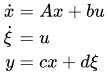

where x ∈ Rn, ξ,u,y are scalars, and A,b,c and d have commensurate dimensions. The nonlinear element Φ: R → R is a time-invariant nonlinearity belonging to open sector (0, ∞), that is, Φ(0) = 0 and yΦ(y) > 0 for all y not equal to 0.
Note that the system studied by Popov has a pole at the origin and there is no direct pass-through from input to output, and the transfer function from u to y is given by
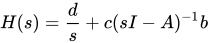
Criterion
Consider the system described above and suppose
- A is Hurwitz
- (A,b) is controllable
- (A,c) is observable
- d > 0 and
- Φ ∈ (0,∞)
then the system is globally asymptotically stable if there exists a number r > 0 such that
![{\textstyle \inf _{\omega \,\in \,\mathbb {R} }\operatorname {Re} \left[(1+j\omega r)H(j\omega )\right]>0.}](https://wikimedia.org/api/rest_v1/media/math/render/svg/ab1eb7ed556a1b0a9387a95beed809db1cb5a18a)
See also
References
- Haddad, Wassim M.; Chellaboina, VijaySekhar (2011). Nonlinear Dynamical Systems and Control: a Lyapunov-Based Approach. Princeton University Press. ISBN 9781400841042.
Content Disclaimer
Informasi ini disarikan dari Wikipedia dan disajikan kembali untuk tujuan edukasi. Konten tersedia di bawah lisensi CC BY-SA 3.0. Kami tidak bertanggung jawab atas ketidakakuratan data yang bersumber dari kontribusi publik tersebut.
- The information displayed on this website is sourced in part or in whole from Wikipedia and has been adapted for the purpose of restating it. We strive to provide accurate and relevant information, however:
- There is no guarantee of absolute accuracy. Wikipedia is an open, collaborative project that can be edited by anyone, so information is subject to change.
- It is not intended to constitute professional advice. The content displayed is for informational and educational purposes only. For important decisions (e.g., medical, legal, or financial), please consult a professional.
- Content copyright. Wikipedia is licensed under the Creative Commons Attribution-ShareAlike License (CC BY-SA). This means that content may be reused with appropriate attribution and shared under a similar license.
- Responsible use. Any risk arising from the use of information from this website is entirely the responsibility of the user.