Point-to-point Lee model
 | This article needs additional citations for verification. (November 2010) |
The Lee model for point-to-point mode is a radio propagation model that operates around 900 MHz. Built as two different modes, this model includes an adjustment factor that can be adjusted to make the model more flexible to different regions of propagation.[1] It is named after William C. Y. Lee.[2]
Applicable to/under conditions
This model is suitable for using in data collected in a specific area for point-to-point links.
Coverage
Frequency: 900 MHz band
Mathematical formulation
The model
The Lee model for point to point mode is formally expressed as:

where,
L = The median path loss. Unit: decibel (dB).
L0 = The reference path loss along 1 km. Unit: decibel (dB).
= The slope of the path loss curve. Unit: decibels per decade.

d = The distance on which the path loss is to be calculated. Unit: kilometer (km).
FA = Adjustment factor
HET = Effective height of terrain. Unit: meter (m).
Calculation of reference path loss
The reference path loss is usually computed along a 1 km or 1 mi link. Any other suitable length of path can be chosen based on the applications.

where,
GB = Base station antenna gain. Unit: decibel with respect to isotropic antenna (dBi).
= Wavelength. Unit: meter (m).

GM = Mobile station antenna gain. Unit: decibel with respect to isotropic antenna (dBi).
Calculation of adjustment factors
The adjustment factor is calculated as:

where,
FBH = Base station antenna height correction factor
FBG = Base station antenna gain correction factor
FMH = Mobile station antenna height correction factor
FMG = Mobile station antenna gain correction factor
FF = Frequency correction factor
The base station antenna height correction factor
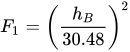
where,
hB = Base station antenna height. Unit: meter.
The base station antenna gain correction factor

where,
GB = Base station antenna gain. Unit: decibel with respect to half-wave dipole (dBd).
The mobile station antenna height correction factor
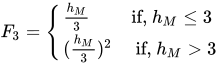
where,
hM = Mobile station antenna height. Unit: meter.
The mobile antenna gain correction factor

where,
GM = Mobile station antenna gain. Unit: decibel with respect to half wave dipole antenna (dBd).
The frequency correction factor
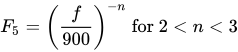
where,
f = Frequency. Unit: megahertz (MHz).
Effective terrain slope calculation
This is computed in the following way:
- Extrapolate terrain slope at the mobile station to the base station.
- Compute the vertical antenna height over the extrapolation line.
See also
References
- ^ "Evaluation of a terrain‐based point‐to‐point propagation model in the 900 MHz band (PDF Download Available)". ResearchGate. Retrieved 2017-05-22.
- ^ "William C.Y. Lee | IEEE Vehicular Technology Society". vtsociety.org. Retrieved 2025-03-28.
Content Disclaimer
Informasi ini disarikan dari Wikipedia dan disajikan kembali untuk tujuan edukasi. Konten tersedia di bawah lisensi CC BY-SA 3.0. Kami tidak bertanggung jawab atas ketidakakuratan data yang bersumber dari kontribusi publik tersebut.
- The information displayed on this website is sourced in part or in whole from Wikipedia and has been adapted for the purpose of restating it. We strive to provide accurate and relevant information, however:
- There is no guarantee of absolute accuracy. Wikipedia is an open, collaborative project that can be edited by anyone, so information is subject to change.
- It is not intended to constitute professional advice. The content displayed is for informational and educational purposes only. For important decisions (e.g., medical, legal, or financial), please consult a professional.
- Content copyright. Wikipedia is licensed under the Creative Commons Attribution-ShareAlike License (CC BY-SA). This means that content may be reused with appropriate attribution and shared under a similar license.
- Responsible use. Any risk arising from the use of information from this website is entirely the responsibility of the user.