Picture language
In formal language theory, a picture language is a set of pictures, where a picture is a 2D array of characters over some alphabet.
For example, the language defines the language of rectangles composed of the character . This language contains pictures such as:



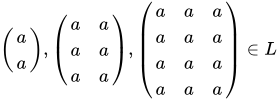
The study of picture languages was initially motivated by the problems of pattern recognition and image processing, but two-dimensional patterns also appear in the study of cellular automata and other parallel computing models. Some formal systems have been created to define picture languages, such as array grammars and tiling systems.
References
- D. Giammaresi, A. Restivo. Two-dimensional languages. In A. Salomaa, G. Rozenberg (Eds.), Handbook of Formal Languages, Vol. 3, Beyond Words, Springer, Berlin, 1997, pp. 215–267.
 | This formal methods-related article is a stub. You can help Wikipedia by adding missing information. |
Content Disclaimer
Informasi ini disarikan dari Wikipedia dan disajikan kembali untuk tujuan edukasi. Konten tersedia di bawah lisensi CC BY-SA 3.0. Kami tidak bertanggung jawab atas ketidakakuratan data yang bersumber dari kontribusi publik tersebut.
- The information displayed on this website is sourced in part or in whole from Wikipedia and has been adapted for the purpose of restating it. We strive to provide accurate and relevant information, however:
- There is no guarantee of absolute accuracy. Wikipedia is an open, collaborative project that can be edited by anyone, so information is subject to change.
- It is not intended to constitute professional advice. The content displayed is for informational and educational purposes only. For important decisions (e.g., medical, legal, or financial), please consult a professional.
- Content copyright. Wikipedia is licensed under the Creative Commons Attribution-ShareAlike License (CC BY-SA). This means that content may be reused with appropriate attribution and shared under a similar license.
- Responsible use. Any risk arising from the use of information from this website is entirely the responsibility of the user.