Perko pair
| Perko pair | |
|---|---|
| Arf invariant | 1 |
| Braid length | 10 |
| Braid no. | 3 |
| Bridge no. | 3 |
| Crosscap no. | 2 |
| Crossing no. | 10 |
| Genus | 3 |
| Hyperbolic volume | 5.63877 |
| Unknotting no. | 3 |
| Conway notation | [3:-20:-20] |
| A–B notation | 10161/10162 |
| Dowker notation | 4, 12, -16, 14, -18, 2, 8, -20, -10, -6 |
| Last / Next | 10160 / 10162 |
| Other | |
| hyperbolic, fibered, prime, reversible | |
In the mathematical theory of knots, the Perko pair, named after Kenneth Perko, is a pair of entries in classical knot tables that actually represent the same knot. In Dale Rolfsen's knot table, this supposed pair of distinct knots is labeled 10161 and 10162. In 1973, while working to complete the classification by knot type of the Tait–Little knot tables of knots up to 10 crossings (dating from the late 19th century),[1] Perko found the duplication in Charles Newton Little's table.[2] This duplication had been missed by John Horton Conway several years before in his knot table and subsequently found its way into Rolfsen's table.[3] The Perko pair gives a counterexample to a "theorem" claimed by Little in 1900 that the writhe of a reduced diagram of a knot is an invariant (see Tait conjectures), as the two diagrams for the pair have different writhes.
In some later knot tables, the knots have been renumbered slightly (knots 10163 to 10166 are renumbered as 10162 to 10165) so that knots 10161 and 10162 are different. Some authors have mistaken these two renumbered knots for the Perko pair and claimed incorrectly that they are the same.[4]
- The Perko pair
-
 10161
10161 -
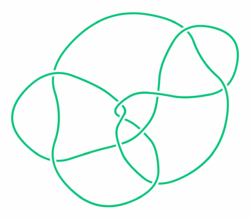 10162 (in Rolfsen's original numbering)


The Perko pair was correctly illustrated and explained on the first page of the Science section of the July 8, 1986 New York Times.
The Perko pair is one of five knots with 10 crossings where the topological and smooth 4-genus are different; the former is equal to 2, while the latter is 3.[5]
References
- ^ Charles Newton Little, Non-alternating +/- knots, Trans. Roy. Soc. Edinburgh 39 (1900), page 774.
- ^ Kenneth A. Perko Jr.(b.1943), On the classification of knots. Proc. Amer. Math. Soc. 45 (1974), 262—266.
- ^ Dale Rolfsen, Knots and Links (see Appendix C for the knot table), 1976, ISBN 0-914098-16-0.
- ^ "The Revenge of the Perko Pair", RichardElwes.co.uk. Accessed February 2016. Richard Elwes points out a common mistake in describing the Perko pair.
- ^ P. Feller, D. McCoy: On 2-bridge knots with differing smooth and topological slice genera, Proc. Amer. Math. Soc. 144, p. 5435–5442, 2016.
External links
- "10_161", The Knot Atlas.
- Pictures of the equivalence between the two knots, as given by Perko: "The Perko pair", WebArchive archive of page hosted by Brian Sanderson. Accessed April 2025.
- Pictures of a different equivalence between the two knots: "Perko pair knots", KnotPlot. Accessed February 2016.
| Hyperbolic |
|
|---|---|
| Satellite | |
| Torus | |
| Invariants | |
| Notation and operations | |
| Other | |


Content Disclaimer
Informasi ini disarikan dari Wikipedia dan disajikan kembali untuk tujuan edukasi. Konten tersedia di bawah lisensi CC BY-SA 3.0. Kami tidak bertanggung jawab atas ketidakakuratan data yang bersumber dari kontribusi publik tersebut.
- The information displayed on this website is sourced in part or in whole from Wikipedia and has been adapted for the purpose of restating it. We strive to provide accurate and relevant information, however:
- There is no guarantee of absolute accuracy. Wikipedia is an open, collaborative project that can be edited by anyone, so information is subject to change.
- It is not intended to constitute professional advice. The content displayed is for informational and educational purposes only. For important decisions (e.g., medical, legal, or financial), please consult a professional.
- Content copyright. Wikipedia is licensed under the Creative Commons Attribution-ShareAlike License (CC BY-SA). This means that content may be reused with appropriate attribution and shared under a similar license.
- Responsible use. Any risk arising from the use of information from this website is entirely the responsibility of the user.