Perfect map
In mathematics, especially topology, a perfect map is a particular kind of continuous function between topological spaces. Perfect maps are weaker than homeomorphisms, but strong enough to preserve some topological properties such as local compactness that are not always preserved by continuous maps.
Formal definition
Let and be topological spaces and let be a map from to that is continuous, closed, surjective and such that each fiber is compact relative to for each in . Then is known as a perfect map.


Examples and properties
- If is a perfect map and is compact, then is compact.
- If is a perfect map and is regular, then is regular. (If is merely continuous, then even if is regular, need not be regular. An example of this is if is a regular space and is an infinite set in the indiscrete topology.)
- If is a perfect map and if is locally compact, then is locally compact.
- If is a perfect map and if is second countable, then is second countable.
- Every injective perfect map is a homeomorphism. This follows from the fact that a bijective closed map has a continuous inverse.
- If is a perfect map and if is connected, then need not be connected. For example, the constant map from a compact disconnected space to a singleton space is a perfect map.
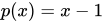
- A perfect map need not be open. Indeed, consider the map given by if and if . This map is closed, continuous (by the pasting lemma), and surjective and therefore is a perfect map (the other condition is trivially satisfied). However, p is not open, for the image of [1, 2] under p is [1, 2] which is not open relative to [1, 3] (the range of p). Note that this map is a quotient map and the quotient operation is 'gluing' two intervals together.
- Notice how, to preserve properties such as local connectedness, second countability, local compactness etc. ... the map must be not only continuous but also open. A perfect map need not be open (see previous example), but these properties are still preserved under perfect maps.
- Every homeomorphism is a perfect map. This follows from the fact that a bijective open map is closed and that since a homeomorphism is injective, the inverse of each element of the range must be finite in the domain (in fact, the inverse must have precisely one element).
- Every perfect map is a quotient map. This follows from the fact that a closed, continuous surjective map is always a quotient map.
- Let G be a compact topological group which acts continuously on X. Then the quotient map from X to X/G is a perfect map.
- Perfect maps are proper. Surjective proper maps are perfect, provided the topology of Y is Hausdorff and compactly generated.[1]

![{\displaystyle p\colon [1,2]\cup [3,4]\to [1,3]}](https://wikimedia.org/api/rest_v1/media/math/render/svg/cf25b053fbab362d2e7d744be832ba6ece1123a7)

![{\displaystyle x\in [1,2]}](https://wikimedia.org/api/rest_v1/media/math/render/svg/f0cdb5a9b7c5bc2f36344ca81390851217a147d3)
![{\displaystyle x\in {}[3,4]}](https://wikimedia.org/api/rest_v1/media/math/render/svg/b2967b8d605e43c17eb91e1bf2ac459a9f31b61f)
See also
- Open and closed maps – Functions that send open (resp. closed) subsets to open (resp. closed) subsets
- Quotient space – Topological space construction
- Proper map – Mathematical map between topological spaces
References
- ^ "ProperCoverings.pdf" (PDF).
- Munkres, James (1999). Topology (2nd ed.). Prentice Hall. ISBN 0-13-181629-2.
Content Disclaimer
Informasi ini disarikan dari Wikipedia dan disajikan kembali untuk tujuan edukasi. Konten tersedia di bawah lisensi CC BY-SA 3.0. Kami tidak bertanggung jawab atas ketidakakuratan data yang bersumber dari kontribusi publik tersebut.
- The information displayed on this website is sourced in part or in whole from Wikipedia and has been adapted for the purpose of restating it. We strive to provide accurate and relevant information, however:
- There is no guarantee of absolute accuracy. Wikipedia is an open, collaborative project that can be edited by anyone, so information is subject to change.
- It is not intended to constitute professional advice. The content displayed is for informational and educational purposes only. For important decisions (e.g., medical, legal, or financial), please consult a professional.
- Content copyright. Wikipedia is licensed under the Creative Commons Attribution-ShareAlike License (CC BY-SA). This means that content may be reused with appropriate attribution and shared under a similar license.
- Responsible use. Any risk arising from the use of information from this website is entirely the responsibility of the user.