Palmerella
| Palmerella | |
|---|---|

| |
| Palmerella debilis var. serrata Blue Canyon Trail Santa Ynez Mountains Santa Barbara County | |
Scientific classification 
| |
| Kingdom: | Plantae |
| Clade: | Embryophytes |
| Clade: | Tracheophytes |
| Clade: | Spermatophytes |
| Clade: | Angiosperms |
| Clade: | Eudicots |
| Clade: | Asterids |
| Order: | Asterales |
| Family: | Campanulaceae |
| Subfamily: | Lobelioideae |
| Genus: | Palmerella A.Gray |
| Species: | P. debilis
|
| Binomial name | |
| Palmerella debilis A.Gray
| |
| Synonyms[1] | |
| |
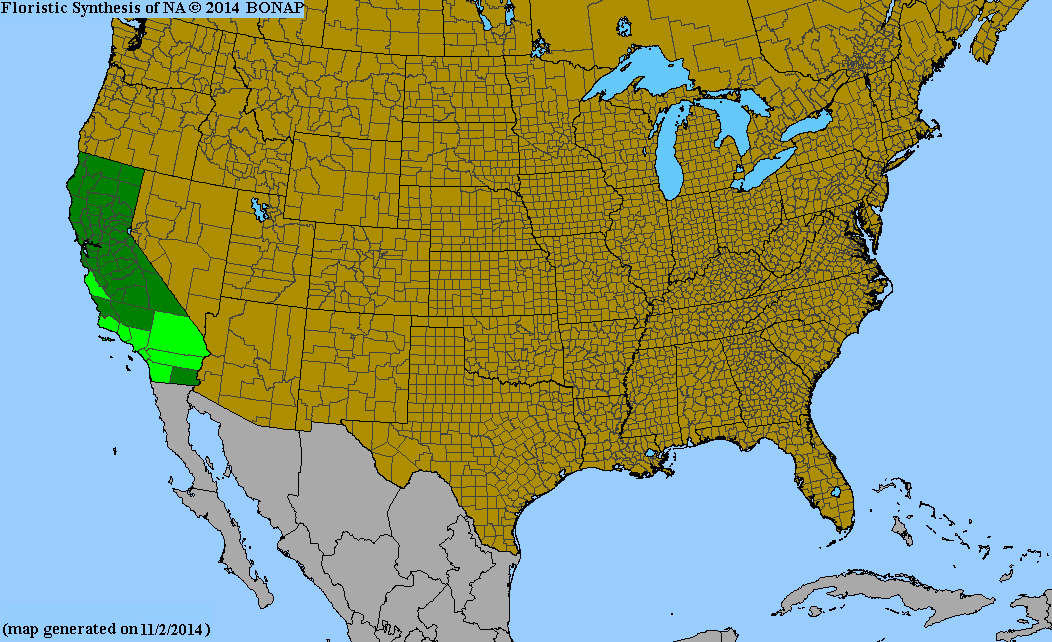
Palmerella is a genus of plants in the family Campanulaceae. It has only one known species, Palmerella debilis, long known by the synonym Lobelia dunnii. It is native to 8 counties in southern California (San Diego, Orange, Riverside, San Bernardino, Los Angeles, Ventura, Santa Barbara and Monterey) plus the northern part of Baja California.[1][2][3][4]
The oldest name for the plant is Palmerella debilis, coined by Asa Gray in 1876. Greene in 1889 wanted to move the species to the genus Lobelia, but could not use the name Lobelia debilis, because that name had already been used for a different plant by Linnaeus f. in 1782. Hence Greene created the replacement name Lobelia dunnii. More recent publications favor reverting to Gray's older name.[5]
Two subspecies are recognized:[1][5]
- Palmerella debilis subsp. debilis - Baja California
- Palmerella debilis subsp. serrata (A.Gray) Lammers - California and Baja California
References
- ^ a b c Kew World Checklist of Selected Plant Families
- ^ Biota of North America Program, 2013 county distribution map
- ^ Gray, Asa. 1876. Palmerella. Proceedings of the American Academy of Arts and Sciences 11: 80–81
- ^ Lammers, Thomas G. 2006. Novon 16(1): 72.
- ^ a b Lammers, T.G. (2007). World checklist and bibliography of Campanulaceae: 1-675. The Board of Trustees of the Royal Botanic Gardens, Kew.
External links
 Media related to Palmerella at Wikimedia Commons
 Data related to Palmerella at Wikispecies
- Calflora taxon report, Lobelia dunnii Greene
- Theodore Payne Foundation for Wild Flowers and Native Plants, California Native Plant Database, Lobelia dunnii var. serrata Archived 2014-07-14 at the Wayback Machine
- Calphotos, University of California at Berkeley, Photo Database, Lobelia dunnii var. serrata
- Mamba, University of California at Irvine, Campanulaceae of Orange County, California, Lobelia dunnii var. serrata


Content Disclaimer
Informasi ini disarikan dari Wikipedia dan disajikan kembali untuk tujuan edukasi. Konten tersedia di bawah lisensi CC BY-SA 3.0. Kami tidak bertanggung jawab atas ketidakakuratan data yang bersumber dari kontribusi publik tersebut.
- The information displayed on this website is sourced in part or in whole from Wikipedia and has been adapted for the purpose of restating it. We strive to provide accurate and relevant information, however:
- There is no guarantee of absolute accuracy. Wikipedia is an open, collaborative project that can be edited by anyone, so information is subject to change.
- It is not intended to constitute professional advice. The content displayed is for informational and educational purposes only. For important decisions (e.g., medical, legal, or financial), please consult a professional.
- Content copyright. Wikipedia is licensed under the Creative Commons Attribution-ShareAlike License (CC BY-SA). This means that content may be reused with appropriate attribution and shared under a similar license.
- Responsible use. Any risk arising from the use of information from this website is entirely the responsibility of the user.