Pairwise error probability
| Part of a series on statistics |
| Probability theory |
|---|
 |
Pairwise error probability is the error probability that for a transmitted signal () its corresponding but distorted version () will be received. This type of probability is called ″pair-wise error probability″ because the probability exists with a pair of signal vectors in a signal constellation.[1] It's mainly used in communication systems.[1]


Expansion of the definition
In general, the received signal is a distorted version of the transmitted signal. Thus, we introduce the symbol error probability, which is the probability that the demodulator will make a wrong estimation of the transmitted symbol based on the received symbol, which is defined as follows:


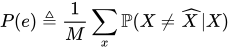
where M is the size of signal constellation.
The pairwise error probability is defined as the probability that, when is transmitted, is received.

- can be expressed as the probability that at least one is closer than to .


Using the upper bound to the probability of a union of events, it can be written:
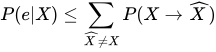
Finally:

Closed form computation
For the simple case of the additive white Gaussian noise (AWGN) channel:

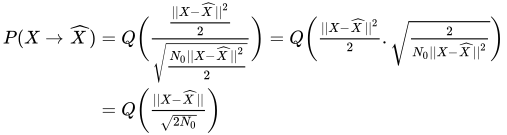
The PEP can be computed in closed form as follows:
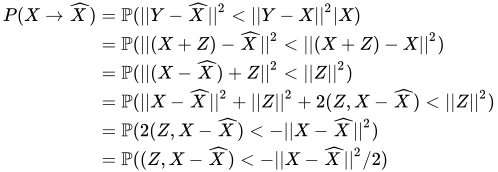
is a Gaussian random variable with mean 0 and variance .

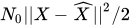
For a zero mean, variance Gaussian random variable:


Hence,
See also
References
- ^ a b Stüber, Gordon L. (8 September 2011). Principles of mobile communication (3rd ed.). New York: Springer. p. 281. ISBN 978-1461403647.
Further reading
- Simon, Marvin K.; Alouini, Mohamed-Slim (2005). Digital Communication over Fading Channels (2. ed.). Hoboken: John Wiley & Sons. ISBN 0471715239.
Content Disclaimer
Informasi ini disarikan dari Wikipedia dan disajikan kembali untuk tujuan edukasi. Konten tersedia di bawah lisensi CC BY-SA 3.0. Kami tidak bertanggung jawab atas ketidakakuratan data yang bersumber dari kontribusi publik tersebut.
- The information displayed on this website is sourced in part or in whole from Wikipedia and has been adapted for the purpose of restating it. We strive to provide accurate and relevant information, however:
- There is no guarantee of absolute accuracy. Wikipedia is an open, collaborative project that can be edited by anyone, so information is subject to change.
- It is not intended to constitute professional advice. The content displayed is for informational and educational purposes only. For important decisions (e.g., medical, legal, or financial), please consult a professional.
- Content copyright. Wikipedia is licensed under the Creative Commons Attribution-ShareAlike License (CC BY-SA). This means that content may be reused with appropriate attribution and shared under a similar license.
- Responsible use. Any risk arising from the use of information from this website is entirely the responsibility of the user.