PRESS statistic

In statistics, the predicted residual error sum of squares (PRESS) is a form of cross-validation used in regression analysis to provide a summary measure of the fit of a model to a sample of observations that were not themselves used to estimate the model. It is calculated as the sum of squares of the prediction residuals for those observations.[1][2][3] Specifically, the PRESS statistic is an exhaustive form of cross-validation, as it tests all the possible ways that the original data can be divided into a training and a validation set.
Procedure
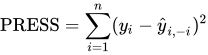
Instead of fitting only one model on all data, leave-one-out cross-validation is used to fit N models (on N observations) where for each model one data point is left out from the training set. The out-of-sample predicted value is calculated for the omitted observation in each case, and the PRESS statistic is calculated as the sum of the squares of all the resulting prediction errors:[4]
Usage
Given this procedure, the PRESS statistic can be calculated for a number of candidate model structures for the same dataset, with the lowest values of PRESS indicating the best structures. Models that are over-parameterised (over-fitted) would tend to give small residuals for observations included in the model-fitting but large residuals for observations that are excluded. The PRESS statistic has been extensively used in lazy learning and locally linear learning to speed-up the assessment and the selection of the neighbourhood size.[5][6]
See also
References
- ^ "Statsoft Electronic Statistics Textbook - Statistics Glossary". Archived from the original on May 10, 2016. Retrieved May 13, 2016.
- ^ Allen, D. M. (1974), "The Relationship Between Variable Selection and Data Augmentation and a Method for Prediction," Technometrics, 16, 125–127
- ^ Tarpey, Thaddeus (2000) "A Note on the Prediction Sum of Squares Statistic for Restricted Least Squares", The American Statistician, Vol. 54, No. 2, May, pp. 116–118
- ^ "R Graphical Manual:Allen's PRESS (Prediction Sum-Of-Squares) statistic, aka P-square". Archived from the original on February 27, 2018. Retrieved February 27, 2018.
- ^ Atkeson, Christopher G.; Moore, Andrew W.; Schaal, Stefan (1 February 1997). "Locally Weighted Learning". Artificial Intelligence Review. 11 (1): 11–73. doi:10.1023/A:1006559212014. ISSN 1573-7462. S2CID 9219592. Archived from the original on 6 May 2021. Retrieved 25 September 2020.
- ^ Bontempi, Gianluca; Birattari, Mauro; Bersini, Hugues (1 January 1999). "Lazy learning for local modelling and control design". International Journal of Control. 72 (7–8): 643–658. doi:10.1080/002071799220830.
 | This statistics-related article is a stub. You can help Wikipedia by adding missing information. |
Content Disclaimer
Informasi ini disarikan dari Wikipedia dan disajikan kembali untuk tujuan edukasi. Konten tersedia di bawah lisensi CC BY-SA 3.0. Kami tidak bertanggung jawab atas ketidakakuratan data yang bersumber dari kontribusi publik tersebut.
- The information displayed on this website is sourced in part or in whole from Wikipedia and has been adapted for the purpose of restating it. We strive to provide accurate and relevant information, however:
- There is no guarantee of absolute accuracy. Wikipedia is an open, collaborative project that can be edited by anyone, so information is subject to change.
- It is not intended to constitute professional advice. The content displayed is for informational and educational purposes only. For important decisions (e.g., medical, legal, or financial), please consult a professional.
- Content copyright. Wikipedia is licensed under the Creative Commons Attribution-ShareAlike License (CC BY-SA). This means that content may be reused with appropriate attribution and shared under a similar license.
- Responsible use. Any risk arising from the use of information from this website is entirely the responsibility of the user.