Owen's T function
In mathematics, Owen's T function T(h, a), named after statistician Donald Bruce Owen, is defined by

The function was first introduced by Owen in 1956.[1]
Applications
The function T(h, a) gives the probability of the event (X > h and 0 < Y < aX) where X and Y are independent standard normal random variables.
This function can be used to calculate bivariate normal distribution probabilities[2][3] and, from there, in the calculation of multivariate normal distribution probabilities.[4] It also frequently appears in various integrals involving Gaussian functions.
Computer algorithms for the accurate calculation of this function are available;[5] quadrature having been employed since the 1970s. [6]
Properties

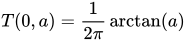





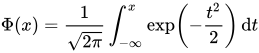
Here Φ(x) is the standard normal cumulative distribution function
More properties can be found in the literature.[7]
References
- ^ Owen, D B (1956). "Tables for computing bivariate normal probabilities". Annals of Mathematical Statistics, 27, 1075–1090.
- ^ Sowden, R R and Ashford, J R (1969). "Computation of the bivariate normal integral". Applied Statististics, 18, 169–180.
- ^ Donelly, T G (1973). "Algorithm 462. Bivariate normal distribution". Commun. Ass. Comput.Mach., 16, 638.
- ^ Schervish, M H (1984). "Multivariate normal probabilities with error bound". Applied Statistics, 33, 81–94.
- ^ Patefield, M. and Tandy, D. (2000) "Fast and accurate Calculation of Owen’s T-Function", Journal of Statistical Software, 5 (5), 1–25.
- ^ JC Young and Christoph Minder. Algorithm AS 76
- ^ Owen, D. (1980). "A table of normal integrals". Communications in Statistics: Simulation and Computation. B9 (4): 389–419. doi:10.1080/03610918008812164.
Software
- Owen's T function (user web site) - offers C++, FORTRAN77, FORTRAN90, and MATLAB libraries released under the LGPL license LGPL
- Owen's T-function is implemented in Mathematica since version 8, as OwenT.
- Owen's T-function is also available as a function in R (https://search.r-project.org/CRAN/refmans/sn/html/T.Owen.html).
External links
- Why You Should Care about the Obscure (Wolfram blog post)
 | This statistics-related article is a stub. You can help Wikipedia by adding missing information. |
Content Disclaimer
Informasi ini disarikan dari Wikipedia dan disajikan kembali untuk tujuan edukasi. Konten tersedia di bawah lisensi CC BY-SA 3.0. Kami tidak bertanggung jawab atas ketidakakuratan data yang bersumber dari kontribusi publik tersebut.
- The information displayed on this website is sourced in part or in whole from Wikipedia and has been adapted for the purpose of restating it. We strive to provide accurate and relevant information, however:
- There is no guarantee of absolute accuracy. Wikipedia is an open, collaborative project that can be edited by anyone, so information is subject to change.
- It is not intended to constitute professional advice. The content displayed is for informational and educational purposes only. For important decisions (e.g., medical, legal, or financial), please consult a professional.
- Content copyright. Wikipedia is licensed under the Creative Commons Attribution-ShareAlike License (CC BY-SA). This means that content may be reused with appropriate attribution and shared under a similar license.
- Responsible use. Any risk arising from the use of information from this website is entirely the responsibility of the user.