Ovality
In telecommunications and fiber optics, ovality or noncircularity is the degree of deviation from perfect circularity of the cross section of the core or cladding of the fiber.
The cross-sections of the core and cladding are assumed to a first approximation to be elliptical, and ovality is defined to be twice the third flattening of the ellipse, , where a is the length of the major axis and b is the length of the minor axis. This dimensionless quantity is between 0 and 1, and may be multiplied by 100 to express ovality as a percentage. Alternatively, ovality of the core or cladding may be specified by a tolerance field consisting of two concentric circles, within which the cross section boundaries must lie.

In measurements, ovality is the amount of out-of-roundness of a hole or cylindrical part in the typical form of an oval.
In chemistry
In computational chemistry, especially in QSAR[1] studies, ovality[2] refers to, a measure of how the shape of a molecule approaches a sphere (at one extreme) or a cigar shape (at the other). Ovality is described by a ratio of volume to area:
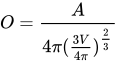
where:
- O = Ovality
- A = Area
- V = Volume
The ovality of the He atom is 1.0 and that of HC24H (12 triple bonds) is ~1.7.
See also
References
- ^ Leach, Andrew R. (2001). Molecular modelling: principles and applications. Englewood Cliffs, N.J: Prentice Hall. ISBN 0-582-38210-6.
- ^ Hehre, Warren J.; William Sean Ohlinger (2008). Spartan'10 Tutorial and User's Guide. Irvine, CA: Wavefunction, Inc. ISBN 1-890661-41-4.
Content Disclaimer
Informasi ini disarikan dari Wikipedia dan disajikan kembali untuk tujuan edukasi. Konten tersedia di bawah lisensi CC BY-SA 3.0. Kami tidak bertanggung jawab atas ketidakakuratan data yang bersumber dari kontribusi publik tersebut.
- The information displayed on this website is sourced in part or in whole from Wikipedia and has been adapted for the purpose of restating it. We strive to provide accurate and relevant information, however:
- There is no guarantee of absolute accuracy. Wikipedia is an open, collaborative project that can be edited by anyone, so information is subject to change.
- It is not intended to constitute professional advice. The content displayed is for informational and educational purposes only. For important decisions (e.g., medical, legal, or financial), please consult a professional.
- Content copyright. Wikipedia is licensed under the Creative Commons Attribution-ShareAlike License (CC BY-SA). This means that content may be reused with appropriate attribution and shared under a similar license.
- Responsible use. Any risk arising from the use of information from this website is entirely the responsibility of the user.