Optimal apportionment
Optimal apportionment is an approach to apportionment that is based on mathematical optimization.
In a problem of apportionment, there is a resource to allocate, denoted by . For example, it can be an integer representing the number of seats in a house of representatives. The resource should be allocated between some agents. For example, these can be federal states or political parties. The agents have different entitlements, denoted by a vector of fractions with a sum of 1. For example, ti can be the fraction of votes won by party i. The goal is to find an allocation - a vector with .


The ideal share for agent i is his/her quota, defined as . If it is possible to give each agent his/her quota, then the allocation is maximally fair. However, exact fairness is usually unattainable, since the quotas are not integers and the allocations must be integers. There are various approaches to cope with this difficulty (see mathematics of apportionment). The optimization-based approach aims to attain, for eacn instance, an allocation that is "as fair as possible" for this instance. An allocation is "fair" if for all agents i, that is, each agent's allocation is exactly proportional to his/her entitlement. in this case, we say that the "unfairness" of the allocation is 0. If this equality must be violated, one can define a measure of "total unfairness", and try to minimize it.


Minimizing the sum of unfairness levels
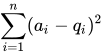
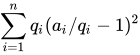
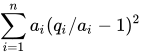
The most natural measure is the sum of unfairness levels for individual agents, as in the utilitarian rule:[1]: 102–104
- One can minimize the sum of differences , or the sum of squares , which weight every state (or party) equally. Both minimization problems are solved by Hamilton's method.
- One can weight the elements in the sum by the population, or equivalently by the quota, and try to minimize the chi-squared statistic . This leads to Webster's method.
- One can weight the elements in the sum by the allocations, and try to minimize . This leads to Hill's method.

Minimizing the largest unfairneses
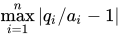
One can minimize the largest unfairness, as in the egalitarian rule:
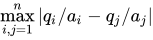
- One can minimize , and proceed to minimize the next-largest unfairness etc., using the leximin order. This yields a method called the leximin apportionment method. It was first developed by Biro, Koczy and Sziklai, who presented an efficient algorithm to compute it.[2] Its main goal is to satisfy the requirement of the Venice Commission that the maximum departure from equal distribution of items among agents should be as small as possible. Its disadvantage is that it violates the quota rule and all monotonicity criteria.[3]
- Burt and Harris (1963) suggested to minimize .[4]
- Minimizing leads to Adams's method.
- Minimizing leads to Jefferson's method.
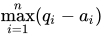
- It is also possible to maximize , or equivalently, minimize . This method satisfies both quotas.
- The minimax method can be generalized to any chosen priority ordering on the fairness criteria.[5]


References
- ^ Balinski, Michel L.; Young, H. Peyton (1982). Fair Representation: Meeting the Ideal of One Man, One Vote. New Haven: Yale University Press. ISBN 0-300-02724-9.
- ^ Biró, Péter; Kóczy, László Á.; Sziklai, Balázs (2015-09-01). "Fair apportionment in the view of the Venice Commission's recommendation". Mathematical Social Sciences. 77: 32–41. doi:10.1016/j.mathsocsci.2015.06.001. hdl:10419/108309. ISSN 0165-4896.
- ^ Koczy, Laszlo A.; Biro, Peter; Sziklai, Balazs (2017-06-01). "US vs. European Apportionment Practices: The Conflict between Monotonicity and Proportionality". Cers-Ie Working Papers.
- ^ Burt, Oscar R.; Harris, Curtis C. (August 1963). "Apportionment of the U.S. House of Representatives: A Minimum Range, Integer Solution, Allocation Problem". Letters to the editor. Operations Research. 11 (4). Institute for Operations Research and the Management Sciences (INFORMS): 648–652. doi:10.1287/opre.11.4.648.
- ^ Gambarelli, Gianfranco (1999-11-01). "Minimax Apportionments". Group Decision and Negotiation. 8 (6): 441–461. doi:10.1023/A:1008675107505. ISSN 1572-9907. S2CID 195220285.
Content Disclaimer
Informasi ini disarikan dari Wikipedia dan disajikan kembali untuk tujuan edukasi. Konten tersedia di bawah lisensi CC BY-SA 3.0. Kami tidak bertanggung jawab atas ketidakakuratan data yang bersumber dari kontribusi publik tersebut.
- The information displayed on this website is sourced in part or in whole from Wikipedia and has been adapted for the purpose of restating it. We strive to provide accurate and relevant information, however:
- There is no guarantee of absolute accuracy. Wikipedia is an open, collaborative project that can be edited by anyone, so information is subject to change.
- It is not intended to constitute professional advice. The content displayed is for informational and educational purposes only. For important decisions (e.g., medical, legal, or financial), please consult a professional.
- Content copyright. Wikipedia is licensed under the Creative Commons Attribution-ShareAlike License (CC BY-SA). This means that content may be reused with appropriate attribution and shared under a similar license.
- Responsible use. Any risk arising from the use of information from this website is entirely the responsibility of the user.