Opial property
In mathematics, the Opial property is an abstract property of Banach spaces that plays an important role in the study of weak convergence of iterates of mappings of Banach spaces, and of the asymptotic behavior of nonlinear semigroups. The property is named after the Polish mathematician Zdzisław Opial.
Definitions
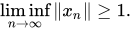
Let (X, || ||) be a Banach space. X is said to have the Opial property if, whenever (xn)n∈N is a sequence in X converging weakly to some x0 ∈ X and x ≠ x0, it follows that

Alternatively, using the contrapositive, this condition may be written as

If X is the continuous dual space of some other Banach space Y, then X is said to have the weak-∗ Opial property if, whenever (xn)n∈N is a sequence in X converging weakly-∗ to some x0 ∈ X and x ≠ x0, it follows that

or, as above,
A (dual) Banach space X is said to have the uniform (weak-∗) Opial property if, for every c > 0, there exists an r > 0 such that

for every x ∈ X with ||x|| ≥ c and every sequence (xn)n∈N in X converging weakly (weakly-∗) to 0 and with
Examples
- Opial's theorem (1967): Every Hilbert space has the Opial property.
- Sequence spaces , , have the Opial property.
- Van Dulst theorem (1982): for every separable Banach space there is an equivalent norm that endows it with the Opial property.
- For uniformly convex Banach spaces, Opial property holds if and only if Delta-convergence coincides with weak convergence.


References
- Opial, Zdzisław (1967). "Weak convergence of the sequence of successive approximations for nonexpansive mappings" (PDF). Bull. Amer. Math. Soc. 73 (4): 591–597. doi:10.1090/S0002-9904-1967-11761-0.
| Spaces |
| ||||
|---|---|---|---|---|---|
| Theorems | |||||
| Operators | |||||
| Algebras | |||||
| Open problems | |||||
| Applications | |||||
| Advanced topics | |||||

Content Disclaimer
Informasi ini disarikan dari Wikipedia dan disajikan kembali untuk tujuan edukasi. Konten tersedia di bawah lisensi CC BY-SA 3.0. Kami tidak bertanggung jawab atas ketidakakuratan data yang bersumber dari kontribusi publik tersebut.
- The information displayed on this website is sourced in part or in whole from Wikipedia and has been adapted for the purpose of restating it. We strive to provide accurate and relevant information, however:
- There is no guarantee of absolute accuracy. Wikipedia is an open, collaborative project that can be edited by anyone, so information is subject to change.
- It is not intended to constitute professional advice. The content displayed is for informational and educational purposes only. For important decisions (e.g., medical, legal, or financial), please consult a professional.
- Content copyright. Wikipedia is licensed under the Creative Commons Attribution-ShareAlike License (CC BY-SA). This means that content may be reused with appropriate attribution and shared under a similar license.
- Responsible use. Any risk arising from the use of information from this website is entirely the responsibility of the user.