Operative temperature
Operative temperature () is defined as a uniform temperature of an imaginary black enclosure in which an occupant would exchange the same amount of heat by radiation plus convection as in the actual nonuniform environment.[1][2][3][4] Some references also use the terms 'equivalent temperature" or 'effective temperature' to describe combined effects of convective and radiant heat transfer.[5] In design, operative temperature can be defined as the average of the mean radiant and ambient air temperatures, weighted by their respective heat transfer coefficients.[6] The instrument used for assessing environmental thermal comfort in terms of operative temperature is called a eupatheoscope and was invented by A. F. Dufton in 1929.[7] Mathematically, operative temperature can be shown as;

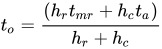
where,
- = convective heat transfer coefficient
- = linear radiative heat transfer coefficient
- = air temperature
- = mean radiant temperature


Or
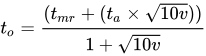
where,
- = air velocity
- and have the same meaning as above.

It is also acceptable to approximate this relationship for occupants engaged in near sedentary physical activity (with metabolic rates between 1.0 met and 1.3 met), not in direct sunlight, and not exposed to air velocities greater than 0.10 m/s (20 fpm). [9]
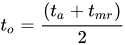
where and have the same meaning as above.
Application
Operative temperature is used in heat transfer and thermal comfort analysis in transportation and buildings.[10] Most psychrometric charts used in HVAC design only show the dry bulb temperature on the x-axis(abscissa), however, it is the operative temperature which is specified on the x-axis of the psychrometric chart illustrated in ANSI/ASHRAE Standard 55 – Thermal Environmental Conditions for Human occupancy.
See also
References
- ^ International Standard Organization (1998). "ISO 7726:1998 Ergonomics of the thermal environment -- Instruments for measuring physical quantities".
{{cite journal}}: Cite journal requires|journal=(help) - ^ International Standard Organization (2005). "ISO 7730:2005 Ergonomics of the thermal environment -- Analytical determination and interpretation of thermal comfort using calculation of the PMV and PPD indices and local thermal comfort criteria".
{{cite journal}}: Cite journal requires|journal=(help) - ^ ASHRAE Standard 55 (2013). "Thermal Environmental Conditions for Human Occupancy".
{{cite journal}}: Cite journal requires|journal=(help)CS1 maint: numeric names: authors list (link) - ^ ASHRAE Terminology, ASHRAE Handbook CD, 1999-2002
- ^ Nilsson, H.O., Comfort Climate Evaluation with Thermal Manikin Methods and Computer Simulation Models, National Institute for Working Life, 2004, pg. 37
- ^ Thermal Comfort, ASHRAE Handbook, Fundamentals, Ch. 9, pg.3, 2009
- ^ Glossary of Meteorology, American Meteorological Society, < "AMS Glossary". Archived from the original on 2011-05-14. Retrieved 2010-09-18.>, accessed Sept 2010
- ^ International Standard Organization (1998). "ISO 7726:1998 Ergonomics of the thermal environment -- Instruments for measuring physical quantities".
{{cite journal}}: Cite journal requires|journal=(help) - ^ ANSI/ASHRAE Standard 55-2010, Thermal Environmental Conditions for Human Occupancy
- ^ Dufton, A. F. The Equivalent Temperature of a room and its Measurement, Building Research Technical Paper No. 13. London, 1932
 | This ecology-related article is a stub. You can help Wikipedia by adding missing information. |
Content Disclaimer
Informasi ini disarikan dari Wikipedia dan disajikan kembali untuk tujuan edukasi. Konten tersedia di bawah lisensi CC BY-SA 3.0. Kami tidak bertanggung jawab atas ketidakakuratan data yang bersumber dari kontribusi publik tersebut.
- The information displayed on this website is sourced in part or in whole from Wikipedia and has been adapted for the purpose of restating it. We strive to provide accurate and relevant information, however:
- There is no guarantee of absolute accuracy. Wikipedia is an open, collaborative project that can be edited by anyone, so information is subject to change.
- It is not intended to constitute professional advice. The content displayed is for informational and educational purposes only. For important decisions (e.g., medical, legal, or financial), please consult a professional.
- Content copyright. Wikipedia is licensed under the Creative Commons Attribution-ShareAlike License (CC BY-SA). This means that content may be reused with appropriate attribution and shared under a similar license.
- Responsible use. Any risk arising from the use of information from this website is entirely the responsibility of the user.