Oil body
An oil body is a lipid-containing structure found in plant cells. The term can refer to at least two distinct kinds of structures in different kinds of plants.
In liverworts
Liverwort complex oil bodies are structures unique to liverworts that contain isoprenoid essential oils and are surrounded by a single membrane.[1] The size, shape, color, and number of oil bodies per cell is characteristic of certain species and may be used to identify these.
In vascular plants
Some species of vascular plants also contain intracellular structures called oil bodies. Vascular plant oil bodies consist mainly of triacylglycerols surrounded by a layer consisting of phospholipids and the protein oleosin.[2] These oil bodies occur largely in seeds but also occur in other plant parts, including leaves.[3]
In seeds
Oil bodies are the organelle that has evolved to hold triglycerides in plant cells. They are therefore the principal store of chemical energy in oleaginous seeds. The structure and composition of plant seed oil bodies has been the subject of research from at least as far back as the 1980s, with several papers published in the 80s and 90s. Recent work, using updated techniques, has given a detailed molecular profile of oil bodies. It now seems that proteins out-number lipids on the surface of oil bodies, and that one protein in particular, called oleosin, dominates.[4] The lipid and protein fractions of oil bodies are remarkable, because they maintain a coherent monolayer over a wide temperature and hydration range.
Gallery
Microscopic views of liverwort cells, showing a variety of oil body shapes and arrangements.
-
 Nardia scalaris, a leafy liverwort
 -
 Ptilidium ciliare, a leafy liverwort
 -
 Chiloscyphus pallescens, a leafy liverwort
 -
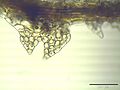 Cephalozia connivens, a leafy liverwort which lacks oil bodies
 -
 Metzgeria furcata, a thallose liverwort


References
- ^ Suire C, Bouvier F, Backhaus RA, Bégu D, Bonneu M, Camara B (November 2000). "Cellular localization of isoprenoid biosynthetic enzymes in Marchantia polymorpha. Uncovering a new role of oil bodies". Plant Physiology. 124 (3). American Society of Plant Biologists (ASPB): 971–978. doi:10.1104/pp.124.3.971. PMC 59197. PMID 11080275.
- ^ Tzen JT, Huang AH (April 1992). "Surface structure and properties of plant seed oil bodies". The Journal of Cell Biology. 117 (2). Rockefeller University Press: 327–335. doi:10.1083/jcb.117.2.327. PMC 2289430. PMID 1560029.
- ^ Lersten NR, Czlapinski AR, Curtis JD, Freckmann R, Horner HT (December 2006). "Oil bodies in leaf mesophyll cells of angiosperms: overview and a selected survey". American Journal of Botany. 93 (12). Wiley: 1731–1739. doi:10.3732/ajb.93.12.1731. PMID 21642118.
- ^ Furse S, Liddell S, Ortori CA, Williams H, Neylon DC, Scott DJ, et al. (April 2013). "The lipidome and proteome of oil bodies from Helianthus annuus (common sunflower)". Journal of Chemical Biology. 6 (2): 63–76. doi:10.1007/s12154-012-0090-1. PMC 3606697. PMID 23532185.
 | This bryophyte-related article is a stub. You can help Wikipedia by adding missing information. |
Content Disclaimer
Informasi ini disarikan dari Wikipedia dan disajikan kembali untuk tujuan edukasi. Konten tersedia di bawah lisensi CC BY-SA 3.0. Kami tidak bertanggung jawab atas ketidakakuratan data yang bersumber dari kontribusi publik tersebut.
- The information displayed on this website is sourced in part or in whole from Wikipedia and has been adapted for the purpose of restating it. We strive to provide accurate and relevant information, however:
- There is no guarantee of absolute accuracy. Wikipedia is an open, collaborative project that can be edited by anyone, so information is subject to change.
- It is not intended to constitute professional advice. The content displayed is for informational and educational purposes only. For important decisions (e.g., medical, legal, or financial), please consult a professional.
- Content copyright. Wikipedia is licensed under the Creative Commons Attribution-ShareAlike License (CC BY-SA). This means that content may be reused with appropriate attribution and shared under a similar license.
- Responsible use. Any risk arising from the use of information from this website is entirely the responsibility of the user.