Normalized number
In applied mathematics, a number is normalized when it is written in scientific notation with one non-zero decimal digit before the decimal point.[1] Thus, a real number, when written out in normalized scientific notation, is as follows:

where n is an integer, are the digits of the number in base 10, and is not zero. That is, its leading digit (i.e., leftmost) is not zero and is followed by the decimal point. Simply speaking, a number is normalized when it is written in the form of a × 10n where 1 ≤ |a| < 10 without leading zeros in a. This is the standard form of scientific notation. An alternative style is to have the first non-zero digit after the decimal point.


Examples
As examples, the number 918.082 in normalized form is
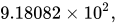
while the number −0.00574012 in normalized form is

Clearly, any non-zero real number can be normalized.
Other bases
The same definition holds if the number is represented in another radix (that is, base of enumeration), rather than base 10.
In base b a normalized number will have the form

where again and the digits, are integers between and .


In many computer systems, binary floating-point numbers are represented internally using this normalized form for their representations; for details, see normal number (computing). Although the point is described as floating, for a normalized floating-point number, its position is fixed, the movement being reflected in the different values of the power.
See also
References
- ^ Fleisch, Daniel; Kregenow, Julia (2013), A Student's Guide to the Mathematics of Astronomy, Cambridge University Press, p. 35, Bibcode:2013sgma.book.....F, ISBN 9781107292550.
Content Disclaimer
Informasi ini disarikan dari Wikipedia dan disajikan kembali untuk tujuan edukasi. Konten tersedia di bawah lisensi CC BY-SA 3.0. Kami tidak bertanggung jawab atas ketidakakuratan data yang bersumber dari kontribusi publik tersebut.
- The information displayed on this website is sourced in part or in whole from Wikipedia and has been adapted for the purpose of restating it. We strive to provide accurate and relevant information, however:
- There is no guarantee of absolute accuracy. Wikipedia is an open, collaborative project that can be edited by anyone, so information is subject to change.
- It is not intended to constitute professional advice. The content displayed is for informational and educational purposes only. For important decisions (e.g., medical, legal, or financial), please consult a professional.
- Content copyright. Wikipedia is licensed under the Creative Commons Attribution-ShareAlike License (CC BY-SA). This means that content may be reused with appropriate attribution and shared under a similar license.
- Responsible use. Any risk arising from the use of information from this website is entirely the responsibility of the user.