Nichols plot

The Nichols plot is a plot used in signal processing and control design, named after American engineer Nathaniel B. Nichols.[1][2][3] It plots the phase response versus the response magnitude of a transfer function for any given frequency, and as such is useful in characterizing a system's frequency response.
Use in control design
Given a transfer function,
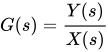
with the closed-loop transfer function defined as,
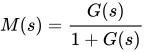
the Nichols plots displays versus . Loci of constant and (so-called Hall circles) are overlaid to allow the designer to obtain the closed loop transfer function directly from the open loop transfer function. Thus, the frequency is the parameter along the curve. This plot may be compared to the Bode plot in which the two inter-related graphs - versus and versus ) - are plotted.





In feedback control design, the plot is useful for assessing the stability and robustness of a linear system. This application of the Nichols plot is central to the quantitative feedback theory (QFT) of Horowitz and Sidi, which is a well known method for robust control system design.
In most cases, refers to the phase of the system's response. Although similar to a Nyquist plot, a Nichols plot is plotted in a Polar coordinate system while a Nyquist plot is plotted in a Cartesian coordinate system.
See also
References
- ^ Isaac M. Howowitz, Synthesis of Feedback Systems, Academic Press, 1963, Lib Congress 63-12033 p. 194-198
- ^ Boris J. Lurie and Paul J. Enright, Classical Feedback Control, Marcel Dekker, 2000, ISBN 0-8247-0370-7 p. 10
- ^ Allen Stubberud, Ivan Williams, and Joseph DeStefano, Shaums Outline Feedback and Control Systems, McGraw-Hill, 1995, ISBN 0-07-017052-5 ch. 17
External links
Content Disclaimer
Informasi ini disarikan dari Wikipedia dan disajikan kembali untuk tujuan edukasi. Konten tersedia di bawah lisensi CC BY-SA 3.0. Kami tidak bertanggung jawab atas ketidakakuratan data yang bersumber dari kontribusi publik tersebut.
- The information displayed on this website is sourced in part or in whole from Wikipedia and has been adapted for the purpose of restating it. We strive to provide accurate and relevant information, however:
- There is no guarantee of absolute accuracy. Wikipedia is an open, collaborative project that can be edited by anyone, so information is subject to change.
- It is not intended to constitute professional advice. The content displayed is for informational and educational purposes only. For important decisions (e.g., medical, legal, or financial), please consult a professional.
- Content copyright. Wikipedia is licensed under the Creative Commons Attribution-ShareAlike License (CC BY-SA). This means that content may be reused with appropriate attribution and shared under a similar license.
- Responsible use. Any risk arising from the use of information from this website is entirely the responsibility of the user.