Neighborhood semantics
Neighborhood semantics, also known as Scott–Montague semantics, is a formal semantics for modal logics. It is a generalization, developed independently by Dana Scott and Richard Montague, of the more widely known relational semantics for modal logic. Whereas a relational frame consists of a set W of worlds (or states) and an accessibility relation R intended to indicate which worlds are alternatives to (or, accessible from) others, a neighborhood frame still has a set W of worlds, but has instead of an accessibility relation a neighborhood function


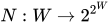
that assigns to each element of W a set of subsets of W. Intuitively, each family of subsets assigned to a world are the propositions necessary at that world, where 'proposition' is defined as a subset of W (i.e. the set of worlds at which the proposition is true). Specifically, if M is a model on the frame, then

where

is the truth set of .

Neighborhood semantics is used for the classical modal logics that are strictly weaker than the normal modal logic K.
Correspondence between relational and neighborhood models
To every relational model M = (W, R, V) there corresponds an equivalent (in the sense of having pointwise-identical modal theories) neighborhood model M' = (W, N, V) defined by

But this is not the only possible choice for equivalence, N can also be defined only with reference to R (and W):

For any w, N'(w) contains N(w) but may be strictly bigger, since some elements of it may not be the truth set of any formula in M.
The fact that the converse fails gives a precise sense to the remark that neighborhood models are a generalization of relational ones. Another (perhaps more natural) generalization of relational structures are general frames.
Relation to predicate transformers
Using that a subset is equivalent to its characteristic function , a neighborhood function can also be understood as a predicate transformer:


References
- Chellas, B.F. Modal Logic. Cambridge University Press, 1980.
- Montague, R. "Universal Grammar", Theoria 36, 373–98, 1970.
- Scott, D. "Advice on modal logic", in Philosophical Problems in Logic, ed. Karel Lambert. Reidel, 1970.
 | This logic-related article is a stub. You can help Wikipedia by adding missing information. |
Content Disclaimer
Informasi ini disarikan dari Wikipedia dan disajikan kembali untuk tujuan edukasi. Konten tersedia di bawah lisensi CC BY-SA 3.0. Kami tidak bertanggung jawab atas ketidakakuratan data yang bersumber dari kontribusi publik tersebut.
- The information displayed on this website is sourced in part or in whole from Wikipedia and has been adapted for the purpose of restating it. We strive to provide accurate and relevant information, however:
- There is no guarantee of absolute accuracy. Wikipedia is an open, collaborative project that can be edited by anyone, so information is subject to change.
- It is not intended to constitute professional advice. The content displayed is for informational and educational purposes only. For important decisions (e.g., medical, legal, or financial), please consult a professional.
- Content copyright. Wikipedia is licensed under the Creative Commons Attribution-ShareAlike License (CC BY-SA). This means that content may be reused with appropriate attribution and shared under a similar license.
- Responsible use. Any risk arising from the use of information from this website is entirely the responsibility of the user.