N-vector model
In statistical mechanics, the n-vector model or O(n) model is a simple system of interacting spins on a crystalline lattice. It was developed by H. Eugene Stanley as a generalization of the Ising model, XY model and Heisenberg model.[1]
Definition
In the n-vector model, n-component unit-length classical spins are placed on the vertices of a d-dimensional lattice. The Hamiltonian of the n-vector model is given by:

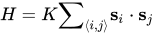
where the sum runs over all pairs of neighboring spins and denotes the standard Euclidean inner product. Special cases of the n-vector model are:


- : The self-avoiding walk[2][3]
- : The Ising model
- : The XY model
- : The Heisenberg model
- : Toy model for the Higgs sector of the Standard Model


The general mathematical formalism used to describe and solve the n-vector model and certain generalizations are developed in the article on the Potts model.
The Hamiltonian of the n-vector model is also the same as the potential term of the quantum rotor model.
Reformulation as a loop model
In a small coupling expansion, the weight of a configuration may be rewritten as
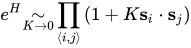
Integrating over the vector gives rise to expressions such as

which is interpreted as a sum over the 3 possible ways of connecting the vertices pairwise using 2 lines going through vertex . Integrating over all vectors, the corresponding lines combine into closed loops, and the partition function becomes a sum over loop configurations:


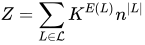
where is the set of loop configurations, with the number of loops in the configuration , and the total number of lattice edges.


In two dimensions, it is common to assume that loops do not cross: either by choosing the lattice to be trivalent, or by considering the model in a dilute phase where crossings are irrelevant, or by forbidding crossings by hand. The resulting model of non-intersecting loops can then be studied using powerful algebraic methods, and its spectrum is exactly known.[4] Moreover, the model is closely related to the random cluster model, which can also be formulated in terms of non-crossing loops. Much less is known in models where loops are allowed to cross, and in higher than two dimensions.
Continuum limit
The continuum limit can be understood to be the sigma model. This can be easily obtained by writing the Hamiltonian in terms of the product

where is the "bulk magnetization" term. Dropping this term as an overall constant factor added to the energy, the limit is obtained by defining the Newton finite difference as

={\frac {\mathbf {s} _{i}-\mathbf {s} _{j}}{h}}}](https://wikimedia.org/api/rest_v1/media/math/render/svg/6d26d94b505b2d1d670ede3b9e307bebb71f3c5a)
on neighboring lattice locations Then in the limit , where is the gradient in the direction. Thus, in the limit,

![{\displaystyle \delta _{h}[\mathbf {s} ]\to \nabla _{\mu }\mathbf {s} }](https://wikimedia.org/api/rest_v1/media/math/render/svg/3ab2022b89a6df8ccea377773adce1674f471553)



which can be recognized as the kinetic energy of the field in the sigma model. One still has two possibilities for the spin : it is either taken from a discrete set of spins (the Potts model) or it is taken as a point on the sphere ; that is, is a continuously-valued vector of unit length. In the later case, this is referred to as the non-linear sigma model, as the rotation group is group of isometries of , and obviously, isn't "flat", i.e. isn't a linear field.


Conformal field theory
At the critical temperature and in the continuum limit, the model gives rise to a conformal field theory called the critical O(n) model. This CFT can be analyzed using expansions in the dimension d or in n, or using the conformal bootstrap approach. Its conformal data are functions of d and n, on which many results are known.[5]
References
- ^ Stanley, H. E. (1968). "Dependence of Critical Properties upon Dimensionality of Spins". Phys. Rev. Lett. 20 (12): 589–592. Bibcode:1968PhRvL..20..589S. doi:10.1103/PhysRevLett.20.589.
- ^ de Gennes, P. G. (1972). "Exponents for the excluded volume problem as derived by the Wilson method". Phys. Lett. A. 38 (5): 339–340. Bibcode:1972PhLA...38..339D. doi:10.1016/0375-9601(72)90149-1.
- ^ Gaspari, George; Rudnick, Joseph (1986). "n-vector model in the limit n→0 and the statistics of linear polymer systems: A Ginzburg–Landau theory". Phys. Rev. B. 33 (5): 3295–3305. Bibcode:1986PhRvB..33.3295G. doi:10.1103/PhysRevB.33.3295. PMID 9938709.
- ^ Jacobsen, Jesper Lykke; Ribault, Sylvain; Saleur, Hubert (2023-05-03). "Spaces of states of the two-dimensional $O(n)$ and Potts models". SciPost Physics. 14 (5). arXiv:2208.14298. doi:10.21468/scipostphys.14.5.092. ISSN 2542-4653.
- ^ Henriksson, Johan (2023). "The critical O(N) CFT: Methods and conformal data". Physics Reports. 1002. Elsevier BV: 1–72. arXiv:2201.09520. doi:10.1016/j.physrep.2022.12.002. ISSN 0370-1573. Retrieved 2025-01-14.
 | This article about lattice models is a stub. You can help Wikipedia by adding missing information. |
 | This article about statistical mechanics is a stub. You can help Wikipedia by adding missing information. |
Content Disclaimer
Informasi ini disarikan dari Wikipedia dan disajikan kembali untuk tujuan edukasi. Konten tersedia di bawah lisensi CC BY-SA 3.0. Kami tidak bertanggung jawab atas ketidakakuratan data yang bersumber dari kontribusi publik tersebut.
- The information displayed on this website is sourced in part or in whole from Wikipedia and has been adapted for the purpose of restating it. We strive to provide accurate and relevant information, however:
- There is no guarantee of absolute accuracy. Wikipedia is an open, collaborative project that can be edited by anyone, so information is subject to change.
- It is not intended to constitute professional advice. The content displayed is for informational and educational purposes only. For important decisions (e.g., medical, legal, or financial), please consult a professional.
- Content copyright. Wikipedia is licensed under the Creative Commons Attribution-ShareAlike License (CC BY-SA). This means that content may be reused with appropriate attribution and shared under a similar license.
- Responsible use. Any risk arising from the use of information from this website is entirely the responsibility of the user.