Multivariate gamma function
In mathematics, the multivariate gamma function Γp is a generalization of the gamma function. It is useful in multivariate statistics, appearing in the probability density function of the Wishart and inverse Wishart distributions, and the matrix variate beta distribution.[1]
It has two equivalent definitions. One is given as the following integral over the positive-definite real matrices:


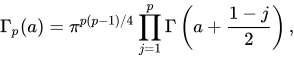
where denotes the determinant of . The other one, more useful to obtain a numerical result is:



In both definitions, is a complex number whose real part satisfies . Note that reduces to the ordinary gamma function. The second of the above definitions allows to directly obtain the recursive relationships for :





Thus


and so on.
This can also be extended to non-integer values of with the expression:


Where G is the Barnes G-function, the indefinite product of the Gamma function.
The function is derived by Anderson[2] from first principles who also cites earlier work by Wishart, Mahalanobis and others.
There also exists a version of the multivariate gamma function which instead of a single complex number takes a -dimensional vector of complex numbers as its argument. It generalizes the above defined multivariate gamma function insofar as the latter is obtained by a particular choice of multivariate argument of the former.[3]
Derivatives
We may define the multivariate digamma function as

and the general polygamma function as

Calculation steps
- Since
- it follows that

- By definition of the digamma function, ψ,

- it follows that
![{\displaystyle {\begin{aligned}{\frac {\partial \Gamma _{p}(a)}{\partial a}}&=\pi ^{p(p-1)/4}\prod _{j=1}^{p}\Gamma (a+(1-j)/2)\sum _{i=1}^{p}\psi (a+(1-i)/2)\\[4pt]&=\Gamma _{p}(a)\sum _{i=1}^{p}\psi (a+(1-i)/2).\end{aligned}}}](https://wikimedia.org/api/rest_v1/media/math/render/svg/53be1f08a21a67f4a4d96fa959255f792b5071d1)
 | This article includes a list of general references, but it lacks sufficient corresponding inline citations. (May 2012) |
References
- ^ James, Alan T. (June 1964). "Distributions of Matrix Variates and Latent Roots Derived from Normal Samples". The Annals of Mathematical Statistics. 35 (2): 475–501. doi:10.1214/aoms/1177703550. ISSN 0003-4851.
- ^ Anderson, T W (1984). An Introduction to Multivariate Statistical Analysis. New York: John Wiley and Sons. pp. Ch. 7. ISBN 0-471-88987-3.
- ^ D. St. P. Richards (n.d.). "Chapter 35 Functions of Matrix Argument". Digital Library of Mathematical Functions. Retrieved 23 May 2022.
- 1. James, A. (1964). "Distributions of Matrix Variates and Latent Roots Derived from Normal Samples". Annals of Mathematical Statistics. 35 (2): 475–501. doi:10.1214/aoms/1177703550. MR 0181057. Zbl 0121.36605.
- 2. A. K. Gupta and D. K. Nagar 1999. "Matrix variate distributions". Chapman and Hall.
Content Disclaimer
Informasi ini disarikan dari Wikipedia dan disajikan kembali untuk tujuan edukasi. Konten tersedia di bawah lisensi CC BY-SA 3.0. Kami tidak bertanggung jawab atas ketidakakuratan data yang bersumber dari kontribusi publik tersebut.
- The information displayed on this website is sourced in part or in whole from Wikipedia and has been adapted for the purpose of restating it. We strive to provide accurate and relevant information, however:
- There is no guarantee of absolute accuracy. Wikipedia is an open, collaborative project that can be edited by anyone, so information is subject to change.
- It is not intended to constitute professional advice. The content displayed is for informational and educational purposes only. For important decisions (e.g., medical, legal, or financial), please consult a professional.
- Content copyright. Wikipedia is licensed under the Creative Commons Attribution-ShareAlike License (CC BY-SA). This means that content may be reused with appropriate attribution and shared under a similar license.
- Responsible use. Any risk arising from the use of information from this website is entirely the responsibility of the user.