Multiplicative independence
 | This article relies largely or entirely on a single source. (April 2016) |
In number theory, two positive integers a and b are said to be multiplicatively independent[1] if their only common integer power is 1. That is, for integers n and m, implies . Two integers which are not multiplicatively independent are said to be multiplicatively dependent.


As examples, 36 and 216 are multiplicatively dependent since , whereas 2 and 3 are multiplicatively independent.

Properties
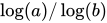
Being multiplicatively independent admits some other characterizations. a and b are multiplicatively independent if and only if is irrational. This property holds independently of the base of the logarithm.
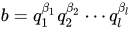
Let and be the canonical representations of a and b. The integers a and b are multiplicatively dependent if and only if k = l, and for all i and j.



Applications
Büchi arithmetic in base a and b define the same sets if and only if a and b are multiplicatively dependent.
Let a and b be multiplicatively dependent integers, that is, there exists n,m>1 such that . The integers c such that the length of its expansion in base a is at most m are exactly the integers such that the length of their expansion in base b is at most n. It implies that computing the base b expansion of a number, given its base a expansion, can be done by transforming consecutive sequences of m base a digits into consecutive sequence of n base b digits.
References
- ^ Bès, Alexis. "A survey of Arithmetical Definability". Retrieved 27 June 2012.
{{cite web}}: CS1 maint: deprecated archival service (link) - ^ Bruyère, Véronique; Hansel, Georges; Michaux, Christian; Villemaire, Roger (1994). "Logic and p-recognizable sets of integers" (PDF). Bull. Belg. Math. Soc. 1: 191–238.
Content Disclaimer
Informasi ini disarikan dari Wikipedia dan disajikan kembali untuk tujuan edukasi. Konten tersedia di bawah lisensi CC BY-SA 3.0. Kami tidak bertanggung jawab atas ketidakakuratan data yang bersumber dari kontribusi publik tersebut.
- The information displayed on this website is sourced in part or in whole from Wikipedia and has been adapted for the purpose of restating it. We strive to provide accurate and relevant information, however:
- There is no guarantee of absolute accuracy. Wikipedia is an open, collaborative project that can be edited by anyone, so information is subject to change.
- It is not intended to constitute professional advice. The content displayed is for informational and educational purposes only. For important decisions (e.g., medical, legal, or financial), please consult a professional.
- Content copyright. Wikipedia is licensed under the Creative Commons Attribution-ShareAlike License (CC BY-SA). This means that content may be reused with appropriate attribution and shared under a similar license.
- Responsible use. Any risk arising from the use of information from this website is entirely the responsibility of the user.