Multiplicative cascade
In mathematics, a multiplicative cascade[1][2] is a fractal/multifractal distribution of points produced via an iterative and multiplicative random process.
Definition
The plots above are examples of multiplicative cascade multifractals.
To create these distributions there are a few steps to take. Firstly, we must create a lattice of cells which will be our underlying probability density field.
Secondly, an iterative process is followed to create multiple levels of the lattice: at each iteration the cells are split into four equal parts (cells). Each new cell is then assigned a probability randomly from the set without replacement, where . This process is continued to the Nth level. For example, in constructing such a model down to level 8 we produce a 48 array of cells.

![{\displaystyle p_{i}\in [0,1]}](https://wikimedia.org/api/rest_v1/media/math/render/svg/14760da7a7625a3070329a16c4c37033424871fe)
Thirdly, the cells are filled as follows: We take the probability of a cell being occupied as the product of the cell's own pi and those of all its parents (up to level 1). A Monte Carlo rejection scheme is used repeatedly until the desired cell population is obtained, as follows: x and y cell coordinates are chosen randomly, and a random number between 0 and 1 is assigned; the (x, y) cell is then populated depending on whether the assigned number is lesser than (outcome: not populated) or greater or equal to (outcome: populated) the cell's occupation probability.
Examples

Generators (left to right): , ,



To produce the plots above, the probability density field is filled with 5,000 points in a space of 256 × 256.
An example of the probability density field:

The fractals are generally not scale-invariant and therefore cannot be considered standard fractals. They can however be considered multifractals. The Rényi (generalized) dimensions can be theoretically predicted. It can be shown [3] that as ,

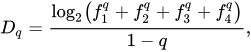
where N is the level of the grid refinement and,

See also

References
- ^ Meakin, Paul (September 1987). "Diffusion-limited aggregation on multifractal lattices: A model for fluid-fluid displacement in porous media". Physical Review A. 36 (6): 2833–2837. doi:10.1103/PhysRevA.36.2833. PMID 9899187.
- ^ Cristano G. Sabiu, Luis Teodoro, Martin Hendry, arXiv:0803.3212v1 Resolving the universe with multifractals
- ^ Martinez et al. ApJ 357 50M "Clustering Paradigms and Multifractal Measures" [1]
Content Disclaimer
Informasi ini disarikan dari Wikipedia dan disajikan kembali untuk tujuan edukasi. Konten tersedia di bawah lisensi CC BY-SA 3.0. Kami tidak bertanggung jawab atas ketidakakuratan data yang bersumber dari kontribusi publik tersebut.
- The information displayed on this website is sourced in part or in whole from Wikipedia and has been adapted for the purpose of restating it. We strive to provide accurate and relevant information, however:
- There is no guarantee of absolute accuracy. Wikipedia is an open, collaborative project that can be edited by anyone, so information is subject to change.
- It is not intended to constitute professional advice. The content displayed is for informational and educational purposes only. For important decisions (e.g., medical, legal, or financial), please consult a professional.
- Content copyright. Wikipedia is licensed under the Creative Commons Attribution-ShareAlike License (CC BY-SA). This means that content may be reused with appropriate attribution and shared under a similar license.
- Responsible use. Any risk arising from the use of information from this website is entirely the responsibility of the user.