Multidimensional Chebyshev's inequality
 | This article needs additional citations for verification. (August 2008) |
In probability theory, the multidimensional Chebyshev's inequality[1] is a generalization of Chebyshev's inequality, which puts a bound on the probability of the event that a random variable differs from its expected value by more than a specified amount.
Let be an -dimensional random vector with expected value and covariance matrix


![{\displaystyle \mu =\operatorname {E} [X]}](https://wikimedia.org/api/rest_v1/media/math/render/svg/ce1b41598b8e8f45f57c1550ebb8d5c7ab8e1210)
![{\displaystyle V=\operatorname {E} [(X-\mu )(X-\mu )^{T}].\,}](https://wikimedia.org/api/rest_v1/media/math/render/svg/3007db3c8528ef8a140908d3d11e21bd5009a33b)
If is a positive-definite matrix, for any real number :



Proof
Since is positive-definite, so is . Define the random variable


Since is positive, Markov's inequality holds:

![{\displaystyle \Pr \left({\sqrt {(X-\mu )^{T}V^{-1}(X-\mu )}}>t\right)=\Pr({\sqrt {y}}>t)=\Pr(y>t^{2})\leq {\frac {\operatorname {E} [y]}{t^{2}}}.}](https://wikimedia.org/api/rest_v1/media/math/render/svg/b14fbba15865485b741adf85030e6b98404c7168)
Finally,
![{\displaystyle {\begin{aligned}\operatorname {E} [y]&=\operatorname {E} [(X-\mu )^{T}V^{-1}(X-\mu )]\\[6pt]&=\operatorname {E} [\operatorname {trace} (V^{-1}(X-\mu )(X-\mu )^{T})]\\[6pt]&=\operatorname {trace} (V^{-1}V)=N\end{aligned}}.}](https://wikimedia.org/api/rest_v1/media/math/render/svg/63849c2be7a2a18c7d1dc83c6c3c7f4cc61f6dd1)
Infinite dimensions
There is a straightforward extension of the vector version of Chebyshev's inequality to infinite dimensional settings[more refs. needed].[3] Let X be a random variable which takes values in a Fréchet space (equipped with seminorms || ⋅ ||α). This includes most common settings of vector-valued random variables, e.g., when is a Banach space (equipped with a single norm), a Hilbert space, or the finite-dimensional setting as described above.

Suppose that X is of "strong order two", meaning that
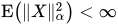
for every seminorm || ⋅ ||α. This is a generalization of the requirement that X have finite variance, and is necessary for this strong form of Chebyshev's inequality in infinite dimensions. The terminology "strong order two" is due to Vakhania.[4]
Let be the Pettis integral of X (i.e., the vector generalization of the mean), and let

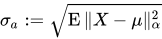
be the standard deviation with respect to the seminorm || ⋅ ||α. In this setting we can state the following:
- General version of Chebyshev's inequality.

Proof. The proof is straightforward, and essentially the same as the finitary version[source needed]. If σα = 0, then X is constant (and equal to μ) almost surely, so the inequality is trivial.
If

then ||X − μ||α > 0, so we may safely divide by ||X − μ||α. The crucial trick in Chebyshev's inequality is to recognize that .

The following calculations complete the proof:
![{\displaystyle {\begin{aligned}\Pr \left(\|X-\mu \|_{\alpha }\geq k\sigma _{\alpha }\right)&=\int _{\Omega }\mathbf {1} _{\|X-\mu \|_{\alpha }\geq k\sigma _{\alpha }}\,\mathrm {d} \Pr \\&=\int _{\Omega }\left({\frac {\|X-\mu \|_{\alpha }^{2}}{\|X-\mu \|_{\alpha }^{2}}}\right)\cdot \mathbf {1} _{\|X-\mu \|_{\alpha }\geq k\sigma _{\alpha }}\,\mathrm {d} \Pr \\[6pt]&\leq \int _{\Omega }\left({\frac {\|X-\mu \|_{\alpha }^{2}}{(k\sigma _{\alpha })^{2}}}\right)\cdot \mathbf {1} _{\|X-\mu \|_{\alpha }\geq k\sigma _{\alpha }}\,\mathrm {d} \Pr \\[6pt]&\leq {\frac {1}{k^{2}\sigma _{\alpha }^{2}}}\int _{\Omega }\|X-\mu \|_{\alpha }^{2}\,\mathrm {d} \Pr &&\mathbf {1} _{\|X-\mu \|_{\alpha }\geq k\sigma _{\alpha }}\leq 1\\[6pt]&={\frac {1}{k^{2}\sigma _{\alpha }^{2}}}\left(\operatorname {E} \|X-\mu \|_{\alpha }^{2}\right)\\[6pt]&={\frac {1}{k^{2}\sigma _{\alpha }^{2}}}\left(\sigma _{\alpha }^{2}\right)\\[6pt]&={\frac {1}{k^{2}}}\end{aligned}}}](https://wikimedia.org/api/rest_v1/media/math/render/svg/cd96928e0d682ce0f0476baa7516a56148c59a8a)
References
- ^ a b Marshall, Albert W.; Olkin, Ingram (December 1960). "Multivariate Chebyshev Inequalities". The Annals of Mathematical Statistics. 31 (4): 1001–1014. doi:10.1214/aoms/1177705673. ISSN 0003-4851.
- ^ Navarro, Jorge (2013-05-24). "A simple proof for the multivariate Chebyshev inequality". arXiv:1305.5646 [math.ST].
- ^ Altomare, Francesco; Campiti, Michele (1994). De Gruyter (ed.). Korovkin-type Approximation Theory and Its Applications. p. 313. doi:10.1515/9783110884586. ISBN 978-3-11-014178-8.
- ^ Vakhania, Nikolai Nikolaevich. Probability distributions on linear spaces. New York: North Holland, 1981.
Content Disclaimer
Informasi ini disarikan dari Wikipedia dan disajikan kembali untuk tujuan edukasi. Konten tersedia di bawah lisensi CC BY-SA 3.0. Kami tidak bertanggung jawab atas ketidakakuratan data yang bersumber dari kontribusi publik tersebut.
- The information displayed on this website is sourced in part or in whole from Wikipedia and has been adapted for the purpose of restating it. We strive to provide accurate and relevant information, however:
- There is no guarantee of absolute accuracy. Wikipedia is an open, collaborative project that can be edited by anyone, so information is subject to change.
- It is not intended to constitute professional advice. The content displayed is for informational and educational purposes only. For important decisions (e.g., medical, legal, or financial), please consult a professional.
- Content copyright. Wikipedia is licensed under the Creative Commons Attribution-ShareAlike License (CC BY-SA). This means that content may be reused with appropriate attribution and shared under a similar license.
- Responsible use. Any risk arising from the use of information from this website is entirely the responsibility of the user.