Modal depth
 | This article relies largely or entirely on a single source. (November 2019) |
In modal logic, the modal depth of a formula is the deepest nesting of modal operators (commonly and ). Modal formulas without modal operators have a modal depth of zero.


Definition
Modal depth can be defined as follows.[1] Let be a function that computes the modal depth for a modal formula :


- , where is an atomic formula.


Example
The following computation gives the modal depth of :


Modal depth and semantics
The modal depth of a formula indicates 'how far' one needs to look in a Kripke model when checking the validity of the formula. For each modal operator, one needs to transition from a world in the model to a world that is accessible through the accessibility relation. The modal depth indicates the longest 'chain' of transitions from a world to the next that is needed to verify the validity of a formula.
For example, to check whether , one needs to check whether there exists an accessible world for which . If that is the case, one needs to check whether there is also a world such that and is accessible from . We have made two steps from the world (from to and from to ) in the model to determine whether the formula holds; this is, by definition, the modal depth of that formula.
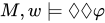


The modal depth is an upper bound (inclusive) on the number of transitions as for boxes, a modal formula is also true whenever a world has no accessible worlds (i.e., holds for all in a world when , where is the set of worlds and is the accessibility relation). To check whether , it may be needed to take two steps in the model but it could be less, depending on the structure of the model. Suppose no worlds are accessible in ; the formula now trivially holds by the previous observation about the validity of formulas with a box as outer operator.





References
- ^ Nguyen, Linh Anh. "Constructing the Least Models for Positive Modal Logic Programs" (PDF). p. 32. Archived from the original (PDF) on January 26, 2019. Retrieved January 26, 2019.
Content Disclaimer
Informasi ini disarikan dari Wikipedia dan disajikan kembali untuk tujuan edukasi. Konten tersedia di bawah lisensi CC BY-SA 3.0. Kami tidak bertanggung jawab atas ketidakakuratan data yang bersumber dari kontribusi publik tersebut.
- The information displayed on this website is sourced in part or in whole from Wikipedia and has been adapted for the purpose of restating it. We strive to provide accurate and relevant information, however:
- There is no guarantee of absolute accuracy. Wikipedia is an open, collaborative project that can be edited by anyone, so information is subject to change.
- It is not intended to constitute professional advice. The content displayed is for informational and educational purposes only. For important decisions (e.g., medical, legal, or financial), please consult a professional.
- Content copyright. Wikipedia is licensed under the Creative Commons Attribution-ShareAlike License (CC BY-SA). This means that content may be reused with appropriate attribution and shared under a similar license.
- Responsible use. Any risk arising from the use of information from this website is entirely the responsibility of the user.