Menuha Formation
| Menuha Formation | |
|---|---|
| Stratigraphic range: Santonian-Early Campanian ~ | |
 Menuha Formation exposed in Wadi Zihor. | |
| Type | Sedimentary |
| Unit of | Mount Scopus Group |
| Underlies | Mishash Formation |
| Overlies | Zihor Formation |
| Thickness | 14–50 m (46–164 ft) |
| Lithology | |
| Primary | Chalk, marly chalk |
| Other | Conglomeratic chalk, limestone |
| Location | |
| Region | Makhtesh Ramon, Negev desert |
| Country | Israel |
The Menuha Formation is the name given to an Upper Cretaceous (Santonian-Early Campanian) chalk, marly chalk and conglomeratic chalk unit exposed throughout the Makhtesh Ramon region of southern Israel and parts of northern Israel (Avni, 1991).
Stratigraphy and paleoenvironment
The Menuha Formation records the earliest occurrence of tectonic activity within the Ramon anticline, forming the present erosive valley known as "Makhtesh Ramon" as an outcome of a sequence of erosive events evolving since the Late Cretaceous (Avni, 1993). It consists of white and yellow/brown chalk that is often glauconitic and sometimes conglomeratic or marly. The Menuha Formation likely represents a temperate to subtropical, open shelf environment deposited during the formation of the Ramon anticline. Reworked conglomeratic chalks in the western section represent marginal facies derived from this structural uplift.
The paleoenvironment is based on the occurrences of several shark and fish teeth, oysters, trace fossils, phosphatic peloids, and foraminiferans. The isolated teeth represent at least ten different species:
- Cretalamna appendiculata
- Cretoxyrhina mantelli
- Squalicorax falcatus?
- Squalicorax kaupi
- Scapanorhynchus rapax
- Scapanorhynchus raphiodon?
- Carcharias samhammeri
- Carcharias cf. C holmdelensis
- Hadrodus priscus
- Micropycnodon kansasensis?
References
- Avni, Y. (1991). "The geology, paleogeography and landscape evolution in the central Negev Highlands and the western Ramon structure". Geological Survey of Israel, Report GSI/6/91: 153 p.
- Avni, Y. (1993). "The structural and landscape evolution of the western Ramon structure". Israel Journal of Earth Sciences. 42: 177–188.
- Retzler, A.; Wilson, M.A.; Avni, Y. (2013). "Chondrichthyans from the Menuha Formation (Late Cretaceous: Santonian–Early Campanian) of the Makhtesh Ramon region, southern Israel". Cretaceous Research. 40: 81–89. Bibcode:2013CrRes..40...81R. doi:10.1016/j.cretres.2012.05.009.
- Wilson, M.A.; Zaton, M.; Avni, Y. (2012). "Origin, paleoecology and stratigraphic significance of bored and encrusted concretions from the Upper Cretaceous (Santonian) of southern Israel". Palaeobiodiversity and Palaeoenvironments. 92 (3): 343–352. Bibcode:2012PdPe...92..343W. doi:10.1007/s12549-012-0082-8.
-
 Thalassinoides burrowing system throughout the Menuha Formation chalk.
 -
 Cretalamna appendiculata tooth, Menuha Formation.
 -
 Squalicorax kaupi tooth, Menuha Formation.
 -
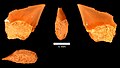 Squalicorax falcatus? tooth, Menuha Formation.
 -
 Carcharias samhammeri tooth, Menuha Formation.
 -
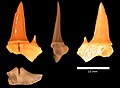 Carcharias cf. C holmdelensis tooth, Menuha Formation.
 -
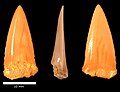 Cretoxyrhina mantelli tooth, Menuha Formation.
 -
 Scapanorhynchus rapax tooth, Menuha Formation.
 -
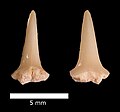 Scapanorhynchus raphiodon? tooth, Menuha Formation.
 -
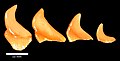 Hadrodus priscus tooth, Menuha Formation.
 -
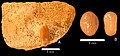 Micropycnodon kansasensis? tooth, Menuha Formation.
 -
 Several foraminiferans replaced by silica from the Menuha Formation.
 -
 Several oysters, possibly Pycnodonte vesicularis, from the Menuha Formation.
 -
 Irregular echinoid spine from the chalk sediments of the Menuha Formation.
 -
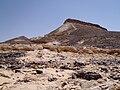 Menuha Formation and capping Mishash Formation south of Makhtesh Ramon.


Content Disclaimer
Informasi ini disarikan dari Wikipedia dan disajikan kembali untuk tujuan edukasi. Konten tersedia di bawah lisensi CC BY-SA 3.0. Kami tidak bertanggung jawab atas ketidakakuratan data yang bersumber dari kontribusi publik tersebut.
- The information displayed on this website is sourced in part or in whole from Wikipedia and has been adapted for the purpose of restating it. We strive to provide accurate and relevant information, however:
- There is no guarantee of absolute accuracy. Wikipedia is an open, collaborative project that can be edited by anyone, so information is subject to change.
- It is not intended to constitute professional advice. The content displayed is for informational and educational purposes only. For important decisions (e.g., medical, legal, or financial), please consult a professional.
- Content copyright. Wikipedia is licensed under the Creative Commons Attribution-ShareAlike License (CC BY-SA). This means that content may be reused with appropriate attribution and shared under a similar license.
- Responsible use. Any risk arising from the use of information from this website is entirely the responsibility of the user.