Mayer f-function
The Mayer f-function is an auxiliary function that often appears in the series expansion of thermodynamic quantities related to classical many-particle systems.[1] It is named after chemist and physicist Joseph Edward Mayer.
Definition
Consider a system of classical particles interacting through a pair-wise potential

where the bold labels and denote the continuous degrees of freedom associated with the particles, e.g.,


for spherically symmetric particles and

for rigid non-spherical particles where denotes position and the orientation parametrized e.g. by Euler angles. The Mayer f-function is then defined as



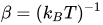
where the inverse absolute temperature in units of energy−1 .
See also
Notes
- ^ Donald Allan McQuarrie, Statistical Mechanics (HarperCollins, 1976), page 228
Content Disclaimer
Informasi ini disarikan dari Wikipedia dan disajikan kembali untuk tujuan edukasi. Konten tersedia di bawah lisensi CC BY-SA 3.0. Kami tidak bertanggung jawab atas ketidakakuratan data yang bersumber dari kontribusi publik tersebut.
- The information displayed on this website is sourced in part or in whole from Wikipedia and has been adapted for the purpose of restating it. We strive to provide accurate and relevant information, however:
- There is no guarantee of absolute accuracy. Wikipedia is an open, collaborative project that can be edited by anyone, so information is subject to change.
- It is not intended to constitute professional advice. The content displayed is for informational and educational purposes only. For important decisions (e.g., medical, legal, or financial), please consult a professional.
- Content copyright. Wikipedia is licensed under the Creative Commons Attribution-ShareAlike License (CC BY-SA). This means that content may be reused with appropriate attribution and shared under a similar license.
- Responsible use. Any risk arising from the use of information from this website is entirely the responsibility of the user.