Matrix analytic method
In probability theory, the matrix analytic method is a technique to compute the stationary probability distribution of a Markov chain which has a repeating structure (after some point) and a state space which grows unboundedly in no more than one dimension.[1][2] Such models are often described as M/G/1 type Markov chains because they can describe transitions in an M/G/1 queue.[3][4] The method is a more complicated version of the matrix geometric method and is the classical solution method for M/G/1 chains.[5]
Method description
An M/G/1-type stochastic matrix is one of the form[3]
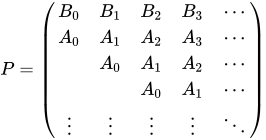
where Bi and Ai are k × k matrices. (Note that unmarked matrix entries represent zeroes.) Such a matrix describes the embedded Markov chain in an M/G/1 queue.[6][7] If P is irreducible and positive recurrent then the stationary distribution is given by the solution to the equations[3]

where e represents a vector of suitable dimension with all values equal to 1. Matching the structure of P, π is partitioned to π1, π2, π3, …. To compute these probabilities the column stochastic matrix G is computed such that[3]
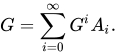
G is called the auxiliary matrix.[8] Matrices are defined[3]
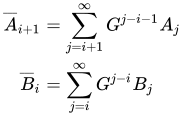
then π0 is found by solving[3]
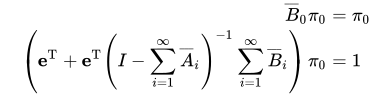
and the πi are given by Ramaswami's formula,[3] a numerically stable relationship first published by Vaidyanathan Ramaswami in 1988.[9]
![{\displaystyle \pi _{i}=(I-{\overline {A}}_{1})^{-1}\left[{\overline {B}}_{i+1}\pi _{0}+\sum _{j=1}^{i-1}{\overline {A}}_{i+1-j}\pi _{j}\right],i\geq 1.}](https://wikimedia.org/api/rest_v1/media/math/render/svg/0991a5676c9a24717aacd3ebc56c35add63d201b)
Computation of G
There are two popular iterative methods for computing G,[10][11]
- functional iterations
- cyclic reduction.
Tools
References
- ^ Harchol-Balter, M. (2012). "Phase-Type Distributions and Matrix-Analytic Methods". Performance Modeling and Design of Computer Systems. pp. 359–379. doi:10.1017/CBO9781139226424.028. ISBN 9781139226424.
- ^ Neuts, M. F. (1984). "Matrix-analytic methods in queuing theory". European Journal of Operational Research. 15: 2–12. doi:10.1016/0377-2217(84)90034-1.
- ^ a b c d e f g Meini, B. (1997). "An improved FFT-based version of Ramaswami's formula". Communications in Statistics. Stochastic Models. 13 (2): 223–238. doi:10.1080/15326349708807423.
- ^ Stathopoulos, A.; Riska, A.; Hua, Z.; Smirni, E. (2005). "Bridging ETAQA and Ramaswami's formula for the solution of M/G/1-type processes". Performance Evaluation. 62 (1–4): 331–348. CiteSeerX 10.1.1.80.9473. doi:10.1016/j.peva.2005.07.003.
- ^ Riska, A.; Smirni, E. (2002). "M/G/1-Type Markov Processes: A Tutorial" (PDF). Performance Evaluation of Complex Systems: Techniques and Tools. Lecture Notes in Computer Science. Vol. 2459. pp. 36. doi:10.1007/3-540-45798-4_3. ISBN 978-3-540-44252-3.
- ^ Bolch, Gunter; Greiner, Stefan; de Meer, Hermann; Shridharbhai Trivedi, Kishor (2006). Queueing Networks and Markov Chains: Modeling and Performance Evaluation with Computer Science Applications (2 ed.). John Wiley & Sons, Inc. p. 250. ISBN 978-0471565253.
- ^ Artalejo, Jesús R.; Gómez-Corral, Antonio (2008). "The Matrix-Analytic Formalism". Retrial Queueing Systems. pp. 187–205. doi:10.1007/978-3-540-78725-9_7. ISBN 978-3-540-78724-2.
- ^ Riska, A.; Smirni, E. (2002). "Exact aggregate solutions for M/G/1-type Markov processes". ACM SIGMETRICS Performance Evaluation Review. 30: 86. CiteSeerX 10.1.1.109.2225. doi:10.1145/511399.511346.
- ^ Ramaswami, V. (1988). "A stable recursion for the steady state vector in markov chains of m/g/1 type". Communications in Statistics. Stochastic Models. 4: 183–188. doi:10.1080/15326348808807077.
- ^ Bini, D. A.; Latouche, G.; Meini, B. (2005). Numerical Methods for Structured Markov Chains. doi:10.1093/acprof:oso/9780198527688.001.0001. ISBN 9780198527688.
- ^ Meini, B. (1998). "Solving m/g/l type markov chains: Recent advances and applications". Communications in Statistics. Stochastic Models. 14 (1–2): 479–496. doi:10.1080/15326349808807483.
- ^ Riska, A.; Smirni, E. (2002). "MAMSolver: A Matrix Analytic Methods Tool". Computer Performance Evaluation: Modelling Techniques and Tools. Lecture Notes in Computer Science. Vol. 2324. p. 205. CiteSeerX 10.1.1.146.2080. doi:10.1007/3-540-46029-2_14. ISBN 978-3-540-43539-6.
| Single queueing nodes | |
|---|---|
| Arrival processes | |
| Queueing networks | |
| Service policies | |
| Key concepts | |
| Limit theorems | |
| Extensions | |
| Information systems | |

Content Disclaimer
Informasi ini disarikan dari Wikipedia dan disajikan kembali untuk tujuan edukasi. Konten tersedia di bawah lisensi CC BY-SA 3.0. Kami tidak bertanggung jawab atas ketidakakuratan data yang bersumber dari kontribusi publik tersebut.
- The information displayed on this website is sourced in part or in whole from Wikipedia and has been adapted for the purpose of restating it. We strive to provide accurate and relevant information, however:
- There is no guarantee of absolute accuracy. Wikipedia is an open, collaborative project that can be edited by anyone, so information is subject to change.
- It is not intended to constitute professional advice. The content displayed is for informational and educational purposes only. For important decisions (e.g., medical, legal, or financial), please consult a professional.
- Content copyright. Wikipedia is licensed under the Creative Commons Attribution-ShareAlike License (CC BY-SA). This means that content may be reused with appropriate attribution and shared under a similar license.
- Responsible use. Any risk arising from the use of information from this website is entirely the responsibility of the user.