Malva multiflora
| Malva multiflora | |
|---|---|

| |
Scientific classification 
| |
| Kingdom: | Plantae |
| Clade: | Embryophytes |
| Clade: | Tracheophytes |
| Clade: | Spermatophytes |
| Clade: | Angiosperms |
| Clade: | Eudicots |
| Clade: | Rosids |
| Order: | Malvales |
| Family: | Malvaceae |
| Genus: | Malva |
| Species: | M. multiflora
|
| Binomial name | |
| Malva multiflora (Cav.) Soldano, Banfi & Galasso
| |
| Synonyms[1] | |
|
List
| |
Malva multiflora (previously known as Lavatera cretica) is a species of flowering plant in the mallow family known by the common names Cornish mallow and Cretan hollyhock. It is native to western Europe, North Africa, and the Mediterranean Basin, and it is naturalized in areas with a Mediterranean climate, such as parts of Australia, South Africa, and California. This is an annual or biennial herb growing a tough, somewhat hairy stem to a maximum height between 1 and 3 meters. The leaves are multilobed with flat or wavy edges, slightly hairy, and up to 10 centimeters long. The plant bears small pink or light purple flowers with petals just over a centimeter long. The fruit is disc-shaped with 7 to 10 segments.
Leaf laminas of Malva multiflora can track solar position throughout the day and turn to face the sunrise, behavior that anticipates the future, despite lacking a central nervous system.[2][3]
Botanical gallery
Photos from Antalya in Turkey.
-
 Plant generally upright
 -
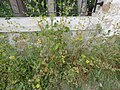 Plant generally upright
 -
 Inflorescence, distant
 -
 Inflorescence, close
 -
 Flower, usually pale
 -
 Flower, rather bigger than calyx, calyx 5-part, epicalyx 3-broad-parts, usually reasonably stellate-hairy
 -
 Floral organs, unopened
 -
 Floral organs, opened
 -
 Epicalyx 3-part broad, joined at base
 -
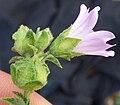 Flowers
 -
 Fruit, hairy form, mature, always lacks wrinkles, with rounded surface
 -
 Fruit, hairy form, mature, from side
 -
 Fruit, hairless form, mature
 -
 Fruit, hairless form, young
 -
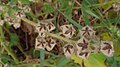 Fruiting inflorescence
 -
 Stellate (starlike) hairs with bulbous bases conspicuous
 -
 Leaf upperside
 -
 Leaf upperside, hairy example (may lack hairs)
 -
 Leaf underside
 -
 Leaf underside
 -
 Leaf stalk hairs
 -
 Biennial form, thick trunked
 -
 Biennial form, trunk
 -
 Trampled form, still showing a main stem
 -
 Trampled form, showing smaller leaves


References
- ^ "Malva multiflora (Cav.) Soldano, Banfi & Galasso". Plants of the World Online. Board of Trustees of the Royal Botanic Gardens, Kew. Retrieved 14 June 2021.
- ^ Schwartz, A; Koller, D (1986). "Diurnal Phototropism in Solar Tracking Leaves of Lavatera cretica". Plant Physiology. 80 (3): 778–781. doi:10.1104/pp.80.3.778. PMC 1075199. PMID 16664701.
- ^ [1]
External links
 | This article about Malveae is a stub. You can help Wikipedia by adding missing information. |
Content Disclaimer
Informasi ini disarikan dari Wikipedia dan disajikan kembali untuk tujuan edukasi. Konten tersedia di bawah lisensi CC BY-SA 3.0. Kami tidak bertanggung jawab atas ketidakakuratan data yang bersumber dari kontribusi publik tersebut.
- The information displayed on this website is sourced in part or in whole from Wikipedia and has been adapted for the purpose of restating it. We strive to provide accurate and relevant information, however:
- There is no guarantee of absolute accuracy. Wikipedia is an open, collaborative project that can be edited by anyone, so information is subject to change.
- It is not intended to constitute professional advice. The content displayed is for informational and educational purposes only. For important decisions (e.g., medical, legal, or financial), please consult a professional.
- Content copyright. Wikipedia is licensed under the Creative Commons Attribution-ShareAlike License (CC BY-SA). This means that content may be reused with appropriate attribution and shared under a similar license.
- Responsible use. Any risk arising from the use of information from this website is entirely the responsibility of the user.