Magic square of squares
The magic square of squares is an unsolved problem in mathematics which asks whether it is possible to construct a three-by-three magic square, the elements of which are all square numbers. The problem was first posed by Martin LaBar in the January 1984 College Mathematics Journal, before being included in Richard Guy's Unsolved problems in number theory (2nd edition) in 1994.[1][2]
The problem has been a popular choice for recreational mathematicians following two articles Martin Gardner published in Quantum Magazine on the problem, offering a prize of US$100 in 1996.[3][4] Other prizes have subsequently been offered for the first solution.[5]
Background

A magic square is a square array of integer numbers in which each row, column, and diagonal sums to the same number.[6] The order of the square refers to the number of integers along each side.[7] A trivial magic square is a magic square which has at least one repeated element, and a semimagic square is a magic square in which the rows and columns, but not both diagonals, sum to the same number.
Problem
The problem asks whether it is possible to construct a third-order magic square such that every element is itself a square number. A square which solves the problem would thus be of the form


and satisfy the following equations[8]

Current research
It has been shown that the problem is equivalent to several other problems.[2]
- Do there exist three arithmetic progressions such that each has three terms, each has the same difference between terms as the other two, the terms are all perfect squares, and the middle terms of the three arithmetic progressions themselves form an arithmetic progression?
- Do there exist three rational right triangles with the same area, such that the squares of the hypotenuses are in arithmetic progression?
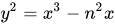
- Does there exist an elliptic curve, , where is a congruent number, with three rational points on the curve, , , , such that each point is "double" another rational point on the curve ("double" in the sense of the group structure for points on an elliptic curve), and , and are in arithmetic progression?


Properties of a magic square of squares
Let denotes the sum of each row, column or main diagonals of a primitive (all cells are pairwise coprime) third-order magic square of squares. If such a magic square of squares exists, it must satisfy the following properties.

- All cells must be odd.[9]
- All cells must be of the form .[10]
- No cell can have a prime divisor of the form .[9]
- must be of the form where is the middle cell.[11]
- must be of the form .[10]
- All prime divisors of the middle cell must be of the form .[9]
- A prime of the form cannot divide a non-corner edge cell.[9]
- If a prime of the form divides a non-center cell then must also divide the center cell and the other cell in that line.[9]
- If a prime of the form divides a corner cell then it must also divide the two non-corner edge cells that are not adjacent to that corner.[9]
- If a prime of the form divides a corner cell then it must also divide the center cell and the opposite corner cell.[12]


Brute force searches for solutions have been unsuccessful, and suggest that if a solution exists, it would consist of numbers greater than at least .[13]

Rice University professor of mathematics Anthony Várilly-Alvarado has expressed his doubt as to the existence of the magic square of squares.[8]
Notable attempts
There have been a number of attempts to construct a magic square of squares by recreational mathematicians.
Sallows' Square
Following Gardner's prize offer for anyone who could find a magic square of squares in 1996, Lee Sallows published his attempt in The Mathematical Intelligencer. His attempt is unique in that all of the rows and columns, and one of the diagonals, all sum to the same square number.[14][8]
| 1272 | 462 | 582 | 1472 | |
| 22 | 1132 | 942 | 1472 | |
| 742 | 822 | 972 | 1472 | |
| 1472 | 1472 | 1472 | 1472 | 38307 |
Bremner Square
In 1999, Andrew Bremner published his attempt at the problem, and further research surrounding magic squares of squares.[15] Bremner's attempt differs from others in that not all elements of the square are square numbers, while all the rows, columns and diagonals sum to the same number.[8]
| 3732 | 2892 | 5652 | 541875 | |
| 360721 | 4252 | 232 | 541875 | |
| 2052 | 5272 | 222121 | 541875 | |
| 541875 | 541875 | 541875 | 541875 | 541875 |
Parker square
The Parker square[16] is an attempt by Matt Parker to solve the problem. His solution is a trivial, semimagic square of squares, as , and all appear twice, and the diagonal sums to 4107 instead of 3051.[17][13]


| 292 | 12 | 472 | 3051 | |
| 412 | 372 | 12 | 3051 | |
| 232 | 412 | 292 | 3051 | |
| 4107 | 3051 | 3051 | 3051 | 3051 |
Non third-order magic squares of squares
Magic squares of squares of orders greater than 3 have been known since as early as 1770, when Leonhard Euler sent a letter to Joseph-Louis Lagrange detailing a fourth-order magic square.[18]
| 682 | 292 | 412 | 372 |
| 172 | 312 | 792 | 322 |
| 592 | 282 | 232 | 612 |
| 112 | 772 | 82 | 492 |
Multimagic squares are magic squares which remain magic after raising every element to some power. In 1890, Georges Pfeffermann published a solution to a problem he posed involving the construction of an eighth-order 2-multimagic square.[19]
| 56 | 34 | 8 | 57 | 18 | 47 | 9 | 31 | 260 | |
| 33 | 20 | 54 | 48 | 7 | 29 | 59 | 10 | 260 | |
| 26 | 43 | 13 | 23 | 64 | 38 | 4 | 49 | 260 | |
| 19 | 5 | 35 | 30 | 53 | 12 | 46 | 60 | 260 | |
| 15 | 25 | 63 | 2 | 41 | 24 | 50 | 40 | 260 | |
| 6 | 55 | 17 | 11 | 36 | 58 | 32 | 45 | 260 | |
| 61 | 16 | 42 | 52 | 27 | 1 | 39 | 22 | 260 | |
| 44 | 62 | 28 | 37 | 14 | 51 | 21 | 3 | 260 | |
| 260 | 260 | 260 | 260 | 260 | 260 | 260 | 260 | 260 | 260 |
References
- ^ LaBar, Martin (January 1984). "Problems". The College Mathematics Journal. 15 (1): 68–74. doi:10.2307/3027440. ISSN 0746-8342 – via JSTOR.
- ^ a b Robertson, John P. (1996-10-01). "Magic Squares of Squares". Mathematics Magazine. 69 (4): 289–293. doi:10.1080/0025570X.1996.11996457. ISSN 0025-570X.
- ^ Gardner, Martin (January 1996). "The magic of 3x3" (PDF). Quantum. 6 (3): 24–26. ISSN 1048-8820. Retrieved 6 January 2024.
- ^ Gardner, Martin (March 1996). "The latest magic" (PDF). Quantum. 6 (4): 60. ISSN 1048-8820. Retrieved 6 January 2024.
- ^ "Can You Solve a Puzzle Unsolved Since 1996?". Scientific American. October 2014.
- ^ Schwartzman, Steven (1994). The Words of Mathematics: An Etymological Dictionary of Mathematical Terms Used in English. MAA. p. 130.
- ^ Wolfram MathWorld: Magic Square Weisstein, Eric W.
- ^ a b c d Várilly-Alvarado, Anthony; et al. (Numberphile). Magic Squares of Squares (are PROBABLY impossible) - Numberphile – via YouTube.
- ^ a b c d e f Rabern, Landon (2017-01-15). "Properties of Magic Squares of Squares". Rose-Hulman Undergraduate Mathematics Journal. 4 (1).
- ^ a b Zimmermann, Paul (2015). "Magic Squares of Squares" (PDF). Inria / LORIA. Retrieved April 30, 2026.
- ^ Gardner, Martin (1987). Riddles of the Sphinx. Anneli Lax New Mathematical Library. Providence, Rhode Island: American Mathematical Society. pp. 136–137. ISBN 978-0-88385-632-1.
- ^ Morgenstern, Maurice (2007). "Properties of a 3x3 Magic Square of Squares" (PDF). Multimagie.com. Christian Boyer. Retrieved April 30, 2026.
- ^ a b Boyer, Christian. "Latest research on the "3x3 magic square of squares" problem". Multimagie.com. Retrieved 19 June 2025.
- ^ a b Sallows, Lee (1997). "The Lost Theorem" (PDF). The Mathematical Intelligencer.
- ^ a b Bremner, Andrew (1999). "On squares of squares" (PDF). Acta Arithmetica.
- ^ Cain, Onno (2019). "Gaussian Integers, Rings, Finite Fields, and the Magic Square of Squares". arXiv:1908.03236 [math.RA].
Some 'near misses' have been found such as the Parker Square [2]
- ^ Matt Parker; et al. (Numberphile) (April 18, 2016). The Parker Square - Numberphile. Retrieved June 6, 2025 – via YouTube.
- ^ Boyer, Christian (12 November 2008). "Some Notes on the Magic Squares of Squares Problem". The Mathematical Intelligencer. 27 (2): 52–64. doi:10.1007/BF02985794.
- ^ Boyer, Christian. "Bimagic squares". Multimagie.com. Retrieved 6 June 2025.
- ^ Boyer, Christian. "Solution of the first bimagic square, 8th-order, of Pfeffermann". Multimagie.com. Retrieved 6 June 2025.
Content Disclaimer
Informasi ini disarikan dari Wikipedia dan disajikan kembali untuk tujuan edukasi. Konten tersedia di bawah lisensi CC BY-SA 3.0. Kami tidak bertanggung jawab atas ketidakakuratan data yang bersumber dari kontribusi publik tersebut.
- The information displayed on this website is sourced in part or in whole from Wikipedia and has been adapted for the purpose of restating it. We strive to provide accurate and relevant information, however:
- There is no guarantee of absolute accuracy. Wikipedia is an open, collaborative project that can be edited by anyone, so information is subject to change.
- It is not intended to constitute professional advice. The content displayed is for informational and educational purposes only. For important decisions (e.g., medical, legal, or financial), please consult a professional.
- Content copyright. Wikipedia is licensed under the Creative Commons Attribution-ShareAlike License (CC BY-SA). This means that content may be reused with appropriate attribution and shared under a similar license.
- Responsible use. Any risk arising from the use of information from this website is entirely the responsibility of the user.