Landau's function
In mathematics, Landau's function g(n), named after Edmund Landau, is defined for every natural number n to be the largest order of an element of the symmetric group Sn. Equivalently, g(n) is the largest least common multiple (lcm) of any partition of n, or the maximum number of times a permutation of n elements can be recursively applied to itself before it returns to its starting sequence.
For instance, 5 = 2 + 3 and lcm(2,3) = 6. No other partition of 5 yields a bigger lcm, so g(5) = 6. An element of order 6 in the group S5 can be written in cycle notation as (1 2) (3 4 5). Note that the same argument applies to the number 6, that is, g(6) = 6. There are arbitrarily long sequences of consecutive numbers n, n + 1, ..., n + m on which the function g is constant.[1]
The integer sequence g(0) = 1, g(1) = 1, g(2) = 2, g(3) = 3, g(4) = 4, g(5) = 6, g(6) = 6, g(7) = 12, g(8) = 15, ... (sequence A000793 in the OEIS) is named after Edmund Landau, who proved in 1902[2] that
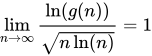
(where ln denotes the natural logarithm). Equivalently (using little-o notation), .

More precisely,[3]

If , where denotes the prime counting function, the logarithmic integral function with inverse , and we may take for some constant c > 0 by Ford,[4] then[3]





The statement that
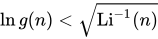
for all sufficiently large n is equivalent to the Riemann hypothesis.
It can be shown that

with the only equality between the functions at n = 0, and indeed

Notes
- ^ Nicolas, Jean-Louis (1968), "Sur l'ordre maximum d'un élément dans le groupe Sn des permutations", Acta Arithmetica (in French), 14: 315–332
- ^ Landau, pp. 92–103
- ^ a b Massias, J. P.; Nicholas, J. L.; Robin, G. (1988), "Évaluation asymptotique de l'ordre maximum d'un élément du groupe symétrique", Acta Arithmetica (in French), 50: 221–242
- ^ Kevin Ford (November 2002). "Vinogradov's Integral and Bounds for the Riemann Zeta Function" (PDF). Proc. London Math. Soc. 85 (3): 565–633. arXiv:1910.08209. doi:10.1112/S0024611502013655. S2CID 121144007. Archived from the original (PDF) on 2022-02-01. Retrieved 2023-12-20.
- ^ Jean-Pierre Massias, Majoration explicite de l'ordre maximum d'un élément du groupe symétrique, Ann. Fac. Sci. Toulouse Math. (5) 6 (1984), no. 3-4, pp. 269–281 (1985).
References
- E. Landau, "Über die Maximalordnung der Permutationen gegebenen Grades [On the maximal order of permutations of given degree]", Arch. Math. Phys. Ser. 3, vol. 5, 1903.
- W. Miller, "The maximum order of an element of a finite symmetric group", American Mathematical Monthly, vol. 94, 1987, pp. 497–506.
- J.-L. Nicolas, "On Landau's function g(n)", in The Mathematics of Paul Erdős, vol. 1, Springer-Verlag, 1997, pp. 228–240.
External links
Content Disclaimer
Informasi ini disarikan dari Wikipedia dan disajikan kembali untuk tujuan edukasi. Konten tersedia di bawah lisensi CC BY-SA 3.0. Kami tidak bertanggung jawab atas ketidakakuratan data yang bersumber dari kontribusi publik tersebut.
- The information displayed on this website is sourced in part or in whole from Wikipedia and has been adapted for the purpose of restating it. We strive to provide accurate and relevant information, however:
- There is no guarantee of absolute accuracy. Wikipedia is an open, collaborative project that can be edited by anyone, so information is subject to change.
- It is not intended to constitute professional advice. The content displayed is for informational and educational purposes only. For important decisions (e.g., medical, legal, or financial), please consult a professional.
- Content copyright. Wikipedia is licensed under the Creative Commons Attribution-ShareAlike License (CC BY-SA). This means that content may be reused with appropriate attribution and shared under a similar license.
- Responsible use. Any risk arising from the use of information from this website is entirely the responsibility of the user.