Khatt Atui
| Khatt Atui Khatt Atoui, Wad Atui, Uad Atui, Oued Atui, Oued Atwiy | |
|---|---|

 1989 map of Western Sahara showing the course of Khatt Atui (Uad Atui) | |
| Location | |
| Countries | Mauritania, Western Sahara |
| Regions | Dakhlet Nouadhibou, Inchiri (Mauritania) |
| Physical characteristics | |
| Source | northeast of Aousserd, Western Sahara |
| • coordinates | 22°47′N 14°07′W / 22.783°N 14.117°W |
| Mouth | Baie d'Aouati, Atlantic Ocean |
• coordinates | 19°53′N 16°15′W / 19.883°N 16.250°W |
Basin size | 83,295 km2 (32,160 sq mi) |
| Basin features | |
| Population | 99,599 |
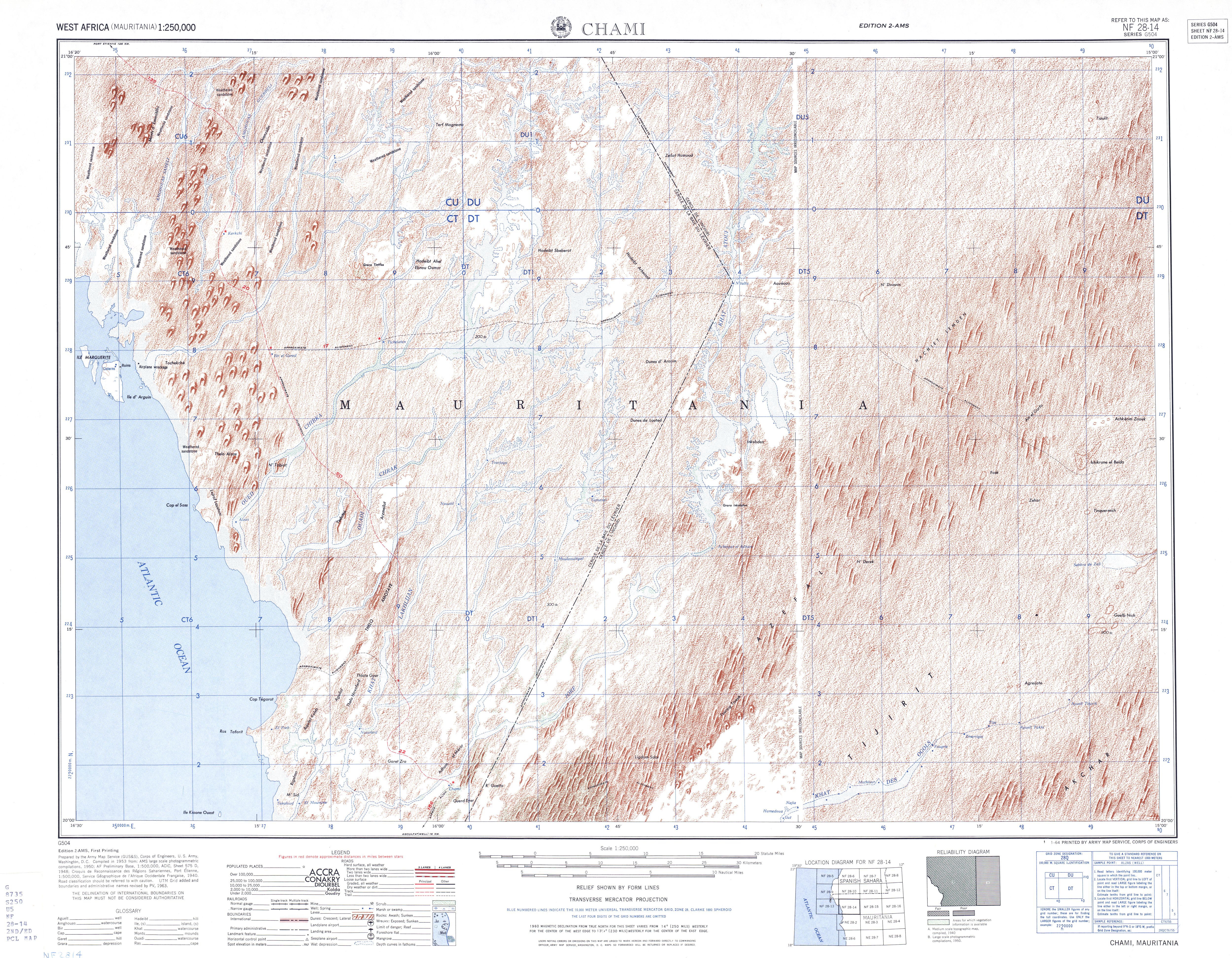
Khatt Atui is a wadi in North Africa. This dry riverbed begins near Aousserd in the disputed territory of Western Sahara and runs southwest through the Dakhlet Nouadhibou and Inchiri Regions of Mauritania,[1] ending at the Baie d'Aouati on the Atlantic coast east of Iouik, Mauritania in Banc d'Arguin National Park.[2]
The Atui basin as defined by the Transboundary Waters Assessment Programme of the Global Environment Facility covers 83,295 square kilometres (32,160 sq mi) and is home to an estimated 99,599 people.[3] The Mauritanian settlements of Chami (on the highway between Nouakchott and Nouadhibou), Imkebden and N'Talfa are located along the wadi,[4] as is the Tasiast gold mine.[5]
Khatt Atui has been suggested as the location of the lower reaches of a major ancient river, dubbed the Tamanrasett paleoriver, that flowed through the Sahara to the Arguin Basin during humid episodes in the late Quaternary.[6] Early Neolithic archaeological sites have been found along the Mauritanian portion of the wadi.[7]
References
- ^ TPC J-1B: El Memrhar, Mauritania (Map). 1:500,000. Tactical Pilotage Chart. Defense Mapping Agency Aerospace Center. 1985.
- ^ NE 28-2: El Memrhar, Mauritania (Map). 1:250,000. Series G504. U.S. Army Map Service. 1963.
- ^ "Atui Basin". Transboundary Waters Assessment Programme. 2016. Archived from the original on 6 March 2019. Retrieved 4 February 2018.
- ^ NF 28-14: Chami, Mauritania (Map). 1:250,000. Series G504. U.S. Army Map Service. 1963.
- ^ "Addendum to the Phase 2 Environmental Impact Assessment for the Expansion Project at the Tasiast Mine in Mauritania" (PDF). SRK Consulting. January 2016. p. 4. Retrieved 4 February 2018.
- ^ Skonieczny, C; Paillou, P; Bory, A; Bayon, G; Biscara, L; Crosta, X; Eynaud, F; Malaizé, B; Revel, M; Aleman, N; Barusseau, JP; Vernet, R; Lopez, S; Grousset, F (2015). "African humid periods triggered the reactivation of a large river system in Western Sahara". Nature Communications. 6: 8751. doi:10.1038/ncomms9751. PMC 4659928. PMID 26556052.
- ^ "Tasiast Gold Mine Expansion Project: Phase 1b Environmental Impact Assessment" (PDF). URS Scott Wilson. 31 July 2011. p. 122. Retrieved 4 February 2018.

Content Disclaimer
Informasi ini disarikan dari Wikipedia dan disajikan kembali untuk tujuan edukasi. Konten tersedia di bawah lisensi CC BY-SA 3.0. Kami tidak bertanggung jawab atas ketidakakuratan data yang bersumber dari kontribusi publik tersebut.
- The information displayed on this website is sourced in part or in whole from Wikipedia and has been adapted for the purpose of restating it. We strive to provide accurate and relevant information, however:
- There is no guarantee of absolute accuracy. Wikipedia is an open, collaborative project that can be edited by anyone, so information is subject to change.
- It is not intended to constitute professional advice. The content displayed is for informational and educational purposes only. For important decisions (e.g., medical, legal, or financial), please consult a professional.
- Content copyright. Wikipedia is licensed under the Creative Commons Attribution-ShareAlike License (CC BY-SA). This means that content may be reused with appropriate attribution and shared under a similar license.
- Responsible use. Any risk arising from the use of information from this website is entirely the responsibility of the user.