Kami-shima
 | This article includes a list of references, related reading, or external links, but its sources remain unclear because it lacks inline citations. (August 2023) |
Native name: Kami-shima (神島) | |
|---|---|
 National Land Image Information (Color Aerial Photographs), Ministry of Land, Infrastructure, Transport and Tourism. | |
 Interactive map of Kami-shima | |
| Geography | |
| Location | Mie Prefecture |
| Coordinates | 34°32′N 136°59′E / 34.533°N 136.983°E |
| Area | 0.75 km2 (0.29 sq mi) |
| Coastline | 3,900 m (12800 ft) |
| Highest elevation | 171 m (561 ft) |
| Highest point | Tōmyōyama |
| Administration | |
Japan | |
| Demographics | |
| Population | 534 (2000) |
| Pop. density | 703/km2 (1821/sq mi) |
| Ethnic groups | Japanese |
Kami-shima (神島) is an inhabited island at the mouth of Ise Bay off the east coast of central Honshu, Japan. It is administered by the city of Toba in Mie Prefecture.
The name for Kami-shima has alternatively been written as Kameshima (亀島) or Kajima (歌島). The current name Kami-shima, or “God island,” refers to a Shinto shrine on the island called Yatsushiro shrine. Archaeologists have found hundreds of ceremonial artifacts on the island, ranging from ancient mirrors to ceramics dating from the Kofun period through the Muromachi period. During the Edo period, the island was used as a prison by Toba Domain, with the sobriquet “Shima-Hachijo” in reference to the prison island of Hachijō-jima used by the Tokugawa shogunate.
The economy of the island is based on commercial fishing in its adjacent waters, and on tourism. Commercial fishing is the dominant industry.
In popular culture
The island is the setting for the 1954 novel by Yukio Mishima The Sound of Waves, and has been used several times as a filming location for movies.
A fictionalized version of the island is used as the primary setting for the video game Paranormasight: The Mermaid's Curse.

Gallery
-
 Climbing stairs on Kami Island
 -
 Benten-misaki
 -
 Kamishima Lighthouse
 -
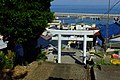 Yatsushiro shrine
_%E7%A5%9E%E5%B3%B6%E3%81%AE%E6%B0%91%E5%AE%B6%E3%83%BB%E8%B7%AF%E5%9C%B0_DSCF6656.jpg)


_%E7%A5%9E%E5%B3%B6%E6%B0%91%E5%AE%B6%E3%83%BB%E8%B7%AF%E5%9C%B0%E3%80%81%E5%85%AB%E4%BB%A3%E7%A5%9E%E7%A4%BE_DSCF6188.jpg)
See also
References
- Saishin-Nihon-chizu - Atlas of Japan, Imidas Shueisha, Tokyo 1990
 | This Mie Prefecture location article is a stub. You can help Wikipedia by adding missing information. |
Content Disclaimer
Informasi ini disarikan dari Wikipedia dan disajikan kembali untuk tujuan edukasi. Konten tersedia di bawah lisensi CC BY-SA 3.0. Kami tidak bertanggung jawab atas ketidakakuratan data yang bersumber dari kontribusi publik tersebut.
- The information displayed on this website is sourced in part or in whole from Wikipedia and has been adapted for the purpose of restating it. We strive to provide accurate and relevant information, however:
- There is no guarantee of absolute accuracy. Wikipedia is an open, collaborative project that can be edited by anyone, so information is subject to change.
- It is not intended to constitute professional advice. The content displayed is for informational and educational purposes only. For important decisions (e.g., medical, legal, or financial), please consult a professional.
- Content copyright. Wikipedia is licensed under the Creative Commons Attribution-ShareAlike License (CC BY-SA). This means that content may be reused with appropriate attribution and shared under a similar license.
- Responsible use. Any risk arising from the use of information from this website is entirely the responsibility of the user.