Inversion temperature
The inversion temperature in thermodynamics and cryogenics is the critical temperature below which a gas that is expanding at constant enthalpy will experience a temperature decrease, and above which will experience a temperature increase. This temperature change is known as the Joule–Thomson effect, and is exploited in the liquefaction of gases. Inversion temperature depends on the nature of the gas. The temperature of an ideal gas remains constant during expansion.
For a van der Waals gas we can calculate the enthalpy using statistical mechanics as


where is the number of molecules, is volume, is temperature (in the Kelvin scale), is the Boltzmann constant, and and are constants depending on intermolecular forces and molecular volume, respectively.


From this equation, if enthalpy is kept constant and there is an increase of volume, temperature must change depending on the sign of . Therefore, our inversion temperature is given where the sign flips at zero, or

- ,
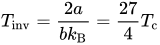
where is the critical temperature of the substance. So for , an expansion at constant enthalpy increases temperature as the work done by the repulsive interactions of the gas is dominant, and so the change in kinetic energy is positive. But for , expansion causes temperature to decrease because the work of attractive intermolecular forces dominates, giving a negative change in average molecular speed, and therefore kinetic energy.[1]


See also
References
- ^ Charles Kittel and Herbert Kroemer (1980). Thermal Physics (2nd ed.). W.H. Freeman. ISBN 0-7167-1088-9.
External links
- Thermodynamic Concepts and Processes (Chapter 2) (part of the Statistical and Thermal Physics (STP) Curriculum Development Project at Clark University)
Content Disclaimer
Informasi ini disarikan dari Wikipedia dan disajikan kembali untuk tujuan edukasi. Konten tersedia di bawah lisensi CC BY-SA 3.0. Kami tidak bertanggung jawab atas ketidakakuratan data yang bersumber dari kontribusi publik tersebut.
- The information displayed on this website is sourced in part or in whole from Wikipedia and has been adapted for the purpose of restating it. We strive to provide accurate and relevant information, however:
- There is no guarantee of absolute accuracy. Wikipedia is an open, collaborative project that can be edited by anyone, so information is subject to change.
- It is not intended to constitute professional advice. The content displayed is for informational and educational purposes only. For important decisions (e.g., medical, legal, or financial), please consult a professional.
- Content copyright. Wikipedia is licensed under the Creative Commons Attribution-ShareAlike License (CC BY-SA). This means that content may be reused with appropriate attribution and shared under a similar license.
- Responsible use. Any risk arising from the use of information from this website is entirely the responsibility of the user.