Interlaced arch

Interlaced arches is a scheme of decoration employed in Islamic and later in Romanesque and Gothic architecture, where arches spring from alternate piers, interlacing or intersecting one another. In the former case, the first arch archivolt is carried alternately over and under the second, in the latter the archivolts actually intersect and stop one another. An example of the former exists in St Peter-in-the-East in Oxford and of the latter in St. Joseph’s chapel in Glastonbury, and in the Bristol Cathedral.[1][2] The arches in the interlacing arcade can be either semicircular or pointed, and usually form purely decorative blind arcades.[3]
The interlaced arches are most likely an invention of Islamic architecture (cf. Bab al-Mardum Mosque, 999-1000 AD and Mosque–Cathedral of Córdoba, 833-988[4]). This decoration was especially popular in England, with the most famous example at Lincoln Cathedral (St Hugh's choir).[3]
-
 Bab al-Mardum Mosque
 -
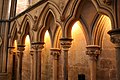 Arcade at St Hugh's choir of Lincoln Cathedral
 -
 Non-blind mixed-line arches at Aljafería Palace


References
- ^ . Encyclopædia Britannica. Vol. 14 (11th ed.). 1911. p. 693.
- ^ "interlacing arches". Merriam-Webster.com Dictionary. Merriam-Webster. OCLC 1032680871.
- ^ a b Hourihane 2012, p. 131, Interlace.
- ^ Moffett, Fazio & Wodehouse 2003, Islamic Architecture.
Sources
- Hourihane, C. (2012). "Arch". The Grove Encyclopedia of Medieval Art and Architecture. Vol. 1. Oxford University Press. pp. 129–134. ISBN 978-0-19-539536-5. Retrieved 2024-12-24.
- Moffett, M.; Fazio, M.W.; Wodehouse, L. (2003). "Islamic Architecture". A World History of Architecture. Monographics (Series : Laurence King Publishing). Laurence King. ISBN 978-1-85669-371-4. Retrieved 2024-12-24.
 | This architecture-related article is a stub. You can help Wikipedia by adding missing information. |
Content Disclaimer
Informasi ini disarikan dari Wikipedia dan disajikan kembali untuk tujuan edukasi. Konten tersedia di bawah lisensi CC BY-SA 3.0. Kami tidak bertanggung jawab atas ketidakakuratan data yang bersumber dari kontribusi publik tersebut.
- The information displayed on this website is sourced in part or in whole from Wikipedia and has been adapted for the purpose of restating it. We strive to provide accurate and relevant information, however:
- There is no guarantee of absolute accuracy. Wikipedia is an open, collaborative project that can be edited by anyone, so information is subject to change.
- It is not intended to constitute professional advice. The content displayed is for informational and educational purposes only. For important decisions (e.g., medical, legal, or financial), please consult a professional.
- Content copyright. Wikipedia is licensed under the Creative Commons Attribution-ShareAlike License (CC BY-SA). This means that content may be reused with appropriate attribution and shared under a similar license.
- Responsible use. Any risk arising from the use of information from this website is entirely the responsibility of the user.