Holly blue
| Holly blue | |
|---|---|
_male.jpg)
| |
| Male | |
_female.jpg)
| |
| Female both Cumnor Hill, Oxford, England | |
Scientific classification 
| |
| Kingdom: | Animalia |
| Phylum: | Arthropoda |
| Clade: | Pancrustacea |
| Class: | Insecta |
| Order: | Lepidoptera |
| Family: | Lycaenidae |
| Genus: | Celastrina |
| Species: | C. argiolus
|
| Binomial name | |
| Celastrina argiolus | |
| Synonyms | |
| |

The Holly blue (Celastrina argiolus)[2] is a butterfly that belongs to the lycaenids or blues family and is native to the Palearctic.
Common names
The common name Holly blue is derived from the association of the larval stage with the Holly tree.[3]
In India, C. argiolus is known as the hill hedge blue.[4]
Description

The holly blue has violet blue wings, and pale silver-blue under-wings spotted with black dots.[5] Seitz describes it:
Male above shining violet blue, only the apical portion of the costal margin being minutely edged with white. The female has both wings broadly bordered with dark, the margin of the hindwing bearing vestiges of ocelli. Underside silver-white, in the disc a row of black dots, some of which are elongate, and before the margin blackish shadowy dots. Egg very flat, whitish. Larva green or brown, marked with yellowish white, bearing catenulate (chain-like) stripes on the back, on segment 7 a gland to attract ants; head brown. On Ivy, Ilex, Euonymus, Rhamnus, Robinia, Genista, Spartium, Astragalus, Rubus, Erica, Pyrus and many other plants; in Europe visited usually by ants of the genus Lasius; in June and the autumn. Pupa mostly fastened to the underside of a leaf, ochreous with brown spots and markings. The butterflies in the spring and again in July, occasionally a third time at the end of August and in September, everywhere common, particularly at the flowers of ivy and brambles[6]
In Europe, the larvae of the first generation (the spring generation) feed mainly on the holly species Ilex aquifolium (the flower buds, berries, and leaves), but the second generation (the summer generation) uses a range of food plants including Spindle, Dogwoods, Ivy, and Bramble.[7][3]
The wingspan is around 2.6 to 3.4 cm.[3][8][9]
The Holly blue usually perches with its wings almost fully closed or around 90 degrees.[10]
The holly blue is the national butterfly of Finland.[11]
Taxonomy
This species was originally described as Papilio argiolus by Carl Linnaeus in 1758, and refers to the examples flying in Europe. In their monograph on the Lycaenopsis group of polyommatine genera, Eliot & Kawazoe, 1983, list 14 taxa as valid subspecies names, plus many further synonyms to which they accord lesser status. According to Eliot & Kawazoe, 1983, these 14 subspecies are divided into four groups as follows:
Palaearctic & North African
South and South-East Asian
|
Far Eastern
|
Range
Found throughout Eurasia.[12] It is particularly common in the south of Great Britain.[13] In South Asia, it occurs from Chitral in Pakistan to Kumaon in India.[4]
Population cycle
The holly blue is subject to marked population cycles which appear to be caused by interactions with the parasitoid ichneumon wasp Listrodromus nycthemerus. The wasp lays an egg on a holly blue caterpillar, inserting the egg into the caterpillar's body and the adult wasp emerges from the chrysalis, killing the chrysalis before its emergence. The population of the butterfly is tracked by that of the wasp, when butterfly populations are low the wasp population falls and this allows the butterfly population to increase and the population of L. nycthemerus can increase as there are more hosts available to be parasitised. As more caterpillars are parasitised the butterfly population crashes.[14][15][16]
See also
Gallery
-
 female laying egg, Bulgaria
 -
 Egg
Egg -
 Imago
Imago -
 Female
 -
 Bottom sides of the wings
 -
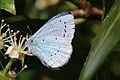 Male
Male
_female_laying_egg_Bulgaria.jpg)


_-_Celastrina_argiolus_-_Havr%C3%A9_(1).JPG)

_male_underside.jpg)
References
- ^ van Swaay, C.; Wynhoff, I.; Verovnik, R.; et al. (2010). "Celastrina argiolus (Europe assessment)". IUCN Red List of Threatened Species. 2010 e.T174235A7033895. Retrieved 13 June 2023.
- ^ Beccaloni, G.; Scoble, M.; Kitching, I.; Simonsen, T.; Robinson, G.; Pitkin, B.; Hine, A.; Lyal, C., eds. (2003). "Celastrina argiolus". The Global Lepidoptera Names Index. Natural History Museum. Retrieved April 20, 2018.
- ^ a b c "Holly blue | The Wildlife Trusts". www.wildlifetrusts.org. Retrieved 2026-04-23.
- ^ a b Evans, W.H. (1932). The Identification of Indian Butterflies (2nd ed.). Mumbai, India: Bombay Natural History Society. pp. 221–226, ser no H21.24.
- ^ "Holly Blue". www.durlston.co.uk. Retrieved 2026-04-23.
- ^ Seitz, Adalbert, ed. (1909). Die Großschmetterlinge des palaearktischen Faunengebietes. Band 1: Die palaearktischen Tagfalter. Vol. 1. p. 322. Retrieved 2023-01-11.
- ^ "Holly Blue". butterfly-conservation.org. Retrieved 2026-04-23.
- ^ Trust, Woodland. "Holly blue (Celastrina argiolus) - Butterflies". Woodland Trust. Retrieved 2026-04-23.
- ^ "Holly Blue, Celastrina argiolus - Butterflies - NatureGate". luontoportti.com. Retrieved 2026-04-23.
- ^ "Butterfly Conservation Yorkshire - Holly Blue". www.yorkshirebutterflies.org.uk. Retrieved 2026-04-23.
- ^ "Finland's national butterfly is the holly blue - Suomi 100". suomifinland100.fi. Archived from the original on 2018-06-19. Retrieved 2017-08-01.
- ^ "Celastrina argiolus (Linnaeus, 1758)". www.gbif.org. Retrieved 2026-04-23.
- ^ "Holly Blue | NatureSpot". www.naturespot.org. Retrieved 2026-04-23.
- ^ "Holly Blue defies predatory wasp - Big Butterfly Count results". Butterfly Conservation. 9 October 2015. Retrieved 13 June 2023.
- ^ theresagreen (2012-04-15). "Butterfly study: Holly Blue". everyday nature trails. Retrieved 2026-04-23.
- ^ "Holly Blue | Wildlife Gardening Forum". wlgf.org. Retrieved 2026-04-23.
- Beccaloni, George; Scoble, Malcolm; Kitching, Ian; Simonsen, Thomas; Robinson, Gaden; Pitkin, Brian; Hine, Adrian; Lyal, Chris. "The Global Lepidoptera Names Index (LepIndex)". Natural History Museum, London. Retrieved 2016-10-15.
- Eliot, J. N. and Kawazoe, A., 1983. Blue butterflies of the Lycaenopsis group: 1–309, 6 pls. London.
- Evans, W.H. (1932). The Identification of Indian Butterflies (2nd ed.). Mumbai, India: Bombay Natural History Society.
- Willmott, Ken and Freed, Tim (1999). The Holly Blue Butterfly. Butterfly Conservation, Colchester, UK, 20p. ISBN 0-9522602-7-1.
- "Celastrina argiolus". Integrated Taxonomic Information System. Retrieved 6 February 2006.
External links


- Savela, Markku. "Celastrina argiolus (Linnaeus, 1758)". Lepidoptera and Some Other Life Forms. Archived from the original on April 3, 2018. Retrieved April 3, 2018.
Content Disclaimer
Informasi ini disarikan dari Wikipedia dan disajikan kembali untuk tujuan edukasi. Konten tersedia di bawah lisensi CC BY-SA 3.0. Kami tidak bertanggung jawab atas ketidakakuratan data yang bersumber dari kontribusi publik tersebut.
- The information displayed on this website is sourced in part or in whole from Wikipedia and has been adapted for the purpose of restating it. We strive to provide accurate and relevant information, however:
- There is no guarantee of absolute accuracy. Wikipedia is an open, collaborative project that can be edited by anyone, so information is subject to change.
- It is not intended to constitute professional advice. The content displayed is for informational and educational purposes only. For important decisions (e.g., medical, legal, or financial), please consult a professional.
- Content copyright. Wikipedia is licensed under the Creative Commons Attribution-ShareAlike License (CC BY-SA). This means that content may be reused with appropriate attribution and shared under a similar license.
- Responsible use. Any risk arising from the use of information from this website is entirely the responsibility of the user.