Group code
 | This article has multiple issues. Please help improve it or discuss these issues on the talk page. (Learn how and when to remove these messages)
|


In coding theory, group codes are a type of code. Group codes consist of linear block codes which are subgroups of , where is a finite Abelian group.


A systematic group code is a code over of order defined by homomorphisms which determine the parity check bits. The remaining bits are the information bits themselves.


Construction
Group codes can be constructed by special generator matrices which resemble generator matrices of linear block codes except that the elements of those matrices are endomorphisms of the group instead of symbols from the code's alphabet. For example, considering the generator matrix
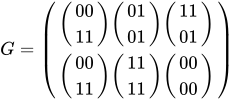
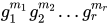
the elements of this matrix are matrices which are endomorphisms. In this scenario, each codeword can be represented as where are the generators of .


See also
- Group coded recording (GCR)
References
Further reading
- Watkinson, John (1990). "3.4. Group codes". Coding for Digital Recording. Stoneham, MA, USA: Focal Press. pp. 51–61. ISBN 978-0-240-51293-8.
- Biglieri, Ezio; Elia, Michele (1993-01-17). "Construction of Linear Block Codes Over Groups". Proceedings. IEEE International Symposium on Information Theory (ISIT). p. 360. doi:10.1109/ISIT.1993.748676. ISBN 978-0-7803-0878-7. S2CID 123694385.
- Forney, George David; Trott, Mitch D. (1993). "The dynamics of group codes: State spaces, trellis diagrams and canonical encoders". IEEE Transactions on Information Theory. 39 (5): 1491–1593. doi:10.1109/18.259635.
- Vazirani, Vijay Virkumar; Saran, Huzur; Rajan, B. Sundar (1996). "An efficient algorithm for constructing minimal trellises for codes over finite Abelian groups". IEEE Transactions on Information Theory. 42 (6): 1839–1854. CiteSeerX 10.1.1.13.7058. doi:10.1109/18.556679.
- Zain, Adnan Abdulla; Rajan, B. Sundar (1996). "Dual codes of Systematic Group Codes over Abelian Groups". Applicable Algebra in Engineering, Communication and Computing. 8 (1): 71–83.
Content Disclaimer
Informasi ini disarikan dari Wikipedia dan disajikan kembali untuk tujuan edukasi. Konten tersedia di bawah lisensi CC BY-SA 3.0. Kami tidak bertanggung jawab atas ketidakakuratan data yang bersumber dari kontribusi publik tersebut.
- The information displayed on this website is sourced in part or in whole from Wikipedia and has been adapted for the purpose of restating it. We strive to provide accurate and relevant information, however:
- There is no guarantee of absolute accuracy. Wikipedia is an open, collaborative project that can be edited by anyone, so information is subject to change.
- It is not intended to constitute professional advice. The content displayed is for informational and educational purposes only. For important decisions (e.g., medical, legal, or financial), please consult a professional.
- Content copyright. Wikipedia is licensed under the Creative Commons Attribution-ShareAlike License (CC BY-SA). This means that content may be reused with appropriate attribution and shared under a similar license.
- Responsible use. Any risk arising from the use of information from this website is entirely the responsibility of the user.