Grothendieck connection
 | This article has multiple issues. Please help improve it or discuss these issues on the talk page. (Learn how and when to remove these messages)
|


In algebraic geometry and synthetic differential geometry, a Grothendieck connection is a way of viewing connections in terms of descent data from infinitesimal neighbourhoods of the diagonal.
Introduction and motivation
The Grothendieck connection is a generalization of the Gauss–Manin connection constructed in a manner analogous to that in which the Ehresmann connection generalizes the Koszul connection. The construction itself must satisfy a requirement of geometric invariance, which may be regarded as the analog of covariance for a wider class of structures including the schemes of algebraic geometry. Thus the connection in a certain sense must live in a natural sheaf on a Grothendieck topology. In this section, we discuss how to describe an Ehresmann connection in sheaf-theoretic terms as a Grothendieck connection.
Let be a manifold and a surjective submersion, so that is a manifold fibred over Let be the first-order jet bundle of sections of This may be regarded as a bundle over or a bundle over the total space of With the latter interpretation, an Ehresmann connection is a section of the bundle (over ) The problem is thus to obtain an intrinsic description of the sheaf of sections of this vector bundle.


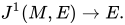
Grothendieck's solution is to consider the diagonal embedding The sheaf of ideals of in consists of functions on which vanish along the diagonal. Much of the infinitesimal geometry of can be realized in terms of For instance, is the sheaf of sections of the cotangent bundle. One may define a first-order infinitesimal neighborhood of in to be the subscheme corresponding to the sheaf of ideals (See below for a coordinate description.)



There are a pair of projections given by projection the respective factors of the Cartesian product, which restrict to give projections One may now form the pullback of the fibre space along one or the other of or In general, there is no canonical way to identify and with each other. A Grothendieck connection is a specified isomorphism between these two spaces. One may proceed to define curvature and p-curvature of a connection in the same language.




See also
- Connection (mathematics) – Function in mathematics
References
- Osserman, B., "Connections, curvature, and p-curvature", preprint.
- Katz, N., "Nilpotent connections and the monodromy theorem", IHES Publ. Math. 39 (1970) 175–232.
Content Disclaimer
Informasi ini disarikan dari Wikipedia dan disajikan kembali untuk tujuan edukasi. Konten tersedia di bawah lisensi CC BY-SA 3.0. Kami tidak bertanggung jawab atas ketidakakuratan data yang bersumber dari kontribusi publik tersebut.
- The information displayed on this website is sourced in part or in whole from Wikipedia and has been adapted for the purpose of restating it. We strive to provide accurate and relevant information, however:
- There is no guarantee of absolute accuracy. Wikipedia is an open, collaborative project that can be edited by anyone, so information is subject to change.
- It is not intended to constitute professional advice. The content displayed is for informational and educational purposes only. For important decisions (e.g., medical, legal, or financial), please consult a professional.
- Content copyright. Wikipedia is licensed under the Creative Commons Attribution-ShareAlike License (CC BY-SA). This means that content may be reused with appropriate attribution and shared under a similar license.
- Responsible use. Any risk arising from the use of information from this website is entirely the responsibility of the user.