Geul
| Geul | |
|---|---|
 The Geul valley in Plombières, Belgium | |
 | |
| Location | |
| Country | Belgium, Netherlands |
| Physical characteristics | |
| Source | |
| • location | near Lichtenbusch |
| • elevation | ±300 m (980 ft) |
| Mouth | |
• location | Meuse near Bunde |
• coordinates | 50°53′49″N 5°43′4″E / 50.89694°N 5.71778°E |
| Length | 58.0 km (36.0 mi) [1] |
| Basin features | |
| Progression | Meuse→ North Sea |
The Geul ([ˈɣøːl] ⓘ, Limburgish: [ˈɣøːl];[tone?] German: Göhl [ˈɡøːl]; French: Gueule [ɡœl] ⓘ) is a river in Belgium and in the Netherlands, where it is a right-bank tributary to the river Meuse.
Geography
The source of the Geul is at about 300 metres (980 ft) above sea level in northeastern Belgium near the German border, south of the German town of Aachen. From there, after flowing some 20 kilometres (12 mi) in a northwestern direction, it leaves Belgium and enters the Netherlands at Cottessen in the Vaals municipality. After a further 38 kilometres (24 mi) in a west-northwestern direction through the southernmost part of Limburg, which in its turn is the most southern province of the Netherlands, it flows into the Meuse, north of the city of Maastricht.
A tributary of the Geul is the Gulp.
Places through which the Geul passes are among others Kelmis (Belgium), Valkenburg aan de Geul, including Schin op Geul, and Meerssen (Netherlands).
Pollution
The water of the Geul is polluted seriously with heavy metals zinc and lead and as a result also is a serious source of heavy metal inflow into the Meuse.
This pollution is a result of former zinc and lead mining activities near the Belgian towns of Kelmis (La Calamine) and Plombières (formerly named Bleiberg).
The last one of these mines have closed early in the 20th century. One of the reasons for giving up mining activities in Plombières was the occasional flooding of the mine by the Geul, as the bedrock (mainly Carboniferous limestone) contains many faults and fissures.
Although mine factory buildings have been demolished, old railway dikes still are abundantly present in the area. They provide ideal hiking routes, that are known for the presence of so-called "zinc flora" (zinc-tolerant plants, such as yellow calamine violet and Viola calaminaria).
Significant events
.jpg)
During the 2021 European floods, the banks of the river flooded, including in some of the major population centers such as Valkenburg aan de Geul.[2]
Gallery
-
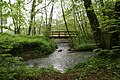 At Kelmis Tueljebach
 -
 At Schin op Geul
 -
 At Strabeek
 -
 Estuary at Voulwammes


See also
References


Content Disclaimer
Informasi ini disarikan dari Wikipedia dan disajikan kembali untuk tujuan edukasi. Konten tersedia di bawah lisensi CC BY-SA 3.0. Kami tidak bertanggung jawab atas ketidakakuratan data yang bersumber dari kontribusi publik tersebut.
- The information displayed on this website is sourced in part or in whole from Wikipedia and has been adapted for the purpose of restating it. We strive to provide accurate and relevant information, however:
- There is no guarantee of absolute accuracy. Wikipedia is an open, collaborative project that can be edited by anyone, so information is subject to change.
- It is not intended to constitute professional advice. The content displayed is for informational and educational purposes only. For important decisions (e.g., medical, legal, or financial), please consult a professional.
- Content copyright. Wikipedia is licensed under the Creative Commons Attribution-ShareAlike License (CC BY-SA). This means that content may be reused with appropriate attribution and shared under a similar license.
- Responsible use. Any risk arising from the use of information from this website is entirely the responsibility of the user.