Generated regressor
 | This article may be too technical for most readers to understand. (January 2019) |
In least squares estimation problems, sometimes one or more regressors specified in the model are not observable. One way to circumvent this issue is to estimate or generate regressors from observable data.[1] This generated regressor method is also applicable to unobserved instrumental variables. Under some regularity conditions, consistency and asymptotic normality of least squares estimator is preserved, but asymptotic variance has a different form in general.
Suppose the model of interest is the following:

where g is a conditional mean function and its form is known up to finite-dimensional parameter β. Here is not observable, but we know that for some function h known up to parameter , and a random sample is available. Suppose we have a consistent estimator of that uses the observation 's. Then, β can be estimated by (Non-Linear) Least Squares using . Some examples of the above setup include Anderson et al. (1976[2] and Barro (1977).[3]

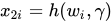


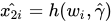
This problem falls into the framework of two-step M-estimator and thus consistency and asymptotic normality of the estimator can be verified using the general theory of two-step M-estimator.[4] As in general two-step M-estimator problem, asymptotic variance of a generated regressor estimator is usually different from that of the estimator with all regressors observed. Yet, in some special cases, the asymptotic variances of the two estimators are identical. To give one such example, consider the setting in which the regression function is linear in parameter and unobserved regressor is a scalar. Denoting the coefficient of unobserved regressor by if and then the asymptotic variance is independent of whether observing the regressor.[4]


![{\displaystyle E[\triangledown \gamma h(W,\gamma )U]=0}](https://wikimedia.org/api/rest_v1/media/math/render/svg/68db780ca040170303b8da2a14454a42e617c3a5)
With minor modifications in the model, the above formulation is also applicable to Instrumental Variable estimation. Suppose the model of interest is linear in parameter. Error term is correlated with some of the regressors, and the model specifies some instrumental variables, which are not observable but have the representation . If a consistent estimator of of is available using as instruments, the parameter of interest can be estimated by IV. Similar to the above case, consistency and asymptotic normality follows under mild conditions, and the asymptotic variance has a different form than observed IV case. Yet, there are cases in which the two estimators have the same asymptotic variance. One such case occurs if In this special case, inference on the estimated parameter can be conducted with the usual IV standard error estimator.
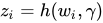
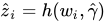
![{\displaystyle E[\triangledown \gamma h(W,\gamma )]=0[4]}](https://wikimedia.org/api/rest_v1/media/math/render/svg/4f79bb4a566838802c9ce3bcb2ab410908ab3579)
References
- ^ Pagan, A., 1984, “Econometric Issues in the Analysis of Regressions with Generated Regressors”, International Economic Review, 25 (1), 221-247.
- ^ Anderson, G. J., I. F. Pearce and P. K. Trivedi, "Output, Expected Demand and Unplanned Stocks," in I. F. Pearce et al., eds., A Model of Output, Employment, Wages and Prices in the U.K., Cambridge University Press.
- ^ Barro, R. J., 1977, "Unanticipated Money Growth and Unemployment in the United States," American Economic Review, 67, 101-115.
- ^ a b Wooldridge, J.M., Econometric Analysis of Cross Section and Panel Data, MIT Press, Cambridge, Mass
Content Disclaimer
Informasi ini disarikan dari Wikipedia dan disajikan kembali untuk tujuan edukasi. Konten tersedia di bawah lisensi CC BY-SA 3.0. Kami tidak bertanggung jawab atas ketidakakuratan data yang bersumber dari kontribusi publik tersebut.
- The information displayed on this website is sourced in part or in whole from Wikipedia and has been adapted for the purpose of restating it. We strive to provide accurate and relevant information, however:
- There is no guarantee of absolute accuracy. Wikipedia is an open, collaborative project that can be edited by anyone, so information is subject to change.
- It is not intended to constitute professional advice. The content displayed is for informational and educational purposes only. For important decisions (e.g., medical, legal, or financial), please consult a professional.
- Content copyright. Wikipedia is licensed under the Creative Commons Attribution-ShareAlike License (CC BY-SA). This means that content may be reused with appropriate attribution and shared under a similar license.
- Responsible use. Any risk arising from the use of information from this website is entirely the responsibility of the user.