Generalized Appell polynomials
 | This article includes a list of references, related reading, or external links, but its sources remain unclear because it lacks inline citations. (May 2024) |
In mathematics, a polynomial sequence has a generalized Appell representation if the generating function for the polynomials takes on a certain form:


where the generating function or kernel is composed of the series

- with
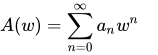

and
- and all
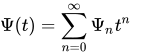

and
- with
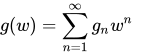

Given the above, it is not hard to show that is a polynomial of degree .


Boas–Buck polynomials are a slightly more general class of polynomials.
Special cases
- The choice of gives the class of Brenke polynomials.
- The choice of results in the Sheffer sequence of polynomials, which include the general difference polynomials, such as the Newton polynomials.
- The combined choice of and gives the Appell sequence of polynomials.


Explicit representation
The generalized Appell polynomials have the explicit representation
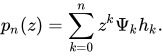
The constant is
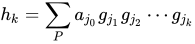
where this sum extends over all compositions of into parts; that is, the sum extends over all such that



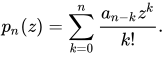
For the Appell polynomials, this becomes the formula
Recursion relation
Equivalently, a necessary and sufficient condition that the kernel can be written as with is that



where and have the power series



and

Substituting
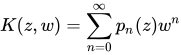
immediately gives the recursion relation
![{\displaystyle z^{n+1}{\frac {d}{dz}}\left[{\frac {p_{n}(z)}{z^{n}}}\right]=-\sum _{k=0}^{n-1}c_{n-k-1}p_{k}(z)-z\sum _{k=1}^{n-1}b_{n-k}{\frac {d}{dz}}p_{k}(z).}](https://wikimedia.org/api/rest_v1/media/math/render/svg/50fa5220f132f927db5f328de38bccc5d8f8fa76)
For the special case of the Brenke polynomials, one has and thus all of the , simplifying the recursion relation significantly.

See also

References
- Ralph P. Boas, Jr. and R. Creighton Buck, Polynomial Expansions of Analytic Functions (Second Printing Corrected), (1964) Academic Press Inc., Publishers New York, Springer-Verlag, Berlin. Library of Congress Card Number 63-23263.
- Brenke, William C. (1945). "On generating functions of polynomial systems". American Mathematical Monthly. 52 (6): 297–301. doi:10.2307/2305289. JSTOR 2305289.
- Huff, W. N. (1947). "The type of the polynomials generated by f(xt) φ(t)". Duke Mathematical Journal. 14 (4): 1091–1104. doi:10.1215/S0012-7094-47-01483-X.
 | This polynomial-related article is a stub. You can help Wikipedia by adding missing information. |
Content Disclaimer
Informasi ini disarikan dari Wikipedia dan disajikan kembali untuk tujuan edukasi. Konten tersedia di bawah lisensi CC BY-SA 3.0. Kami tidak bertanggung jawab atas ketidakakuratan data yang bersumber dari kontribusi publik tersebut.
- The information displayed on this website is sourced in part or in whole from Wikipedia and has been adapted for the purpose of restating it. We strive to provide accurate and relevant information, however:
- There is no guarantee of absolute accuracy. Wikipedia is an open, collaborative project that can be edited by anyone, so information is subject to change.
- It is not intended to constitute professional advice. The content displayed is for informational and educational purposes only. For important decisions (e.g., medical, legal, or financial), please consult a professional.
- Content copyright. Wikipedia is licensed under the Creative Commons Attribution-ShareAlike License (CC BY-SA). This means that content may be reused with appropriate attribution and shared under a similar license.
- Responsible use. Any risk arising from the use of information from this website is entirely the responsibility of the user.