G-module

In mathematics, given a group , a G-module is an abelian group on which acts compatibly with the abelian group structure on . This widely applicable notion generalizes that of a representation of G. Group (co)homology provides an important set of tools for studying general -modules.


The term G-module is also used for the more general notion of an R-module on which acts linearly (i.e. as a group of -module automorphisms).

Definition and basics
Let be a group. A left -module consists of[1] an abelian group together with a left group action such that


for all and in and all in , where denotes . A right -module is defined similarly. Given a left -module , it can be turned into a right -module by defining .


A function is called a morphism of -modules (or a -linear map, or a -homomorphism) if is both a group homomorphism and -equivariant.


The collection of left (respectively right) -modules and their morphisms form an abelian category (resp. ). The category (resp. ) can be identified with the category of left (resp. right) -modules, i.e. with the modules over the group ring .


![{\displaystyle \mathbb {Z} [G]}](https://wikimedia.org/api/rest_v1/media/math/render/svg/f40260c366fc309a5872899d2ea34cf094855857)
A submodule of a -module is a subgroup that is stable under the action of , i.e. for all and . Given a submodule of , the quotient module is the quotient group with action .



Examples
- Given a group , the abelian group is a -module with the trivial action .
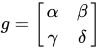
- Let be the set of binary quadratic forms with integers, and let (the 2×2 special linear group over ). Define


- where
- and is matrix multiplication. Then is a -module studied by Gauss.[2] Indeed, we have



- If is a representation of over a field , then is a -module (it is an abelian group under addition).


Topological groups
If is a topological group and is an abelian topological group, then a topological G-module is a -module where the action map is continuous (where the product topology is taken on ).[3]


In other words, a topological -module is an abelian topological group together with a continuous map satisfying the usual relations , , and .


Notes
- ^ Curtis, Charles W.; Reiner, Irving (1988) [1962]. Representation Theory of Finite Groups and Associative Algebras. John Wiley & Sons. ISBN 978-0-470-18975-7.
- ^ Kim, Myung-Hwan (1999), Integral Quadratic Forms and Lattices: Proceedings of the International Conference on Integral Quadratic Forms and Lattices, June 15–19, 1998, Seoul National University, Korea, American Mathematical Soc.
- ^ D. Wigner (1973). "Algebraic cohomology of topological groups". Trans. Amer. Math. Soc. 178: 83–93. doi:10.1090/s0002-9947-1973-0338132-7.
References
- Chapter 6 of Weibel, Charles A. (1994), An introduction to homological algebra, Cambridge Studies in Advanced Mathematics, vol. 38, Cambridge University Press, ISBN 978-0-521-55987-4, MR 1269324, OCLC 36131259
Content Disclaimer
Informasi ini disarikan dari Wikipedia dan disajikan kembali untuk tujuan edukasi. Konten tersedia di bawah lisensi CC BY-SA 3.0. Kami tidak bertanggung jawab atas ketidakakuratan data yang bersumber dari kontribusi publik tersebut.
- The information displayed on this website is sourced in part or in whole from Wikipedia and has been adapted for the purpose of restating it. We strive to provide accurate and relevant information, however:
- There is no guarantee of absolute accuracy. Wikipedia is an open, collaborative project that can be edited by anyone, so information is subject to change.
- It is not intended to constitute professional advice. The content displayed is for informational and educational purposes only. For important decisions (e.g., medical, legal, or financial), please consult a professional.
- Content copyright. Wikipedia is licensed under the Creative Commons Attribution-ShareAlike License (CC BY-SA). This means that content may be reused with appropriate attribution and shared under a similar license.
- Responsible use. Any risk arising from the use of information from this website is entirely the responsibility of the user.