Forward scattering alignment
The Forward Scattering Alignment (FSA) is a coordinate system used in coherent electromagnetic scattering indicating direction.[1]
The coordinate system is defined from the viewpoint of the electromagnetic wave, before and after scattering. The FSA is most commonly used in optics, specifically when working with Jones Calculus because the electromagnetic wave is typically followed through a series of optical components that represent separate scattering events. It is also considered in the content of remote sensing and radar.[2][3]
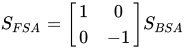
FSA gives rise to regular eigenvalue equations. The general alternative coordinate system in electromagnetic scattering is the Back Scattering Alignment (BSA) which is primarily used in radar.[4][5] Both coordinate systems contain essentially the same information and meaning, and thus a scattering matrix can be transformed from one to the other by use of the matrix,
References
- ^ Woodhouse, Iain H. (2005-11-02). Introduction to Microwave Remote Sensing. CRC Press. p. 79. ISBN 978-0-203-64652-6. Retrieved 2025-07-25.
- ^ Richards, John A. (2009-10-08). Remote Sensing with Imaging Radar. Springer Science & Business Media. p. 81. ISBN 978-3-642-02020-9. Retrieved 2025-07-25.
- ^ Chen, C. H. (2024-06-11). Signal and Image Processing for Remote Sensing. CRC Press. ISBN 978-1-04-003125-4. Retrieved 2025-07-25.
- ^ Okamoto, Ken'ichi (2001). Global Environment Remote Sensing. IOS Press. p. 41. ISBN 978-1-58603-101-5. Retrieved 2025-07-25.
- ^ Jin, Ya-Qiu; Xu, Feng (2013-03-29). Polarimetric Scattering and SAR Information Retrieval. John Wiley & Sons. ISBN 978-1-118-18816-3. Retrieved 2025-07-25.
See also
 | This electromagnetism-related article is a stub. You can help Wikipedia by adding missing information. |
 | This scattering–related article is a stub. You can help Wikipedia by adding missing information. |
Content Disclaimer
Informasi ini disarikan dari Wikipedia dan disajikan kembali untuk tujuan edukasi. Konten tersedia di bawah lisensi CC BY-SA 3.0. Kami tidak bertanggung jawab atas ketidakakuratan data yang bersumber dari kontribusi publik tersebut.
- The information displayed on this website is sourced in part or in whole from Wikipedia and has been adapted for the purpose of restating it. We strive to provide accurate and relevant information, however:
- There is no guarantee of absolute accuracy. Wikipedia is an open, collaborative project that can be edited by anyone, so information is subject to change.
- It is not intended to constitute professional advice. The content displayed is for informational and educational purposes only. For important decisions (e.g., medical, legal, or financial), please consult a professional.
- Content copyright. Wikipedia is licensed under the Creative Commons Attribution-ShareAlike License (CC BY-SA). This means that content may be reused with appropriate attribution and shared under a similar license.
- Responsible use. Any risk arising from the use of information from this website is entirely the responsibility of the user.